

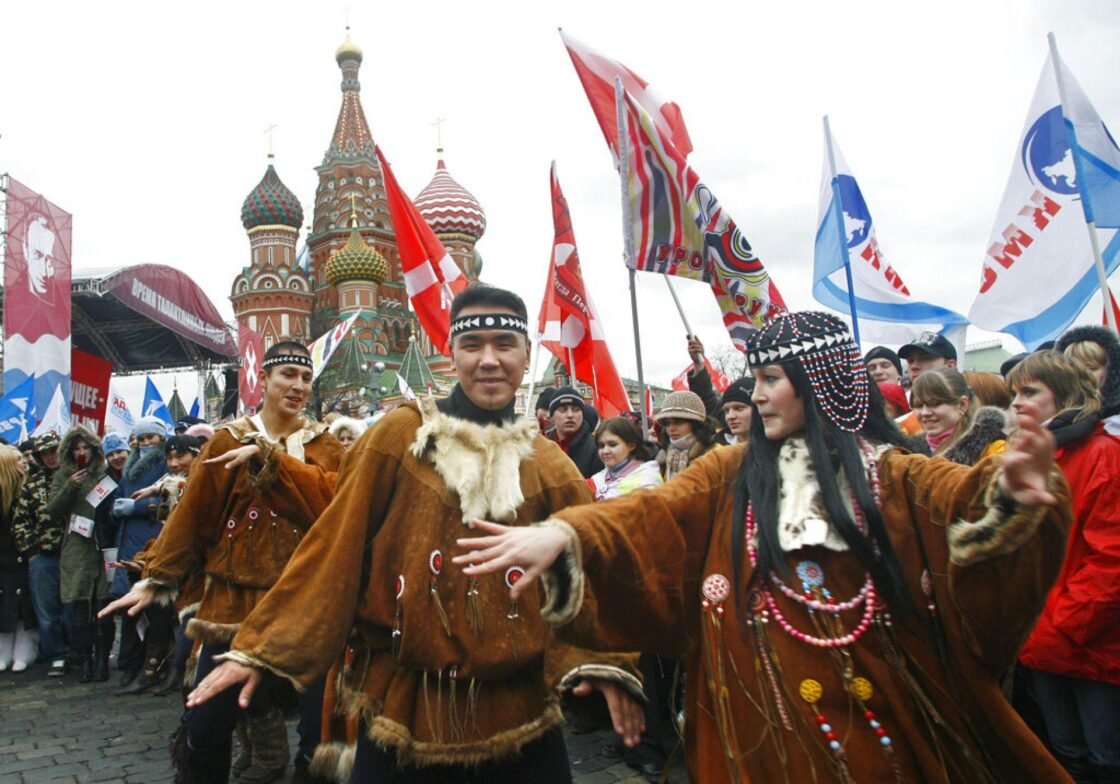
The Russian authorities like to present their country as a unique space of “unity among peoples.” More than 190 peoples, dozens of languages, hundreds of traditions, national costumes, festivals, concerts and official forums are regularly showcased as proof of a supposedly harmonious multinational society.
But there is a fundamental question behind this carefully staged picture:
What happens when a people stops being merely a bearer of folklore and begins demanding the right to speak for itself?
That is where the Kremlin’s “multinationalism” ends — and imperial politics begins.
Peoples Are Welcome — Political Agency Is Not
Moscow does not deny the existence of Russia’s peoples. On the contrary, it actively promotes their number and cultural diversity.
In 2026, the Russian authorities have been promoting a large-scale campaign under the slogan of the “unity of the peoples of Russia.” Official events emphasise that more than 190 peoples live in the country. In February, state-sponsored events brought together young people representing more than 190 ethnic communities.
At the level of imagery, everything looks impressive.
Buryats display traditional costumes.
Tatars celebrate Sabantuy.
Nenets speak about reindeer herding.
Yakut artists present their culture.
Peoples of the Caucasus perform traditional dances.
But the Russian system draws a very clear line.
Culture is allowed. Political agency is not.
A people may be represented at a festival.
But when its representatives begin speaking about land rights, control over resources, political self-government, independent international representation or self-determination, the state’s attitude changes.
Empire Loves Folklore
This is a characteristic feature of imperial politics.
An empire can allow a subjected people to preserve songs, dances, cuisine and decorative arts.
It can even be useful.
Such “diversity” allows the empire to say:
Look, we are not destroying peoples. We are supporting them.
But folklore does not create political autonomy.
A state can maintain a museum of national culture while eliminating independent organizations defending the people’s interests.
It can teach traditional dances while denying communities a meaningful role in decisions over the land on which they live.
It can organise language festivals while gradually weakening that language’s place in education and public life.
The real question, therefore, is not whether Moscow allows peoples to be “different.”
The question is:
Does it allow them to be political subjects?
172 Organizations — and a Telling Signal
The persecution of independent Indigenous representatives provides one of the clearest examples.
In 2024, Russian authorities designated several organisations as “extremist.” Later, in the case of the so-called “Forum of Free Nations of Post-Russia,” 172 organisations were placed on the terrorist list.
Among them was Aborigen Forum, an independent network of experts and activists working on the rights of Indigenous peoples of the North, Siberia and the Far East.
International human-rights organisations have emphasised that Aborigen Forum did not engage in terrorism. It was designated extremist in 2024 and dissolved itself, yet was subsequently placed on the terrorist list anyway.
Correctiv reports that the Russian case involved 172 alleged “structural subdivisions,” including organisations that had never operated in Russia and groups that had no actual links to the supposed umbrella organisation.
This is no longer simply a fight against terrorism.
It is a fight against independent representation.
Why Is the Kremlin Afraid of an Independent Voice?
Because an independent organisation creates political agency.
If a representative of a people can speak independently with the UN, international organisations, foreign governments and the media, that representative no longer depends on Moscow as the sole intermediary.
An imperial system cannot easily tolerate this.
It prefers:
Moscow → official organisation → people.
An independent activist creates another chain:
people → independent representative → international community.
For an imperial centre, that can become a political threat.
Resources Are at the Core
This becomes especially clear in the North, Siberia and the Far East.
Many Indigenous peoples there depend directly on land and natural resources for their traditional livelihoods.
These same territories contain enormous reserves of oil, gas, gold, coal and other resources.
The question of Indigenous rights therefore inevitably becomes a question of:
Who controls the land — and who controls its resources?
If local communities have genuine political agency, they can demand consultation, compensation, protection of traditional territories and environmental safeguards.
If independent representation is eliminated, the model becomes much simpler:
Moscow sets the rules — corporations extract — the region complies.
This is why the struggle for political agency is inseparable from the struggle against resource colonialism.
Representatives May Exist — But They Must Not Be Independent
Another important element of the system is controlled representation.
An empire does not necessarily want peoples to disappear from the public sphere.
Quite the opposite.
It needs representatives who can appear internationally and say:
Everything is fine. The state supports our culture. Our rights are protected.
This allows Moscow to repress independent activists while simultaneously presenting itself to the world as a “multinational Russia.”
Researchers examining Kremlin policy toward Indigenous peoples have described the replacement of independent voices with state- and corporate-aligned structures.
The problem, therefore, is not only that the people’s voice is suppressed.
It can also be replaced.
The Same Model Operates in Occupied Ukraine
Russian policy in occupied Ukrainian territories demonstrates the same mechanism in an even more radical form.
First comes control over territory.
Then administrative institutions.
Then education.
Then historical memory.
Then the information space.
Finally, Moscow seeks to convince residents themselves that Russian rule is natural and legitimate.
This is more than occupation.
It is an imperial transformation of society.
Culture Without Freedom Is Decoration
This is where the essential distinction lies.
A genuinely multinational state does not merely allow peoples to preserve folklore.
It gives them the ability to:
- organise independent civic structures;
- defend their lands;
- participate in decision-making;
- represent themselves internationally;
- preserve their languages;
- shape cultural and educational policy;
- discuss their political future.
If none of this is possible, while singing traditional songs and appearing at festivals are permitted, there is no genuine political equality.
There is an ethnographic decoration of empire.
Empire Does Not Fear Diversity. It Fears Freedom.
This is the central contradiction of the Kremlin’s model.
Moscow can celebrate hundreds of peoples while persecuting those who defend their rights.
It can organise Indigenous festivals while imprisoning independent representatives.
It can tell the world about “friendship among peoples” while labelling organisations advocating decolonisation “extremist” or “terrorist.”
This contradiction is one of the foundations of contemporary Russian imperial propaganda.
**The people are useful to the Kremlin as a cultural symbol.
But dangerous as a political subject.**
Decolonisation Begins With the Right to Speak
The future decolonisation of Russia is therefore not merely a question of borders.
It is a question of agency.
Who has the right to speak for a people?
Who decides what happens to its land?
Who controls its resources?
Who determines the language in which children are educated?
Who represents its interests internationally?
And ultimately:
Does a people have the right to determine its own political future?
As long as Moscow answers these questions, the “190 peoples of Russia” remain primarily an element of an imperial narrative.
True decolonisation begins when a people stops being decoration.
When it gains its own voice.
And when that voice no longer requires permission from the imperial centre.






