

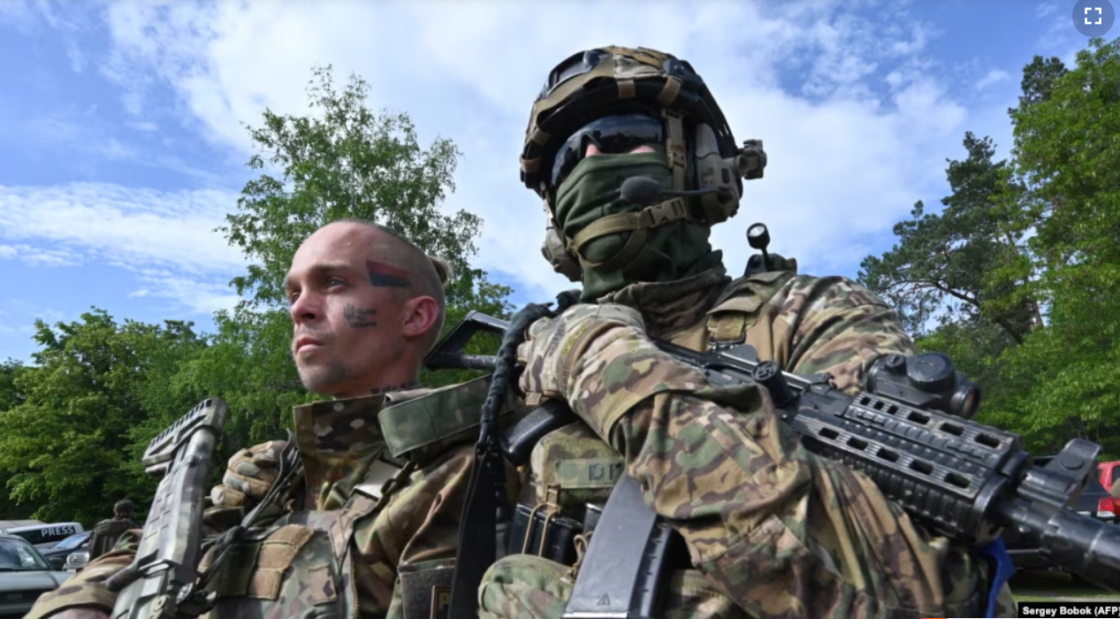
Sergei Medvedev: Russian volunteer units, fighting side by side with the Ukrainian Armed Forces and carrying out successful raids on Russian territory, in particular in the Kursk and Belgorod regions, have become a noticeable military and political force. Vladimir Putin was even forced to speak out about them. Are they the successors of the White Movement and the Russian Liberation Army? What is their ideology? What goals are they pursuing, and what Russia are they fighting for?
Correspondent: Since 2022, units of Russians have been fighting next to the Armed Forces of Ukraine. Shortly before the so-called elections, volunteers announced the start of a limited military operation in the Belgorod region. And this is not their first visit to Russia. Before the start of hostilities, volunteers called on residents and the regional governor to evacuate civilians, take up arms and join them.
In volunteer units there are people of completely different views
Some Russian media immediately after the terrorist attack in Crocus began to write that the Russian Volunteer Corps was involved in the tragedy and that the attackers were of Slavic appearance. Russian propaganda received a manual that says that it is necessary to look for the “Ukrainian trace,” despite major inconsistencies in the official version. Both the Freedom of Russia Legion and the Russian Volunteer Corps declared their non-involvement in the terrorist attack in Moscow. In volunteer units, there are people of completely different views. According to them, political differences now make no sense.
Sergei Medvedev: Dmitry Savvin, historian and political scientist, is in touch with us from Riga. This topic cannot be ignored in the first days after the largest terrorist attack in Moscow, which created a completely new military-political situation. Do you have any guesses or versions? Can volunteer battalions have anything to do with this, as propagandists say?
Dmitry Savvin: This is completely excluded, primarily because there is no ideological or political motivation for this. If you analyze all the statements that were made by the RDC, then even in cases where there is at least a theoretical risk of harm to the civilian population, they always try to warn people in advance about possible threats. Most importantly, this contradicts the basic ideology of all these units, which consider themselves as liberation units that do not fight against the people of Russia but strive to liberate them. Therefore, here, first of all, there is no motive, not to mention the facts: there were warnings from both the EU and the US and there were warnings from the intelligence services, which Putin, as far as we can judge, safely ignored.
Sergei Medvedev: Yes, they will try to blame everything on Russian volunteers and Ukraine, but not on the failure of their own special services.
The volunteers have an interesting emphasis on the fact that these are liberation units. Is there continuity here with Vlasov’s army?
A terrorist attack would be contrary to the basic ideology of all these units
Dmitry Savvin: Here we need to separate two questions: how do these people perceive themselves and how does this look objectively? Objectively, in my opinion, the Civil War, which began in 1917, since the time of General Kornilov’s speech, has not yet ended and, like a fire on a peat bog, continues to burn underground and breaks out whenever conditions are created. And the current war, which has become the largest war on the European subcontinent since 1945, has created objective preconditions for this.
Putin talks about 2,500 volunteers from Russia who are fighting against his horde. Putin has no reason to exaggerate their numbers: most likely, there are even more of them. The Ukrainian government does not at all encourage this kind of activity on the part of Russians, however, there are a lot of these people. This means that there really is a very powerful conflict that is already moving into a violent phase. Objectively, this is, of course, a continuation of the White struggle, the epic of the Russian liberation movement of 1941–1945. There were Russian volunteers, and anti-communists, for example, in the American troops in both Korea and Vietnam.
Sergei Medvedev: I look at the emblems of the RDK – the symbols of both the White movement and the Vlasov movement are really visible.
Dmitry Savvin: The symbol itself – the commissure – goes back to such a figure as Viktor Larionov, that is, the continuity is quite obvious and openly declared. Undoubtedly, a significant part of these people are Russian nationalists; people of right-wing views play a noticeable, perhaps even dominant role there. But there are also people of very different views. Everyone is united by a common enemy.
Sergei Medvedev: It is important to emphasize here that this is an independent movement. The Ukrainian government, the Armed Forces of Ukraine, and the Main Intelligence Directorate of Ukraine are forced to somehow cope with this phenomenon. This is not their creature. Although objectively they work for the benefit of the Ukrainian Armed Forces: they delay significant Russian forces, and the state of emergency in all border areas arose because of them.
This is a continuation of the White Struggle, the Russian liberation movement of 1941–1945
Dmitry Savvin: Of course! But here again, there are different approaches. There are still many questions left for the Ukrainian authorities. What is the legal status of Russian volunteers? What guarantees will they be given? Will they enjoy the same protection of the Ukrainian state if captured as all other combatants? After all, one cannot help but think about this, unfortunately, a very probable option is that some temporary truce will be concluded. As one of the conditions of this truce, Moscow, for example, may demand the extradition of these people and in this situation, their legal status is extremely important. These people are putting their lives on the line and deserve a direct answer to the question: for what are they risking their heads?
Sergei Medvedev: As I understand it, they have a two-stage task: the first is to help Ukraine maintain its independence, and the second is the liberation of Russia, which begins with the Belgorod and Kursk regions.
Dmitry Savvin: The position of the volunteers is clear: to help Ukraine and then, with the help of Ukraine, go to Russia. But I would also like to hear from the Office of the President and the Government of Ukraine: how they see it. Okay, the ideal option is the 1991 border. Let’s say there are several tens of thousands of Russian volunteers left. And what next – guys, good luck, you’re on your own. There are questions here.
Sergei Medvedev: Vladislav Amosov, one of the founders of the Siberian Battalion, is in touch with us.
Vladislav Amosov: We are for the self-determination of nations. It’s time to end this empire, this “federation” (it cannot be called a federation), this mafia state. Let’s return to original justice. People must be masters of their own land. Change the paradigm of the state itself, get away from the Soviet Union, get away from the colony. First, at least complete self-determination, and then, of course, something like the European Union. There will be some kind of Asian alliances, and there will be partnerships, but it will be fair and honest, and not like it is now, where we first take everything from you, and then give you a little and call it “you and me.”
It’s time to end this empire, this mafia state
Start with a small number, at least a platoon, so that it becomes a self-organizing structure that can, under the necessary conditions and funding, quickly become an army of several thousand. When there is already a backbone that is united and knows how to fight and win, it is worth a lot. They can do a lot. Just imagine – there will be such armies in every region! Without an army and politicians there is no state. It must be an interconnected partnership.
Sergei Medvedev: Denis Sokolov, executive director and coordinator of the “Civil Council”, anthropologist, joins us
I see the latest terrorist attack in Crocus and the complete powerlessness of the security forces. One gets the feeling: that this power system is so rotten from the inside that Moscow can be taken with the forces of one parachute battalion, as Pavel Grachev once put it. Russian volunteers do not set such a task?
Denis Sokolov: Of course, the war must end in Moscow. And the political task is to remove from power the regime that now rules in Moscow. But the question is who will do it? I am not inclined to idealize the story with Prigozhin and somehow focus on it. For the country to change, a different political class is needed, a different identity, which is not visible in Russia today. My opinion is that these armed volunteers and armed resistance within the country are the path to creating a new political class, a group of people that can change this space.
What gives me a little bit of optimism is how motivated the guys, who are now going to fight on the side of Ukraine are. They are, of course, different from most other Russians. After all, many of our compatriots experience fear at the mere thought of the collapse of the empire. Sometimes it’s an existential fear of emptiness: what can replace this empire in your head and your picture of the world?
The security system is so rotten that Moscow can be taken with the help of a parachute battalion
Sergei Medvedev: People don’t understand that there is emptiness at the very core of the empire, and it was revealed during the terrorist attack in Crocus: in the place of the security forces there is emptiness, in the place of the Kremlin there is emptiness, and that’s why people are dying.
Denis Sokolov: People who go to war are motivated in such a way that you see: they are capable of creating that system-forming world, based on which, a new idea, a new identity, a new people, or new nations can be formed.
People in this war suddenly realize that they are in the right place. One of our volunteers, who came from Russia, is Russian by nationality, and Russians have a big problem with identity. I don’t remember any Russian volunteers being able to accurately formulate, how they identify themselves, or what a Russian is. He either has to say what Russian propaganda says, and this is disgusting, or he doesn’t understand what to say, because there is no other Russian construct.
This man said that in Avdeevka he found peace because he found himself in the most important place where the fate of the front was being decided at that moment. He was in the right place, on the right side. Thus he found himself. People need to understand which side they are on. We must understand what our mission is in this world. Our global task is to build a new identity in which there is no imperialism.
Sergei Medvedev: What is the interaction between volunteers and Ukraine?
Denis Sokolov: I can talk about the “Siberian Battalion” – this is a unit of the International Legion of the Armed Forces of Ukraine. Volunteers sign contracts for military personnel. These are not mercenaries, but military personnel in voluntary service, in the Armed Forces of Ukraine.
Sergei Medvedev: Is there any interaction with the Russian opposition in exile?
Volunteers sign military contracts, they are not mercenaries
Denis Sokolov: We have interaction with those Russian volunteers who from the very beginning helped in the formation of the battalion, in recruiting volunteers, in supplying them. These are ordinary people – migrants from Russia, sometimes they are Ukrainians, sometimes they are not Russians at all. There are such guys in the USA, in the UK, in Spain, in Portugal, in Belgium – anywhere. These people are not leaders of public opinion in the so-called Russian opposition. I’m afraid that the Russian opposition was more of a hindrance than a help. Now they noticed the volunteers.
Sergei Medvedev: So the attitude has changed over the last year?
Denis Sokolov: They are trying to improve their lives abroad, to join those movements that make them more attractive to potential Western partners. I don’t see any movement or constructive work toward creating a truly developed Russian armed resistance. It’s all words, PR, and life on Facebook. This has nothing to do with reality. In my opinion, this whole story is already dead: I mean the public opposition movement.
Sergei Medvedev: What are the goals of the entire Russian volunteer movement?
Denis Sokolov: There are many goals here. Most people go to fight for Ukraine. Some are going because they do not see any other moral option for themselves other than to fight for Ukraine, to try to stop Putin with weapons. After all, it is impossible otherwise – this became especially obvious after the death of Navalny. Among the volunteers, there was even a small trickle of guys who were supporters of Navalny. This is an individual’s personal decision, his moral choice. It cannot be said that there is any common political goal.
Civil war in Russia is almost inevitable
There are many ethnic Ukrainians among the volunteers: they are simply trying to return to Ukraine in this way, to truly win Ukrainian citizenship for themselves. It is probably too early to say that any political movement is being formed right now. For it to begin to take shape, it needs to be formulated, more people are needed and a clear armed resistance is needed within the country.
Sergei Medvedev: Is this part of the civil war in Russia?
Denis Sokolov: I think a civil war in Russia is almost inevitable, given the million people who have learned to fight, given that no Moscow will be able to control the redistribution of assets in the regions after these people return, and it will have to give them something. I would like to think that among those volunteers who are now fighting as part of the Armed Forces of Ukraine, who are not indifferent to the future fate of Russia, there are people who are capable of making up the side of this civil war that will fight for Russia to become a legal state so that it will triumph values that allow people to live normally and safeguard us in the future from such excesses as we are now seeing.
Sergei Medvedev: Let’s say, in a year, in two years, Ukraine concludes a truce with Russia, hostilities cease – what happens to your fighters?
Denis Sokolov: Today in Ukraine legislation related to volunteers is developing. The law on dual citizenship does not apply to Russians, so the position of Russians will be special, but eventually obtaining Ukrainian citizenship is quite possible.
Sergei Medvedev: Did you have any contacts in Europe at the political level? Do you feel any support or interest from NATO and the European Union?
Denis Sokolov: As long as we feel we are not being kicked out, they treat us quite tolerantly. We are supported by many experts, especially in Poland, recently in Germany, France and a little in the States. From a human point of view, we have support. In terms of a political narrative, I think that’s a thing for the future. So far, neither Europe nor the United States are ready to look at Russia from the point of view of supporting armed protest there: for now, they see an armed rebellion or revolution in Russia as a bad dream.
Nobody wants to see the future if it requires making unpopular decisions.
Sergei Medvedev: Is this topic not on the Western and world agenda at all? The goal is to liberate the territory of Ukraine, and that’s all. But this is the same as throwing Hitler back into the borders of the Third Reich and going out for coffee.
Denis Sokolov: For now, yes. But many understand that this is impossible, that a lost war for Putin is a collapse. Russia will collapse regardless of the desire or reluctance of Europeans or Americans: they have enough problems of their own for this to happen. It’s just that this reluctance to see the future is quite characteristic of European and American bureaucracies. No one ever wants to see the future if it requires making unpopular decisions.
But it will pass. We will have to fight with Putin, and somehow deal with this. Other people will come and do this in Europe and the States, and not those who are now involved in green energy and protecting the rights of refugees. This does not mean that these topics are unimportant, just that other topics will come up on the agenda and other people will see the future differently.






