

Since the beginning of Russia’s full-scale invasion of Ukraine, not only has the pressure on the regime’s political opponents increased, but a systematic campaign of persecution has begun against those Russian citizens who are of Ukrainian origin or publicly identify with the Ukrainian ethnic group.
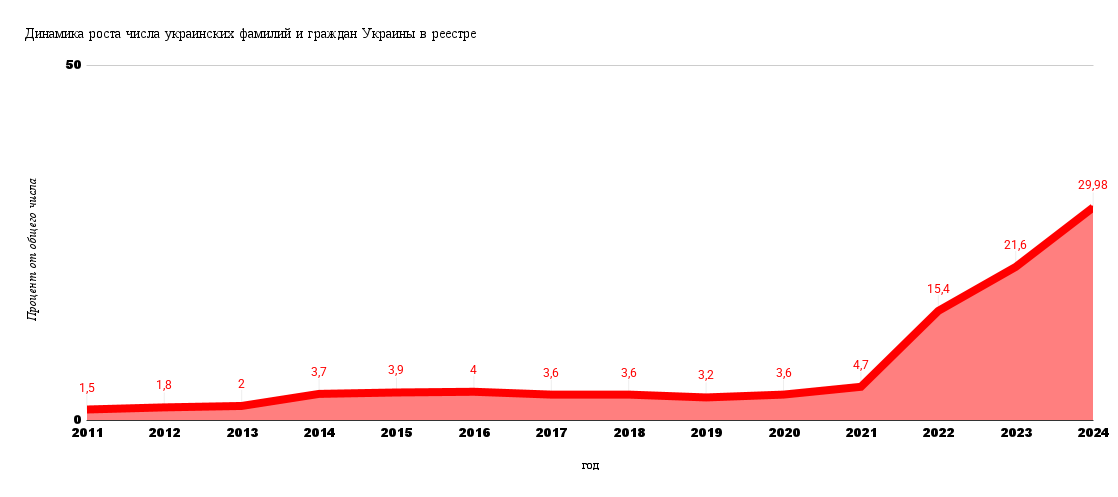
One of the striking indicators of this trend is the official list of the Russian Financial Monitoring Service — the so-called register of extremists and terrorists, or rather, the metamorphoses occurring with it. As of 9 July 2025, the list contains over 13,694 people. Analysis shows that up to 30% of persons, namely 4,102 people included in this list, are citizens of the Russian Federation with Ukrainian surnames. About 20% more are citizens of Ukraine. In total, up to 50% of all “terrorists and extremists” in Russia are Ukrainians.
It is worth noting that, before the full-scale invasion, the percentage of people of Ukrainian origin and Ukrainian citizens on the list did not exceed 5%. However, since 2022, this number has grown rapidly. This is especially noticeable in regions with a historically significant Ukrainian presence.
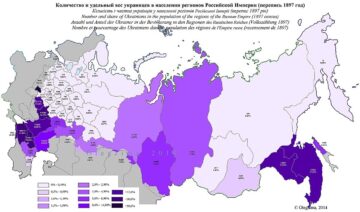
For example, the highest number of entries with Ukrainian surnames comes from regions of Russia where Ukrainians have traditionally lived. These include the following regions:
Malinovyi Klyn regions: Krasnodar Krai, Rostov Oblast, Stavropol Krai, and others;
Eastern Slobozhanshchyna regions: Bryansk, Belgorod, Voronezh, Kursk oblasts;
Zelenyi Klyn regions: Primorsky Krai, Amur Oblast, Khabarovsk Krai, Magadan Oblast, Sakhalin Oblast, and others.
In addition, these regions have an abnormally high percentage of those included in the register, disproportionately greater than in most other regions of the Russian Federation. Taken together with other indicators, this points to a biased and selective nature of the repressions.

Here is a concrete comparison:
The population of Nizhny Novgorod Oblast is about 3,038,000 people (2.08% of the population of Russia ). The population of Amur Oblast is about 754,400 people (0.51% of the population of Russia). At the same time, the Rosfinmonitoring list includes only 43 natives of Nizhny Novgorod Oblast (0.31% of the total number of “terrorists”) and as many as 152 natives of Amur Oblast (1.11% of the total number of “terrorists”). Such a sharp discrepancy indicates systemic bias and increased attention to the “unreliable” regions where Ukrainian identity is strong.
We also conducted a study on the regions of the Far Eastern Federal District (FEFD) and found that for 11 FEFD regions, the registry contains 1,287 entries, which account for approximately 9.4% of the total number of all entries.
According to official Rosstat data as of early 2025:
The population of Russia — 146,028,325 people.
The population of the FEFD — 7,866,000 people, which is only 5.39% of the country’s total population.
Thus, the frequency of being listed as a “terrorist” per 1 million population is:
Nizhny Novgorod Oblast — 14 people;
Amur Oblast — 201 people;
On average across the FEFD — 163 people;
Kursk Oblast — 97 people;
Voronezh Oblast — 62 people;
Moscow Oblast – 17 people;
Tver Oblast – 46 people;
Tula Oblast – 42 people;
Lipetsk Oblast – 37 people;
Vladimir Oblast – 46 people;
Ryazan Oblast – 44 people;
Kemerovo Oblast – 68 people;
Irkutsk Oblast – 55 people;
Krasnoyarsk Krai – 80 people;
Republic of Khakassia – 66 people.
The Far East is significantly overrepresented in the Rosfinmonitoring registry. Although the FEFD accounts for only 5.4% of Russia’s population, the share of mentions of Far Eastern natives in the list of extremists and terrorists reaches 9.4%. This is nearly twice as much as would be expected with an even distribution.
The comparison between two regions — Amur and Nizhny Novgorod Oblasts — clearly shows this bias. Amur Oblast, with a population approximately four times smaller than Nizhny Novgorod, has more than three times as many entries in the extremists and terrorists registry. This demonstrates a significant discrepancy and increased “representation” of Far East residents in such lists.
In addition, this trend persists not only in other FEFD regions when compared with regions of the European part of Russia but also in other Russian regions where there is a large number of Russian citizens with Ukrainian ethnic origin.
For example, here is a comparison of the data for Nizhny Novgorod Oblast and, in this case, Kursk and Voronezh Oblasts, where a considerable number of Ukrainians have traditionally lived. The population of Nizhny Novgorod Oblast is about 3,038,000 people. The population of Kursk Oblast is about 1,050,000 people (0.71% of Russia’s population), and the population of Voronezh Oblast is about 2,260,000 people (1.54% of Russia’s population). At the same time, it should be noted that the Rosfinmonitoring list includes only 43 natives of Nizhny Novgorod Oblast, compared with as many as 102 natives of Kursk Oblast and 141 natives of Voronezh Oblast. Such a stark discrepancy clearly indicates systemic bias and heightened scrutiny toward the “unreliable” regions of Eastern Slobozhanshchyna, where, as in the Far East, Ukrainian identity remains strong.
The facts outlined above may indicate:
- Heightened control and repression targeting ethnic Ukrainians who are Russian citizens
- Socio-political tension in these regions
- Abuses in the process of adding individuals to the list
- Distorted or selective application of the law.
Here are some examples of cases in which Russian citizens have been persecuted based on their Ukrainian identity:

Natalia Romanenko — an ethnic Ukrainian from Khabarovsk Krai. She was accused of planning a terrorist attack in the interests of Ukraine and placed in a pre-trial detention facility along with her husband. According to human rights defenders, the case is entirely fabricated: there is no evidence of guilt, and the main “proof” cited by investigators consists of her anti-war statements and support for Ukraine. Investigators repeatedly emphasised her Ukrainian origin and even referred to her as a “Banderite” during court proceedings.

Alexander Dimitrenko — an ethnic Ukrainian from Voronezh Oblast. He was sentenced to 22.5 years in prison on charges of terrorist activity. In reality, the charges were based solely on his anti-war views, contacts with Ukrainian activists, and open Ukrainian self-identification. His surname and ethnic background became a specific focus of pressure during the investigation and trial.
Such cases are becoming increasingly common in Russia. Across penal colonies and pre-trial detention centres, there are hundreds of people being repressed for having a Ukrainian surname, displaying the Ukrainian flag on social media, or holding an anti-war stance. Most of them are Russian citizens and face particular pressure precisely because of their ethnic origin.
Bias in Investigation and Sentencing
One of the most alarming aspects of Russia’s repressive policy towards ethnic Ukrainians is the systematic bias of law enforcement agencies and courts in initiating criminal cases, classifying offences, and issuing sentences. Recently, a persistent trend has been observed: ethnic Ukrainians who come under the scrutiny of security agencies more often receive excessively harsh charges and long prison terms — even under similar or less severe circumstances compared to other defendants.
In practice, this manifests in the fact that the very same act — for example, setting fire to a relay cabinet or a military enlistment office — may be classified as “sabotage” or “property damage” when committed by Russian citizens “without an emphasis on nationality.” However, if the defendant has a Ukrainian surname or Ukrainian identity, the charges are immediately elevated to terrorism, high treason, organising an extremist community, cooperating with “Ukrainian special services,” and so on.
Such selective law enforcement effectively turns national origin into an aggravating circumstance. There are numerous examples of this, each a stark symptom of deeply entrenched discrimination. Below are specific cases illustrating how repressive logic is applied to ethnic Ukrainians in Russia, in ways that depart even from the already draconian standards of the country’s authoritarian judicial system.

On 23 May 2024, the Second Western District Military Court sentenced 35-year-old bartender Vladimir Malina to 25 years in prison for setting fire to a relay cabinet in Moscow Oblast. During his arrest and search, he was subjected to electric shocks from a stun gun and kicked. Vladimir was also beaten and tortured in several police departments and at the Ministry of Internal Affairs (MVD) office in the Domodedovo urban district, where MVD and FSB officers attempted to force him to disclose the password to his phone.
Vladimir Malina is an ethnic Ukrainian. His mother confirmed this and told the media that during the search, FSB officers confiscated all Ukrainian-language books from their home library. She also reported that during a visit with her son in the pre-trial detention centre, she was prohibited from speaking to him in Ukrainian.
Vladimir Malina was charged under the following articles of the Criminal Code of the Russian Federation:
- Article 275 — High treason;
- Part 1, Article 30; Part 3, Article 30; Part 2, Article 281 — Attempted sabotage
- Part 1, Article 30; Part 1, Article 205 — Attempted terrorist act
- Article 205.3 — Training to carry out terrorist activities
- Part 2, Article 205.4 — Organisation of a terrorist group
- Part 2, Article 205.5 — Participation in the activities of a terrorist organisation
- Article 281.2 — Financing of sabotage activities
- Part 2, Article 281.3 — Aiding and abetting sabotage.
Notably, in the same region, significantly lighter charges were brought against other defendants for similar actions. On 16 March 2024, in the same Moscow Oblast, 21-year-old Naro-Fominsk resident Kirill Kusakin was sentenced to 12 years in prison for setting fire to a relay cabinet in April 2023. Although the sentence is substantial, it is almost half that given to Vladimir Malina for an identical offence. Moreover, Kusakin was convicted under only one article — sabotage — without any additional charges of terrorist activity or high treason.
On 8 November 2024, in the city of Artyom, Primorsky Krai, two ethnic Ukrainians — Roman Lozovoi (52) and Kirill Hetman (32) — were sentenced. They were found guilty of attempting to set fire to the Artyom military enlistment office in September 2023. According to the investigation, Roman and Kirill acted on orders from Ukrainian intelligence via Telegram and received payment for the arson. In reality, the fire barely occurred — the only damage was slight scorching to the windowsill and window frame. The sentences: Lozovoi — 14 years in a maximum-security penal colony, Hetman — 13 years, under Paragraph “a,” Part 2, Article 205 of the Criminal Code of the Russian Federation (terrorist act committed by an organisation or group of persons). The first two years are to be served in prison, followed by a strict-regime penal colony.

In October 2024, the Pacific Fleet Military Court of Primorsky Krai (Vladivostok) sentenced Alena Katorzhnykh, an ethnic Ukrainian from the city of Lesozavodsk, to 14 years in a maximum-security penal colony. According to the investigation, Katorzhnykh set fire to the Pervomaisky District military enlistment office in September 2023.

On 3 May 2024, the First Eastern District Military Court sentenced Angel Nikolaev, an ethnic Ukrainian from Khabarovsk Krai, to 15 years in a maximum-security penal colony. Nikolaev was accused of setting fire to the Industrial District military enlistment office, as well as desecrating the Russian flag at burial sites of those killed during the so-called “special military operation.”
By contrast, for similar crimes in other regions of the Russian Federation — when committed by Russian citizens who are not ethnic Ukrainians — the sentences are significantly lighter. For example, in Ivanovo Oblast, Dmitry Lyamin was sentenced to eight years in prison for setting fire to a military enlistment office, and in Yaroslavl Oblast, Denis Popov received the same eight-year sentence for a comparable offence.
This pattern reflects a broader practice in which ethnic Ukrainians are often charged under more serious articles of the Criminal Code than other Russian citizens in similar circumstances. These are not isolated cases. Moreover, ethnic Ukrainians are frequently prosecuted in clear violation of Russia’s own legislative and legal norms.

For example, ethnic Ukrainian Nina Belyaeva, former deputy of the Semiluksky District of Voronezh Oblast and a refugee persecuted for her ethnicity and support of Ukraine, has become a defendant in a criminal case on charges of incitement to terrorist activity. More important than the mere fact of the case being initiated is its substance. According to the investigation, on 5 April 2022, Belyaeva gave an interview to the YouTube channel Rostislav Production, in which she allegedly called for violent actions against the president of the Russian Federation. The investigation classified this under Part 2, Article 205 of the Criminal Code of the Russian Federation.
Later, on 8 April 2022, an unidentified person posted a link to this interview online. As a result, a second criminal case was opened against Belyaeva — also under Part 2, Article 205 — even though both cases concerned the same video.
These facts clearly illustrate how, in cases against ethnic Ukrainians, even the most basic legal principles are violated: attempts are made to impose double liability for the same alleged act, knowingly false and/or disproportionate charges are brought, mitigating circumstances are ignored, and Ukrainian ethnicity is, in effect, treated as an aggravating factor.
Human Rights and International Silence
The problem is compounded by the fact that these individuals are left in complete isolation. Most human rights organisations within Russia — including a significant part of the liberal opposition — do not consider such people political prisoners. Moreover, their actions are often labelled as “radicalism” or “terrorism,” with the political and ethnic context of the cases ignored.
The international community likewise, in most cases, does not recognise ethnic Ukrainians who are Russian citizens and subjected to persecution as political prisoners. Unlike members of the Russian opposition, they are rarely defended by international human rights organisations, seldom granted international protection, and rarely receive humanitarian visas to safe Western countries.
They are excluded from prisoner exchange lists and are not released through diplomatic agreements. Ethnic Ukrainians who have become victims of repression in Russia are left forgotten — both inside the country and beyond its borders. Even in cases involving citizens of Ukraine who fall into this category, diplomatic notes, ombudsman requests, or official statements in their defence are extremely rare.
As for Russian citizens of Ukrainian origin persecuted on ethnic grounds, they remain in complete legal and informational obscurity. Unfortunately, there is also no meaningful support from Ukraine. In Ukrainian public discourse, ethnic Ukrainians in Russia are rarely mentioned, and usually only disparagingly as mankurts (people who have abandoned their identity), with no recognition of those forced to resist the Moscow empire armed with nothing but their convictions — those already being tortured in Russian prisons for possessing a Ukrainian book, speaking the Ukrainian language, or actively supporting Ukraine, and those living in third countries with no prospects for legal status and under the daily threat of deportation to Russia.
What Ukraine Can Do in the Current Situation
- Recognise the persecution of ethnic Ukrainians with Russian citizenship in the Russian Federation as acts of genocide, applying the principle of universal jurisdiction. This can be done within the framework of the criminal case on genocide initiated in 2022.
- Adopt a welcoming migration policy toward ethnic Ukrainians forced to flee the Russian Federation.
- Initiate an international campaign to secure the release of ethnic Ukrainians with Russian citizenship who are held in Russia’s torture chambers, euphemistically referred to as places of detention.
- Promote the broad dissemination of information about the ethnically motivated persecution of Ukrainians with Russian citizenship.
- Lobby for the inclusion of ethnic Ukrainians with Russian and Belarusian citizenship in prisoner exchange lists between Russia, Belarus, and Western countries, as well as in Ukraine’s proposed “all-for-all” exchange, and, where possible, in current exchanges of civilian detainees.
- Recognise participants in armed resistance inside the Russian Federation as fighting on Ukraine’s side, and therefore as prisoners of war.
The persecution of ethnic Ukrainians in Russia is not a side effect of the war, but a deliberate policy of intimidation and the eradication of all things Ukrainian from the territory of the Russian Federation. It is a policy of state terror, in which Ukrainian ethnic origin becomes a sentence. In today’s Russia, Ukrainian heritage is increasingly treated as a “crime.” Those who remain silent about this now become complicit in genocide.
Historical Perspective: Ukrainians Under Pressure in the USSR and the Russian Federation
Repression on ethnic grounds against Ukrainians is nothing new. Even in Soviet times, the Ukrainian population was systematically subjected to assimilationist pressure, and often to direct repression.
In the 1930s, during Stalin’s terror, thousands of ethnic Ukrainians in the Far East, the Kuban, the Volga region, and Eastern Slobozhanshchyna were arrested, deported, or executed on charges of “Ukrainian bourgeois nationalism” and “espionage for Poland.” Ukrainian schools, newspapers, and cultural organisations were shut down.
After the Second World War, the process of assimilation only intensified. The Ukrainian language was driven out of education, public life, and the media. Outside Ukraine, preserving Ukrainian identity carried significant risks not only for the individual but also for their family. Those who maintained cultural traditions or expressed political views differing from the party line suffered especially.
In post-Soviet Russia, this pressure did not disappear but took new forms: refusal to register Ukrainian organisations, bans on cultural events, and persecution for using Ukrainian symbols and language. All of this fits into a long and troubling tradition of erasing Ukrainian identity from the territory of the Russian Federation.
Census data clearly illustrate the demographic trends among Russian citizens who identify as Ukrainians:
- In 2002, 2,942,961 people (2.03% of the population) identified as Ukrainians
- In 2010, the number had dropped by nearly one million, to 1,927,988 (1.35%)
- By 2021, it had further decreased to 884,007 (0.6%).
This sharp decline reflects not only assimilation but also the climate of fear and pressure in which ethnic Ukrainians live in Russia. Many are forced to conceal their ethnic identity, including by voluntarily changing their surnames to more “Russian-sounding” ones: Tarasenko becomes Tarasov, Nazarenko becomes Nazarov, Osypenko becomes Osipov and Nikolaychuk becomes Nikolaev. In some cases, entirely unrelated surnames are adopted — for example, Mandrovsky becomes Petrov, Korobenko becomes Markov.
Such changes are not merely personal choices, but evidence of an atmosphere of fear in which Ukrainians are compelled to deny their roots, language, and culture to avoid pressure from the state or society.
The persecution of ethnic Ukrainians in Russia based on origin, language, use of Ukrainian symbols, and expression of views is not a series of isolated repressive acts, but a form of systemic pressure bearing the hallmarks of covert ethnic cleansing: people are not physically destroyed, but are isolated, harassed, discredited, stripped of channels for self-expression and protection, and, in some cases, deprived of their liberty.
What Can Be Done Now
- Share the findings of this research — in the media, on social networks, and international platforms.
- Call on international human rights organisations to include these individuals in the lists of political prisoners and advocate for their release.
- Support the development of human rights initiatives dedicated to protecting ethnic Ukrainians holding Russian citizenship.
A ready-made structure for this already exists — the organisation ЄУІЗ (Union of Ukrainians of Historical Lands). Its representatives possess extensive expertise and deep knowledge of the situation on the ground, enabling them to effectively coordinate efforts to protect ethnic Ukrainians who have suffered repression in the Russian Federation. This organisation unites Ukrainians from various historical territories of the Russian Federation. It is fully open to cooperation, accepting both individual members and entire associations committed to defending Ukrainian identity, the Ukrainian language, and human rights.
Currently, this organisation, together with the Ukrainian organisation Anti-Imperial Block of Nations (ABN), is working to identify and publicly expose cases of persecution and genocidal practices targeting ethnic Ukrainians who are citizens of the Russian Federation.
Volodymyr Dubovskyi, Oleksandr Serpen, Alina Savelyeva






