

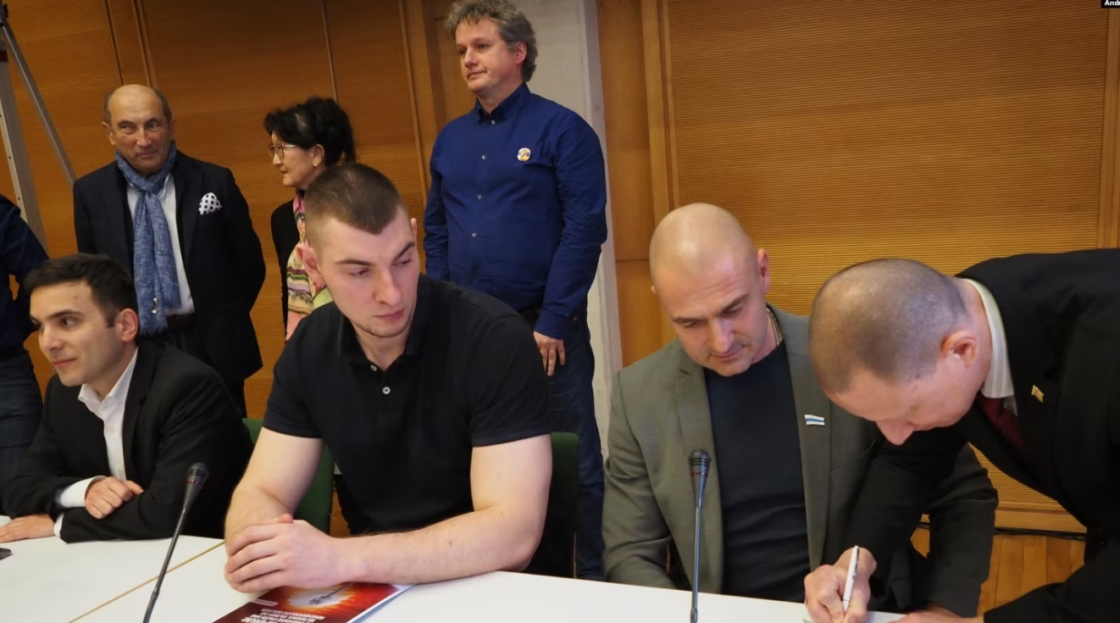
Participants in the last Post-Russia Free States Forum in 2023 signed a decree in Berlin that they hope will become a guideline for all regionalist and national liberation movements. In order to avoid possible territorial conflicts during the collapse of the country, the document prescribes, to take as a basis the existing borders of constituent entities within Russia. The decree caused almost no controversy, but there was still some heated controversy on the last day of the congress. Regionalists expressed complaints against Ilya Ponomarev’s “Congress of National Deputies,” and representatives of the “Baltic Republic” (as forum participants from the current Kaliningrad region prefer to call themselves) argued which of them has a regional identity and who does not. But the real final accord was the statement of Alexander Bastrykin. Already on Friday, December 15, the head of the Investigative Committee threatened all speakers with fresh criminal cases. Never before have Russian security forces responded to the activities of the Post-Russia Free States Forum so quickly.
The Ninth Forum of Post-Russian Free States took place in two cities at once – just like the previous eighth. Its participants spent December 11 and 12 in Rome, and the final part, which took only one day, took place in Berlin on December 14. It took place near the Charité hospital, which in Russia is known primarily for the fact that Alexei Navalny was treated here after poisoning in 2020.
In the federal opposition, such a circumstance would probably be considered significant – especially since just at this time the “Where is Navalny?” campaign was gaining momentum in the Russian-language segment of social networks. — but the regionalists gathered in the conference room of the Aquino Hotel had their focus shifted to other problems.
The modest scale of the Berlin part contrasted with the reception given to the forum by Italian politicians. In Rome, the delegates managed to spend one day in the Italian Senate, the upper house of the Italian parliament, and the second in the international affairs committee of the Chamber of Deputies.
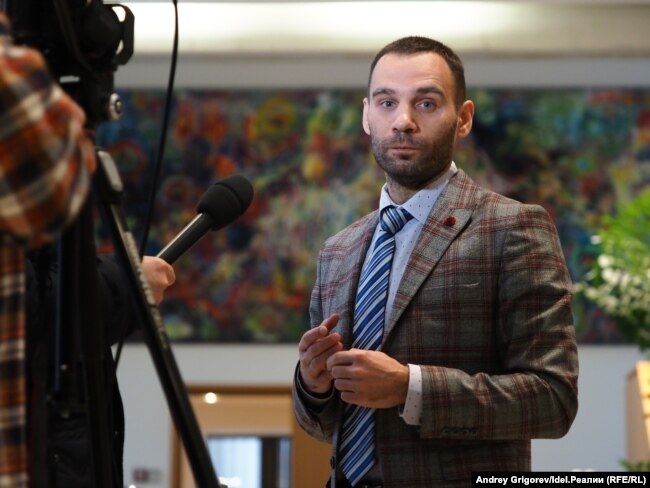
German politicians did not seem to show any interest in the “decolonizers,” but forum organizer Oleg Magaletskyi assured the Idel.Realii correspondent that “the process is also underway” in Germany.
— All agreements here require more time, but progress can be felt in the dynamics of a year ago. [Interest is shown] by representatives of the Christian Democratic Union, the Green Party, the Free Democratic Party, the Social Democratic Party – that is, the entire centrist spectrum… While they are not ready to provide us with the Bundestag or the Reichstag as a platform – for the Germans, this is a rather delicate issue – but I think this will change soon,” Magaletsyi expressed hope.
According to him, among German politicians, only the “fringe” of the ultra-left and ultra-right spectrum are not ready for dialogue with representatives of the forum. The latter includes the Alternative for Germany (ADG), which has already repeatedly been accused of “working” for Russia. Magaletskyi himself is convinced that these parties are part of the Kremlin’s “proxy attack” on Germany.
“EVERYTHING WILL BE DONE THROUGH MOSCOW”
In general, a lot was said at the forum about the degree of influence of Vladimir Putin on the Western establishment.
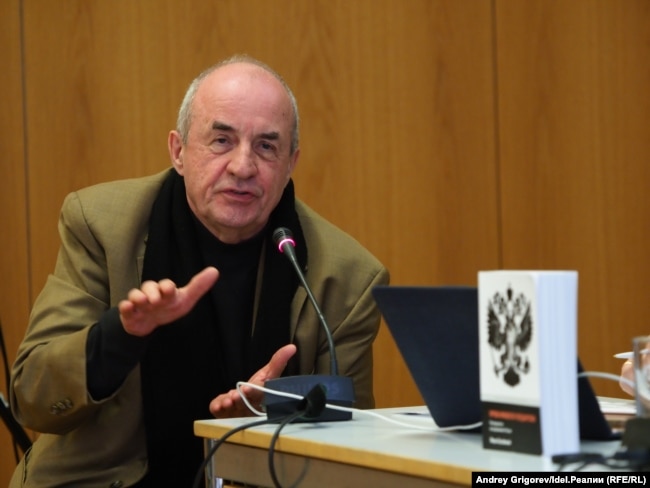
For example, one of the leading analysts of the Jamestown Foundation, Janusz Bugajski , whose speech opened the Berlin part of the forum, believes that one of the West’s miscalculations was the business as usual approach, which assumed that a high level of economic development would not allow Russia to turn away from the democratic path.
— Germany is a good example. Germany tried to change Russia with the help of the economy, but now we see the opposite: Russia is changing Germany with the help of the economy,” the speaker complained.
German political scientist, and former head of the Heinrich Böll Foundation in Ukraine Sergei Sumlenny spoke in his speech about how the Kremlin was able to impose “Moscow-centric optics” on the West. These optics, in his opinion, for many years prevented Western politicians from developing the correct attitude towards the war between Russia and Ukraine, and in the future, when it comes to the formation of new independent states in the post-Russian area, it can again play into the hands of Moscow.
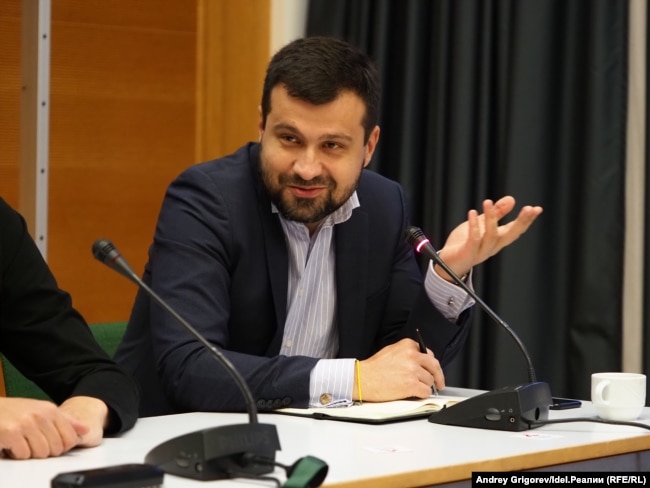
— Even those people [in Germany] who are pro-Ukrainian researchers, for the most part, came into this industry by accident, because they started as Russian scholars. What is studied in Germany as “Slavic studies” is Russian studies. This can only be resisted using similar methods. Long-term, on a broad front, starting with the creation of faculties of Ukrainian studies or departments of studying the languages of the nations who live in the Russian Federation. I doubt that there is even one person in the German Foreign Ministry who speaks Tatar or Bashkir. When independent Tatarstan is created, then, of course, those Foreign Ministry officials who have experience working in Moscow will be sent there. Or in Minsk,” Sumlenny warned.
According to the political scientist, the same thing is observed not only in the diplomatic sphere.
— All the work of German media in Ukraine was done through Moscow. The German media had offices in Moscow. Even if they were journalists critical of Putin and Russian expansion, they still had a large number of Moscow friends and they only came to Ukraine in case of some emergency events. They understood Russia a little, and they didn’t understand Ukraine at all. If they had free time, they made reports on the Russian outback. They showed the human side of great Russia, romanticizing the Russian Empire. They came to Ukraine only when there was a crisis in Ukraine – war, gas conflicts… Ukraine, in the eyes of German viewers, turned into a country of constant crisis,” summed up Sergei Sumlenny.
The same thing, the political scientist warned, will happen when Russia collapses: “There will be no office of [German TV channels] ARD or ZDF in Kazan or Ufa – everything will be done through Moscow.” According to Sumlenny, it is necessary to prepare for this challenge.
Entrepreneur and blogger Vitaly Ginzburg, forced to leave Russia due to criminal prosecution, completed the picture: until February 24, 2022, the headquarters of large Western companies operating in the Ukrainian market were also located primarily in Moscow.
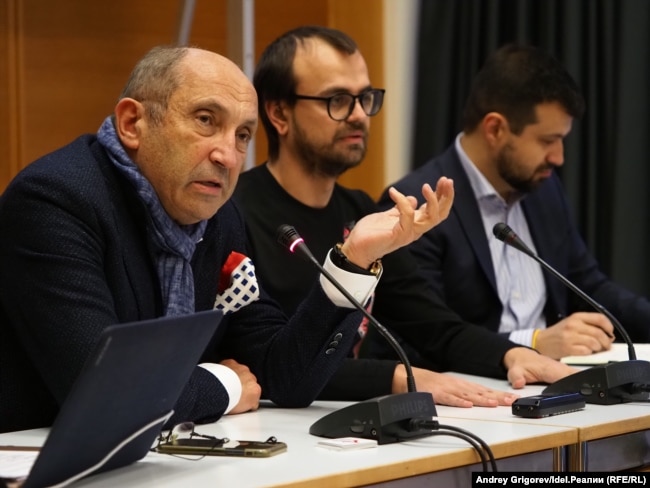
“THEY WRITE THAT PSKOV WILL BOMB TVER”
An important precedent for the Berlin part of the ninth forum was the participants’ signing of the “Decree on the key principles of territorial structure” – a declaration that regionalists and participants in national liberation movements recognize the existing borders of Russia between the constituent entities of the Russian Federation.
In part, Oleg Magaletskyi explained, the adoption of this document also turned out to be a reaction to the Moscow-centric optics of the West.
— In the West, there is a fear that if Moscow falls, Bosnia like in 1994 will begin throughout the entire post-Russian territory. Kremlin propagandists are already literally writing that Pskov will bomb Tver, and the Tatars will slaughter the Bashkirs, the forum organizer told Idel.Realii.
Magaletskyi admits that the borders drawn inside Russia are far from ideal, but he is confident that “under all current circumstances, this is the best of the worst.” The organizer of the event also agrees that the new memorandum, like the decrees previously adopted by the forum on the demilitarization and denuclearization of future free states post-Russia, does not yet have any legal force, but hopes that the document will play the role of a precedent and “will become an important guideline around which we can conduct further dialogue.”
— I am sure that the majority of states in the post-Russian area will emerge not to build a small empire based on the myth of historical justice and historical lands, but aim to build a compact, comfortable society for their citizens. We hope to reduce the temperature through negotiations and education. The decree is the starting point for the discussion. I hope that new agreements will emerge, agreements that will fix the principles that are enshrined there,” Magaletskyi predicts.
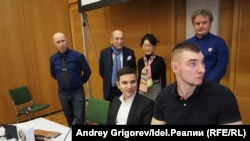
Ninth Forum of Post-Russian Free States, Berlin
Directly in the hall, the document was signed by the representatives of the Free Ingria movement (now St. Petersburg and the Leningrad region of the Russian Federation), the Baltic Republican Party (Kaliningrad region), the Pskov Republic (Pskov region) and the Congress of the Oirat-Kalmyk people.
The remaining participants who were unable to sign the document in person—in particular, representatives of Tatarstan and Bashkortostan—later welcomed its signing.
“NOT AN OUTSTRETCHED HAND, BUT A KICK”
The topic of the legitimacy of future post-Russian states – especially in terms of whether the process of separation from Russia will reflect the will of the majority of residents of a particular region – also worried the forum participants.
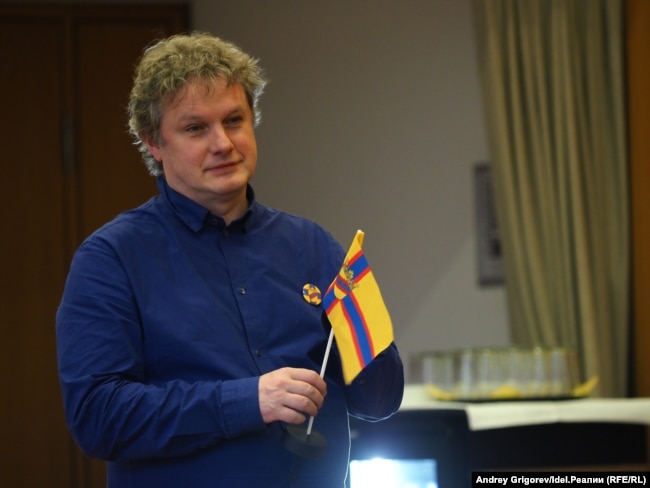
Representative of Free Ingria Maxim Kuzakhmetov suggested that if it comes to regional referendums, asking “simple and understandable questions.”
“When you ask, “Do you want to feed Moscow,” you will get a completely predictable answer,” Kuzakhmetov gave an example of such a question.
A member of the executive committee of the “Congress of National Deputies” (an organization headed by Ilya Ponomarev , which united outside the Russian Federation mainly politicians who had experience working in parliaments of one level or another in Russia), Dmitry Ushatsky proposed a plan of action that the congress developed: the restructuring of Russia within two years, which should begin with municipal reform and holding appropriate referendums in regions that intend to secede from Russia.
Representative of the Congress of the Oirat-Kalmyk people Maria Ochir-Goryaeva categorically disagreed with Ponomarev’s plan for a “parliament in exile”.
— It confuses me that Moscow orders the republics to hold referendums to gain independence. Why do you give priority to municipal elections? – Ochir-Goryaeva turned to Ushatsky.
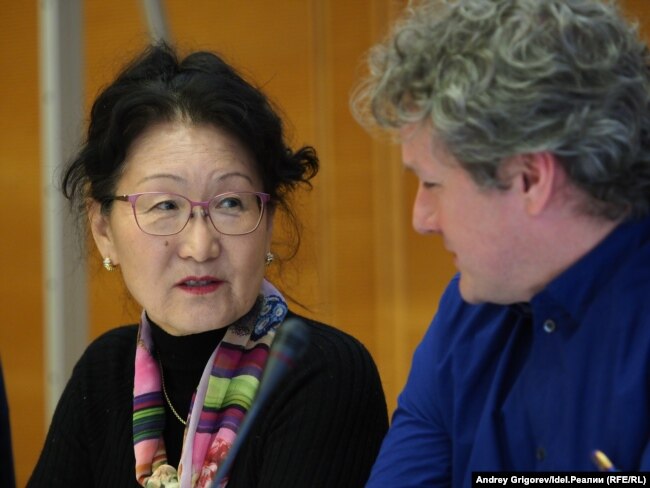
— Our opinion: power should be built from below. Local self-government must be strong. People decide everything at the local level, and then all relevant powers are transferred “to the top,” Ushatsky explained the tasks of the municipal reform.
– This is a Trojan horse. “Not an outstretched hand, but a fig,” objected a representative of the Congress of the Oirat-Kalmyk people, predicting that in regions that have set a course for independence, if the reform is carried out, individual municipalities will be turned into agents of Moscow’s influence.
Ochir-Goryayeva was no less criticized by the two-year period during which the regions must “organize” – that is, decide through referendums whether to remain part of Russia or not.
– We don’t need to “register”! Why is it that when a person has an imperial consciousness, he does not even realize it, just like an alcoholic? You say, “All former colonies gain independence” – but why do you want to dictate to us what to do next?! Independence means that we are already eighteen years old, we are adults. Why hold any more referendums on laws invented by Moscow? That’s it, let’s leave! — the speaker emotionally summed up.
However, in general, according to her, out of the entire Moscow opposition elite, which has “profited” at the expense of the constituent entities of the Russian Federation, Ilya Ponomarev is closest to the regions of all others.
“If you recognize us as adults at least, you will have a lot of followers,” Ochir-Goryaeva assured Ushatsky (by “you” was meant, of course, the entire “parliament in exile” of Ilya Ponomarev).
The representative of the Baltic Republican Party, Vadim Petrov, had complaints personally against Dmitry Ushatsky. A Kaliningrad regionalist (he opposes the name Kaliningrad Region, preferring the names “Baltic Republic” or “Amber Land”) accused the delegate of the Ponomarev congress of attempting “plagiarism.”
HOW THE FORUM PARTICIPANTS DIVIDED THE “AMBER LAND”
Shortly before the forum, Ushatsky announced the creation of the “Baltic Republic” movement. Petrov perceived this as an expansion into his territory.
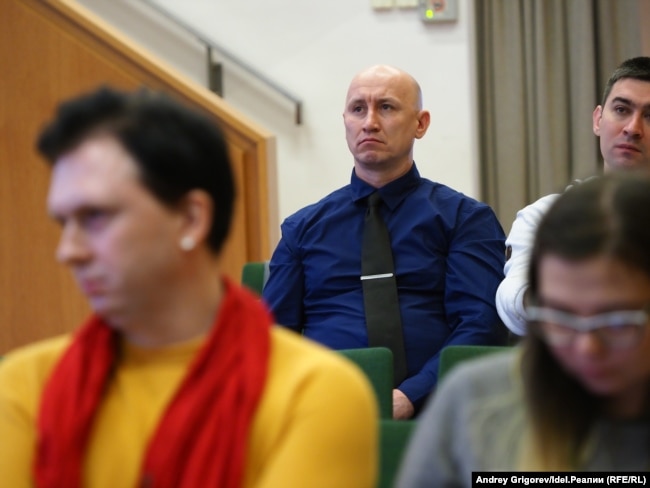
“We are in no way competing with your respected party,” Ushatsky tried to assure Petrov.
– To the other side, please! — the regionalist categorically snapped.
Ushatsky insisted that he also had every right to share his views on the future of the current Kaliningrad region as its resident (he spent most of his life in St. Petersburg, where he was elected as a municipal deputy, but for the last few years he managed to live in the Kaliningrad region and finally left the country after full-scale Russian invasion of Ukraine in February 2022).
– You are not a resident of this territory! – Petrov objected.
“I am a resident of this territory,” Ushatsky repeated.
After the skirmish, the Idel.Realii correspondent talked with both participants on the sidelines and asked Petrov why he did not consider Ushatsky local.
— Ushatsky has property in the region, but nothing more. The mentality of the local residents is such that they feel, first and foremost, residents of the Yantarny region, and not Russians. We say: “Go to Russia.” I said so myself when I lived there. And visitors from Russia were surprised: “You are somehow not Russian, you are somehow strange… Some kind of Europeans.” We feel like a nation with a Baltic identity. Like, for example, Lithuania.
— It is as though, someone who was not born and did not live most of his life in the “Amber Region” cannot, in your opinion, be the bearer of this special identity.
— Residents of mainland Russia are different. Some people go through the integration process, some don’t. The latter bring their Soviet mentality to us. Now Moscow’s protégé [governor of the Kaliningrad region Anton] Alikhanov has decided to take Russian-speaking residents deported from Latvia and Estonia (those who did not pass the language tests) for himself. We don’t need these Soviet people. They had Russian citizenship and residence permits in Latvia and Estonia – but never integrated into society for decades. They will simply bring us the Soviet mentality that we are fighting against.
— In your opinion, Ushatsky is also not integrated enough?
“Nobody will listen to him, he’s not local.” So that you understand, as a percentage of locals [in the Kaliningrad region] there are about 60 percent of a million residents, that is, 600 thousand.
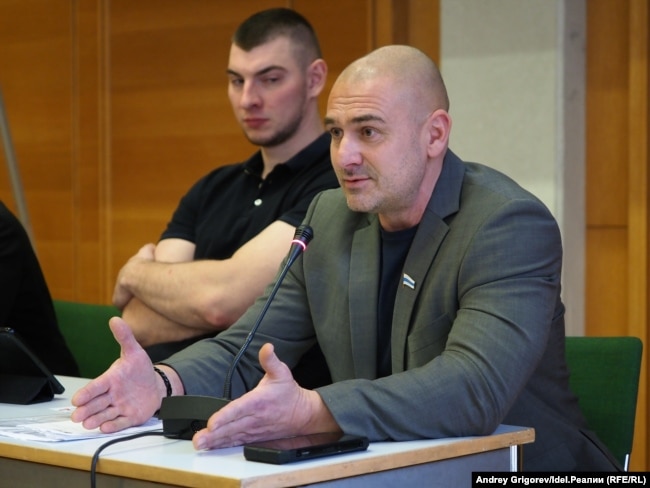
In a conversation with an Idel.Realii correspondent, Dmitry Ushatsky repeated that he did not understand the essence of Vadim Petrov’s claims.
— My fellow countrymen and I from the Kaliningrad region launched the “Baltic Republic” discussion platform on the Internet. Our task is to find like-minded people and initiate a discussion about the future fate of the region. The idea of such a platform was inspired by the Free Ingria conference, which I attended in November in Riga. “Free Ingria” has no bosses, and no party discipline but there is a free exchange of opinions. The common goal is to build an independent republic. I like this horizontal format, without bosses…
— According to Vadim Petrov, you have lived too little in the region and do not have the identity of a resident of the “Amber Region.”
— I believe that this is not based on the right of “he who stood up first gets the slippers,” but according to the right of ideas. If Vadim has good, competent ideas, we must bring them to life together. On the site of the “Baltic Republic,” there will probably appear people who, for security reasons, will hide behind aliases. We won’t delve into their past. But if this alias sounds like an interesting idea, why not use it? Moreover, this person may not be from Kaliningrad…
The organizers of the forum themselves preferred to “settle” the dispute between Ushatsky and Petrov as diplomatically as possible. Discussion moderator Taras Byk stated that “competition of ideas is what drives progress in the modern world.”
“LET’S MAKE BANDERA AVENUE IN PSKOV”
The speech of Pskov regionalist Artyom Tarasov caused no less excitement on the last day of the forum. Like other forum participants from Russia, Artyom now lives outside of Russia.
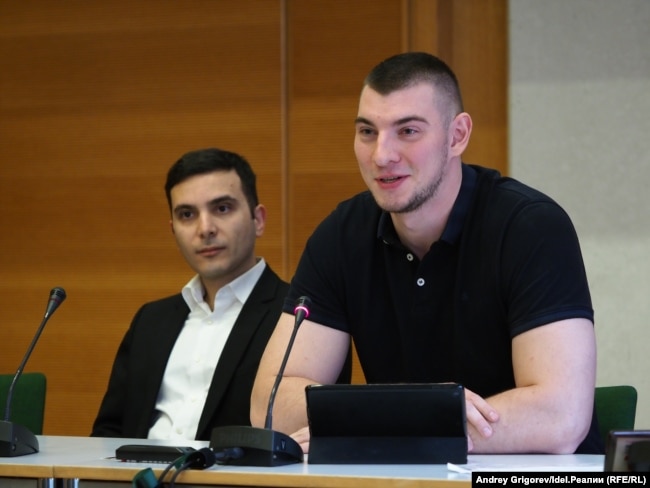
Tarasov called the “shift” of Russian borders to the east “a decisive factor in European security” and a “long-term political investment.” According to the regionalist, the Pskov region as part of Russia poses a great threat to the West.
“These are logistics, military bases and weapons aimed at the West. More decisive action is needed than what took place in Germany [at the end of World War II]. The western regions of Russia should not be viewed as purely and originally Russian. Europe without Pskov, Smolensk, St. Petersburg is not a united Europe… If Comrade Major is listening to us… Yes, these are public calls for violating the territorial integrity of the Russian Federation. If necessary, we’ll make a Bandera Avenue in Pskov ,” Tarasov chuckled at the end of his speech.
— Do Pskov residents have territorial claims against their neighbours? – asked Maxim Kuzakhmetov.
— Maybe someone in Pskov wants to see a huge Pskov Empire, but I think this is stupidity, and we will never see anything like it.
— How do you assess the potential of insurgency? – asked Magaletsky.
— I haven’t discussed this with anyone, but I’m sure Pskov, as a border region, will pick it up if it starts. This is a very weapons-filled region, you need to understand this. There won’t even be five or ten people,” Tarasov predicted.
Yulia Faizrakhmanova , representing Tatarstan, also spoke about Russia as a threat. In her opinion, the world will receive security guarantees only after taking “actions to divide Russia into independent states.”
“For me, the issue of regional independence is now perceived through the lens of the war in Ukraine,” said an activist who participated in the online forum.
A journalist from Kazan Yulia Faizrakhmanova: a case was opened against me for “calls for terrorism”.
As Idel.Realii already wrote, that in Tatarstan a criminal case was opened against Yulia Faizrakhmanova because she participated in the Forum of Free Nations of Post-Russia. Having mentioned this fact, she lamented that many Russians with an anti-Putin position are now forced to return to Russia, where they are faced with two prospects.
— People forced to return either fall into the clutches of the system, or are forced to abandon their projects… There is an opinion that such a return can trigger protests and raise people to fight. But the people are under such pressure that they cannot destroy the regime from within. We can remember, of course, the revolution of 1917, but these are very long and rare historical processes…,” the activist outlined the situation.
In her opinion, in the West, for Russians with an anti-Putin and regionalist position, there is still “not enough support, grant projects aimed at decolonization and supporting Ukraine.”
THE EMPIRE OF CARTOONS AND THE VIEWERS FROM SKR
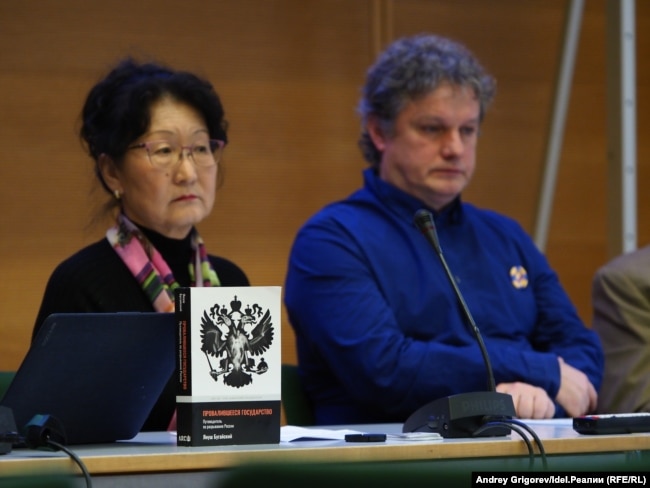
Representative of “Free Udmurtia” Artyom Medvedev, who has been living in the United States for four years, in his short speech also touched upon the topic of imperial optics, according to which Udmurtia “itself became” part of the Russian state. He shared an optimistic forecast: if Udmurtia gains independence, it is quite capable of becoming “economically successful.” Not only because the republic has “oil and other resources.” The regionalist called for looking at the experience of Finland with Karelia, and even better, at the experience of Estonia.
“Estonia has neither oil nor diamonds, it was also occupied by the USSR, but at the same time it can now serve as an example to all of us,” concluded Artyom Medvedev.
Maxim Kuzakhmetov expressed confidence that the future free Ingria will also be quite capable of doing without mineral resources.
— St. Petersburg is already the cartoon capital of Russia. “Masha and the Bears” and “Smeshariki” are filmed here. The Disney studio is comparable to Russia in terms of turnover,” the St. Petersburg regionalist drew parallels.
When Kuzakhmetov was reminded by the audience that St. Petersburg itself, as the capital of the empire, once siphoned resources from the regions, the activist was not at a loss and drew another parallel.
— Many states were once the centre of empires. I like the example of Austria. It shows that it is quite possible to build a modern, prosperous state on the ruins of an empire. Even without access to the sea. In addition, another comparison arises here: Hitler was from Austria, and Putin was from Leningrad,” Kuzakhmetov concluded.
— The real good Russians are you! (“You are the real good Russians!”) exclaimed another speaker, blogger Kemil Kerimoglu, clearly inspired by what he had heard at the Forum.
“Good non-Russians,” moderator Taras Byk corrected him. – Good Ingrians, good Bashkirs, good Tatars…
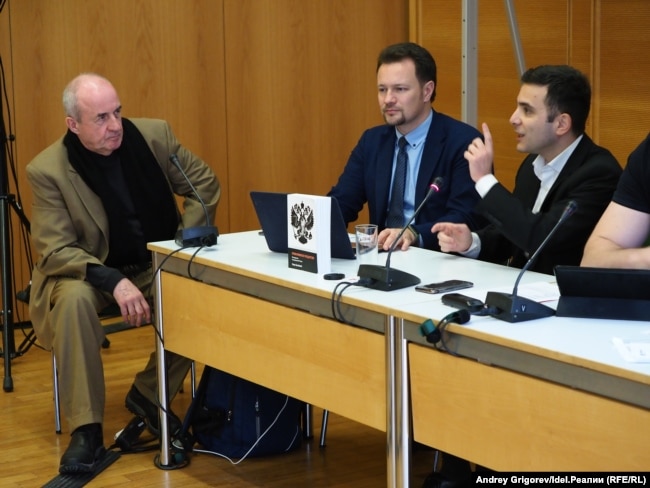
As one might expect, the Russian security forces did not like such talk. This time they reacted very quickly. Already on Friday, December 15, it became known that the head of the Investigative Committee, Alexander Bastrykin, ordered the initiation of a criminal case “in connection with statements made by participants in anti-Russian events in Germany and Italy.” The reason for this was allegedly shown “on air on a federal television channel” as “a story about events that took place in Germany and Italy.”
For comparison: a criminal case against Yulia Faizrakhmanova was opened last October, and the reason was the activist’s speech at the Forum of Free Nations of Post-Russia in Brussels in January 2023.
“Chairman of the Investigative Committee Alexander Bastrykin ordered to initiate a criminal case in connection with the statements made and give a legal assessment of the actions of these individuals,” the TASS news agency quotes a message from the press service of the Investigative Committee.
The organizers of the Post-Russia Free States Forum reacted to the news with irony, reporting on their Telegram channel that Bastrykin and the investigative committee had joined the “team of promoters” of the “decolonial” platform.
Andrey Grigoriev
Idel.Реалии





