

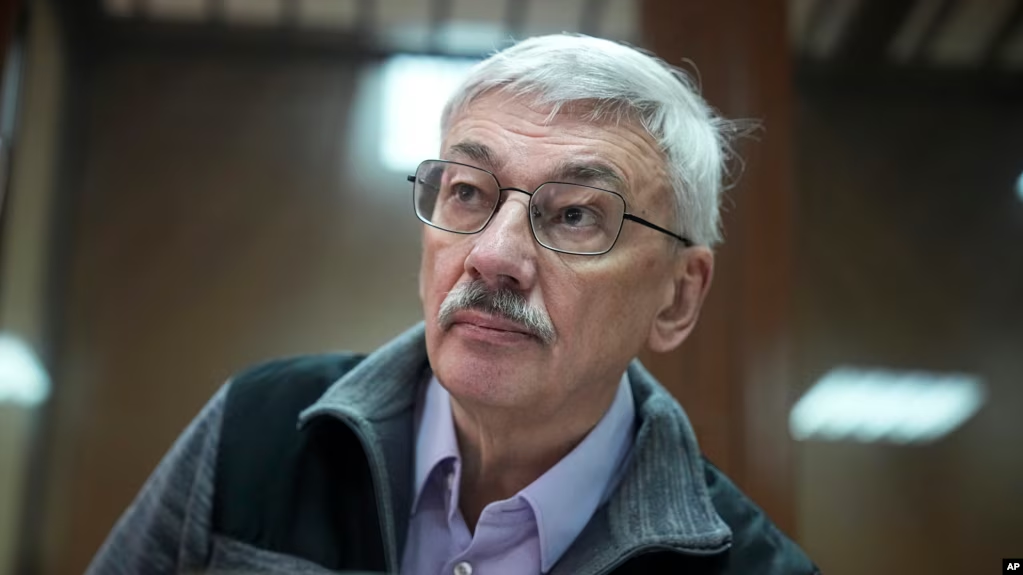
Russian human rights activist and former chairman of the board of the Memorial Human Rights Center – about his attitude to the “Big Exchange” and assistance to the Armed Forces of Ukraine, about colleagues who remain in prison and the possibility of future reforms in Russia
Oleg Orlov is one of the most famous Russian human rights activists, who created the Memorial Society and then the Memorial Human Rights Center together with the victims of Soviet repressions. This man, who enjoys the unconditional respect of his colleagues in the human rights movement on all continents, was awarded the highest human rights award of the European Union in 2009 – the Andrei Sakharov Prize for Freedom of Thought.
Oleg Orlov’s courage has been proven time and again in his disputes with the highest – and most dangerous – figures in Russian power. In the 1990s, he worked in the center of Grozny, which was under fire from Russian troops; in the 2000s, he sued the Chechen leader Ramzan Kadyrov; in the 2010s, he defended the rights of political prisoners and openly criticized Vladimir Putin.
In the 2020s, the Kremlin decided to acknowledge Oleg Orlov’s work in its own way: in 2021, the Memorial Human Rights Center was forcibly closed by a court decision, and after the already closed center received the Nobel Peace Prize in 2022, a criminal case was opened against Orlov in March 2023 for “repeatedly discrediting the Armed Forces of the Russian Federation.” Oleg Orlov spoke out directly and publicly against Russia’s aggression in Ukraine, and for this, the court sentenced the 70-year-old human rights activist to 2.5 years in prison.
On August 1 of this year, it became known that Oleg Orlov was included in the list for a prisoner exchange between Russia and the West. On the night of August 2, the human rights activist, along with 15 other political prisoners and foreign hostages of the Russian authorities, was taken to Ankara, where they were exchanged for Russian intelligence officers and hackers who were imprisoned in the West.
In an interview with the Voice of America Russian Service observer Danila Galperovich, Oleg Orlov talks about his attitude towards the “Big Exchange” and assistance to the Ukrainian Armed Forces, about his colleagues who remain in prison and the possibility of future reforms in Russia.
— What have you heard in the last few days since you were released – what does that tell you about your attitude towards the exchange that took place and of which you were a part?
— I didn’t follow the press or everything that was happening around my exchange that closely. Right now, the first few days are still a bit of a fog for me, I’m just coming to my senses, and I feel that I’m finally free, but what I’m learning is very clear to me. I know that the attitude towards the exchange that took place is very ambiguous and that the exchange itself is subject to a lot of criticism. I understand when they say: “How is it possible that they released a murderer, exchanged him, who committed obvious crimes, for people who were obviously innocent of the crimes and were illegally deprived of their freedom?” I also hear the assertion: they exchanged, so to speak, “bad Russians” for “good Russians.” But there was no exchange of “bad Russians” for “good Russians.” There was an exchange of a murderer and spies for American citizens and German citizens. Now that was an exchange! And we, political prisoners, were heading towards this exchange like trailers to a locomotive. Is it good or bad that we were attached to this locomotive? It would be strange for me, who was free, to say that it was bad. I am happy that I am free! Of course, to say otherwise would be a lie. On the other hand, I cannot say that I have an unequivocal attitude to all this. I am very grateful to the German authorities, who, risking their political position and career, nevertheless agreed to this exchange – well, at least because without this exchange, Volodya Kara-Murza simply would not have survived. The man would have died, they would have killed him there with the treatment that was given. Well, how was the world supposed to close its eyes to this murder and say: “Yes, God bless him – let them kill”? Or Sasha Skochilenko, whose health was deliberately, intentionally undermined there? Therefore, I can only welcome this exchange. On the other hand, I understand perfectly well that from a legal point of view, this exchange is criticized: “They released a murderer.” And I understand that too! An ambiguous event, it has political, humanitarian, and simply moral aspects. I do not believe that any thoughtful person can say unambiguously about this exchange. Everything is ambiguous, but in this case, Europe, represented by Germany, acted based on humanitarian principles, at least based on the principle of freeing the hostages. The hostages were in the hands of terrorists, the release of the hostages happened, and that is good.
— The statements of Vladimir Kara-Murza, Ilya Yashin and Andrey Pivovarov are now being subjected to quite serious criticism, especially from Ukrainians. What is your attitude to the discussion around their position that “sanctions against Putin are good, but against Russians are bad”? In addition, Andrey Pivovarov said that he does not consider it possible for him to help the Armed Forces of Ukraine with money. What is your position on the possibility of helping the Armed Forces of Ukraine with money and, in general, helping Ukraine in the war?
— Your question contains several questions at once. First: Pivovarov does not consider it possible for himself to help the Armed Forces of Ukraine, it is his right to help or not. This is Pivovarov’s position, and he has the right to decide as he pleases. Am I ready to give my money to help the Armed Forces of Ukraine now, or would I rather spend it on helping Russian political prisoners? I don’t know, I’ll think about it. As for helping the Armed Forces of Ukraine in general, in my opinion, this is one of the most important and necessary tasks for the entire civilized world today. At the moment, in my opinion, the entire civilized world is trying to stop the aggressor and help the victim of the aggressor. Of course, you can help the victim of the aggressor only with humanitarian aid, you can condemn the aggressor and say “Oh-oh-oh, how bad”, you can adopt some resolutions – all this will be correct and good, all this needs to be done. But, the aggressor who continues military aggression, accompanied by the death of civilians, must be stopped, including with the help of armed forces. Therefore, for the entire civilized world, in my opinion, direct military assistance to Ukraine in repelling aggression is a sacred duty.
— 30 years ago, you and I saw another aggression, when the Russian army entered Chechnya with tanks. Then, both human rights activists and journalists witnessed serious war crimes and crimes against humanity. Do you see any similarities or differences in the behavior of the Russian military and officials now, compared to that war?
— The Memorial Human Rights Center, and later the Memorial Human Rights Center, issued reports in which my colleagues and I spoke about a certain continuity. Unfortunately, the continuity in criminal behavior, the disregard for humanitarian law, and even more so, the deliberate attacks on civilian targets and cruel treatment of combatants, are quite obvious. The question remains whether the first and second Chechen wars were international conflicts or not. Nevertheless, it was a brutal military conflict with massive violations of humanitarian law and human rights. All those types of violations that we saw then, which Memorial documented and described in great detail, we later saw in the Syrian conflict (the Russian armed forces were almost inactive on the ground, but carried out air strikes, indiscriminate and brutal). And now we see all of this on a huge, terrifying scale in Ukraine. Therefore, of course, this continuity of cruelty and disregard for any international norms is reproduced. And those terrible violations of human rights during the first and second Chechen wars did not receive an appropriate assessment and reaction from the international community – that is, they received in the form of some resolutions, in the form of reports, especially in PACE – and nevertheless, there was no adequate and harsh assessment of their actions then, in my opinion. And we see, unfortunately, the consequences of impunity. You can count on the fingers of one hand the cases when those Russian military personnel who committed crimes were punished in any way, and the system of impunity leads to the reproduction of crimes. We clearly see this now.
— What message does it send to people inside Russia itself that Putin greeted a convicted murderer at the airport with an honor guard and personal embraces?
— It is quite obvious – this is a signal, first of all, to the security forces inside Russia: “Guys, you will not be held accountable for the crimes that you commit on my orders or in the execution of my orders. You will not be held accountable!” A very clear and distinct signal that Putin gave.
— If we talk about those who remain in prison in Russia, how can we release them now, and will it be possible to release them? What will be your further efforts in this matter, and who would you name in the first ranks, who should be released immediately?
— I will name Alexey Gorinov first of all, if only because when we were already sitting on the bus and understood what was happening — we greeted each other, talked, and so on — the first question that arose for us was: “Is Alexey here?” We started shouting at each other: “Who is here? Oh, hello, Ilya! Is Alexey here? Where is Gorinov?” That was our first question and our first bewilderment — there was none. Also Igor Baryshnikov, a man who has cancer and is in the most difficult condition. I will not name anyone else, but I just want to say that, already on the plane, we got together and started to figure out: who else should be first? We threw out a lot of names. In any case, I can say for sure about myself: I feel inside that I should not have been among those who were changed first. We need to save other political prisoners, and this, first of all, is what my work will be dedicated to. How, in what way to carry out the exchange, for whom can they be exchanged – I am not ready to talk now, it would be rash. But we discussed some considerations, and ideas among ourselves on the plane. Therefore, of course, this should not be the last release of political prisoners or the last exchange. Russian political prisoners must be saved. In my opinion, this is not only a moral obligation and moral priority for the Western world, which proclaims the primacy of the principles of human rights, humanism and so on, but it is also pure pragmatism. A stable world and a stable Europe without a democratic prosperous Russia, which will not be aggressive and will not pose a threat to the surrounding world, as it is now. And for this, it is necessary that both inside Russia and outside it, there are forces consisting of Russians fighting for this new Russia. Therefore, supporting people who are imprisoned for fighting for such a Russia is an important and pragmatic point of view. If the world is interested in there being a struggle within Russia, within Russian society and on the part of the émigré community, and there being hope for at least some success in this struggle, then it means we need to save those people who sacrificed themselves for this struggle.
— You are talking about a possible democratic Russia of the future. But many have a vision that for this to happen, Russia must first suffer a defeat, and perhaps then an understanding of what happened will come. Ukraine’s victory logically presupposes Russia’s defeat. How do you feel about the possibility of such a defeat, is it necessary?
— We can talk about anything, but we need to see reality. We see that what many people have said — that the Russian military machine will collapse in the near future, and that this will help democratize the country — has not happened. We see that the Russian military machine stupidly, sacrificing masses of Russian soldiers, including prisoners, continues to fight, and human lives are of no importance at all. As for how many prisoners die who go there — it is quite obvious that the majority of those who go there from prisons and pretrial detention centers do not return alive. And despite this, the regime is ready to continue, continue, and continue this war.
Question: does military defeat of any country lead to the collapse of the regime that wages war? I must say that if we take the history of Russia from the Crimean War to the Russo-Japanese War, then the defeat in the Crimean War led not only to the untimely death of the tsar-dictator Nicholas I but also to the inevitable democratization under his successor. Yes, this option, in principle, has been reproduced in history in many cases. For example, the military adventure of the Argentine junta in the Falkland Islands and its war with the United Kingdom led to the collapse of this military junta.
But this does not in the least diminish the importance of any, including military, assistance to Ukraine in the fight against the aggressor because we see that such a scenario is not being realized in Russia now. However, we know historical examples of when a dictator, if there was too much on him, leaves (we can recall the most diverse dictators, absolutely unlike each other – from Stalin to Franco), then immediately among the successors, among the “elite” that formed around him, an internal struggle begins over who will be the reformer, who will correct the mistakes and crimes that led the country to a complete dead end. In this sense, it becomes important whether these will be “reforms” in quotation marks, or real reforms, for example, as happened in Spain after Franco left and the fall of Francoism. Here the role of the opposition, and civil society both inside the country and in emigration becomes paramount.
— What is the most important thing for you that you took away in terms of experience and impressions from your imprisonment?
— I can’t formulate it yet. I have a lot of impressions, memories and thoughts. But in general, I can probably say the following: until a political prisoner has encountered the kind of lawlessness that Sasha Skochilenko encountered, that Kara-Muza encountered, that others encountered, including those who were exchanged – in these conditions of captivity, difficult, humiliating, sometimes terrible, nevertheless, it is possible to live and even not lose heart. You can’t tell yourself that after the arrest – it’s the end! Those who fear arrest and imprisonment as the end of their life, tell themselves that after that there will be nothing, only darkness and horror – this is not always the case. It seems that this was the case with Volodya Kara-Murza, but it was not the case with me. This is an important experience that needs to be understood, and it is important to come out with some positive conclusions. And for me, it was an important, interesting, and very difficult experience.
Danila Galperovich






