

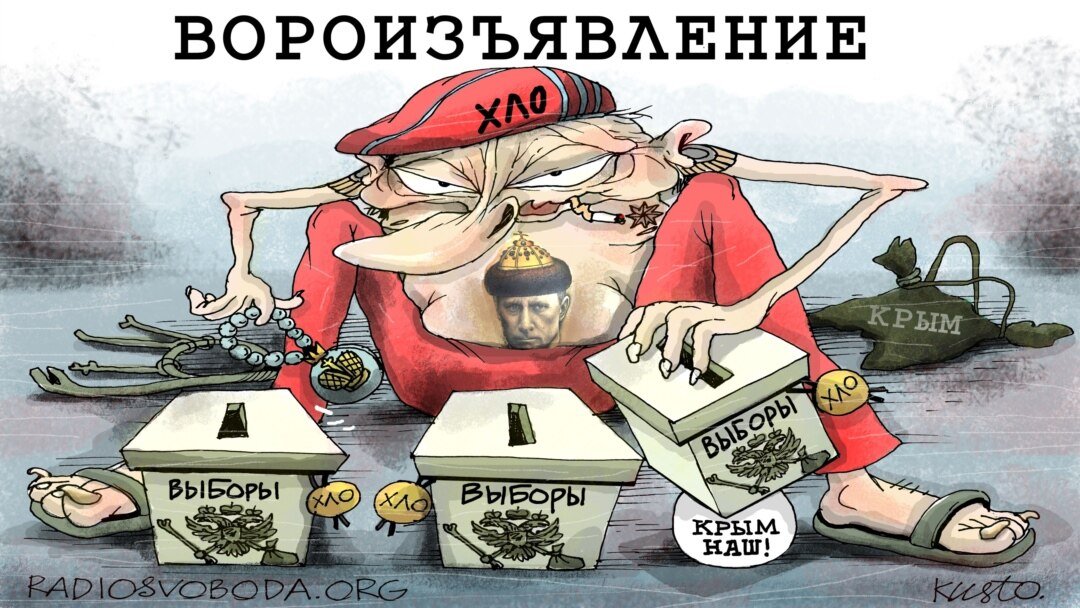
From 15 March to 17 March 2024, presidential elections are being held in Russia. For Vladimir Putin, they became the fifth; he has been in power for the 25th year. But only recently has the question of its legitimacy begun to be seriously discussed outside Russia.
At the end of February, the European Parliament adopted a resolution, in which it named Putin and the Russian authorities responsible for the murder of opposition politician Alexei Navalny (the resolution was supported by 506 people, nine voted against, and another 32 abstained). According to European deputies, this gives grounds to raise the question of the president’s legitimacy.
Alexei Navalny’s widow, Yulia, also stated that a president who “killed his main political opponent cannot be legitimate by definition.” Speaking at a meeting of the EU Foreign Affairs Council on 19 February, she called on European leaders not to recognize the results of the upcoming Russian presidential elections. Politician Vladimir Kara-Murza, who is serving a 25-year sentence in the Omsk maximum security penal colony No. 7, made the same request to the West.
“Now everyone is paying attention to Putin’s legitimacy when discussing the next elections. But there is also a question about past results,” says Russian independent election observer Ivan.
He was part of a group of specialists who, in 2022, at the request of Meduza, studied the video archive from the 2021 State Duma elections. Using a programme based on the neural network “Inspector”, experts concluded that in those elections up to 17 million votes could have been thrown in (in total, according to the Central Election Commission, 56.5 million people voted then).
According to official calculations by the Central Election Commission, in the elections of 18 March 2018, Vladimir Putin received an unprecedented result – more than half of the Russians who, in theory, could come to the polls voted for the president: 76.69% or more than 56.4 million people. Although the turnout fell slightly short of the record then and amounted to about 67.5% (Medusa described in detail how the authorities fought to increase it), neither Putin himself nor other presidential candidates had ever received such support before.
CEC Chairman Ella Pamfilova then argued that, although there were “irregularities and shortcomings” in the elections, there were no serious violations (voting results were cancelled in only 16 polling stations). At the same time, the “Map of Election Violations” website, which collects and publishes information about possible violations, received more than 3.2 thousand messages in March. “This is just the tip of the iceberg,” an election observer tells Meduza, “as only a small portion of observers decide to file a complaint. And even less to publish information about violations on the Map.”
Other independent experts also spoke about fraud in the 2018 elections. According to calculations by mathematician Dmitry Kobak and physicist Maxim Pshennikov (when studying the distribution of votes, they relied on mathematical models), about six million votes could have been cast for Putin, or almost 10% of the total number of votes allegedly cast for him. Physicist Sergei Shpilkin, who constantly analyzes voting in Russia, estimated possible fraud of 8.6 million votes.
However, despite the massive falsifications, there is no evidence that any independent experts studied the issue of the formal legality of Putin’s tenure in office. Therefore, in 2024, a group of observers, says Ivan, decided to “take a fresh look at the old data.” Namely, to analyze violations at polling stations in the context of invalidating the 2018 presidential elections.
What did the video analysis show?
According to the Federal Law “On Presidential Elections” (namely, subparagraph 2, paragraph 5, article 76 ), the Central Election Commission declares the presidential elections invalid “if the voting results are declared invalid in part of the polling stations, the lists of voters for which at the time of the end of voting in the aggregate include no less than one-quarter of the total number of voters included in the voter lists at the time of the end of voting.”
In other words, if there are grounds to invalidate the voting results in precincts where more than 25% of all voters are registered, then by law the election results in the country must be annulled.
“Let’s imagine that there is one large precinct that accounts for 25% of all voters, and other smaller precincts,” suggests election observer Ivan. “Even if there is fraud only in this one large polling station, the ‘disease’ will affect a quarter of the total number of voters, which means the election results need to be cancelled.” The amount of falsification in this case, the expert notes, does not matter: “They can throw in 10 votes, or they can throw in 10 thousand. It is equally illegal.”
To calculate the percentage of voters registered in polling stations with significant violations, a group of observers turned to the video archive from this vote (it was given to them by volunteers). It contains recordings from 16,494 cameras on 8282 PEC from 58 regions of Russia.
“Not all sections [that broadcast] were recorded, because already in 2018 it was more difficult to get a video,” says Ivan. According to him, everyone who tries to monitor the integrity of elections in Russia faces tangible obstacles from the authorities.
Why has it become more difficult to obtain broadcast recordings from polling stations?
To work, the “Inspector” needs a good view from a camera installed on the site, explains Ivan. The CEC resolution also states that “all objects” related to the voting procedure (for example, the premises itself, places where ballots are issued and voting boxes) must be visible to at least one of the video surveillance cameras. But in reality, this requirement was not observed during the 2018 presidential elections, says Meduza’s interviewer: in some of the records received by volunteers, even ballot boxes are not visible.
Of the 1,748 records, “The Inspector” was able to analyze only a portion. Another part of the videos, randomly selected from the archive, was studied by volunteers. In some cases, people revised records that the “artificial intelligence” had already checked to reduce the likelihood of errors in the calculation.
The team of observers selected for the study only those regions where they were able to check at least ten sites. “Roughly speaking, if only one site was recorded in a region, it is impossible to draw a conclusion from it,” explains Ivan. “So we took those regions where there was enough material.”
The study showed: that among 1748 entries 933 contained evidence of significant falsifications.
According to observers, areas with significant violations account for 55% of the number of registered voters for all verified areas (that is, for PEC 1748). This number exceeds the norm of 25% specified in the law “On Presidential Elections”, to invalidate the elections.
Independent observers admit that this approach to assessing voting has significant flaws. According to the Central Election Commission, there were about 109 million people on the voter list for the 2018 presidential elections. Only 67.5% of them took part in the voting – about 73.6 million in total. Accordingly, for the elections to be declared illegitimate, violations had to affect polling stations where about 27.25 million voters were registered. In areas where observers counted significant fraud, just over 1.7 million people were registered. Observers do not have videos that allow them to conclude violations throughout Russia.
“Formally, crooks can easily fight back by saying that in those areas that we did not check, everything was fair,” says observer Ivan. At the same time, he adds, videos analyzed by experts indicate that falsifications have spread to all regions. “It’s not that we [with the help of “The Inspector”] chose 25% of the “damages” only at the expense of Chechnya and Tatarstan, while the remaining regions are clean,” says Ivan. “Falsification is common, and we show the extent of this problem.”
What do statistics say about Putin’s legitimacy?
To test the hypothesis that the Russian presidential elections in 2018 could not be recognized as valid by law, a group of observers also turned to statistics. In particular, according to the calculations of electoral analyst Sergei Shpilkin, who suggested that in those elections 8.6 million votes could have been “added” to Putin (in the fall of 2022, security forces came with searches to Shpilkin and Golos activists; by that time, the electoral analyst had already left Russia).
The Kisling-Shpilkin method helps to see “pure stuffing” and is based on observing how turnout in a polling station and votes for each candidate correlate. The graph shows that with low turnout, votes for all candidates are correlated with each other – the lines repeat each other up to scale. And if the turnout is more than 68%, the curve with votes for Putin deviates significantly upward, which indicates possible falsification.
The scatter plot also shows the results of all candidates in the 2018 presidential election but in the form of points that form clusters (also called “clouds”). Elections without violations look like smooth “clouds”, dense inside and fading at the edges. However, in the diagram of the 2018 elections, the so-called “tail of a comet” extends upward from the “cloud” of votes for Putin (and the “tail” of votes for other candidates goes down).
“The “tail” is formed as a result of adding votes to the desired candidate, which at the same time leads to an increase in turnout,” writes Sergei Shpilkin.
The diagrams look completely different in regions where, according to Shpilkin’s calculations, there were practically no violations (that means, anomalous votes do not exceed 2%). Among them are Moscow and St. Petersburg, the Republics of Karelia and Komi, Vladimir, Kostroma, Murmansk, Sverdlovsk, Sakhalin, Tomsk and Yaroslavl regions, as well as the Khabarovsk Territory.
Taking the charts for these regions as a guide explains independent election observer Ivan, it is possible to determine the border of the “cloud” without falsification. “The number of anomalous votes in these regions does not exceed 2%,” says Meduza’s interviewer. “So if we take a margin of error of 2% and construct an ellipse that covers the cluster with 98% of voters, we can conclude that everything outside the figure is, within the margin of error, falsified.”
The same zone, the election expert continues, can be noted on a diagram with data for all of Russia, compiled using the Shpilkin method. “With fair voting throughout the country, the error would also be 2%,” explains Ivan. “However, outside the ellipse, we see more than 30.6% of voters .”
This means the observer summarizes, that During the 2018 presidential elections, there were significant violations in the polling stations where more than a quarter of all voters were registered.
From the point of view of the law, Vladimir Putin has been illegitimate since 2018, says Ivan.
He notes that this approach produces an underestimation. Based on statistics, it is impossible to identify areas with relatively minor violations, that is, insufficient for the polling station point on the diagram to leave the “fair” ellipse.
Among such polling stations, for example, is PEC No. 378 in Grozny (Chechen Republic), where in the 2018 elections the official turnout was 1,077 voters, the source says. At the same time, from the video from this polling station, “The Inspector” was able to identify only 833 voters who came, and the volunteer who studied the recording was able to identify 896.
Another example is polling station No. 197 in Ufa (Republic of Bashkortostan), where, according to video observers, 300 votes were stuffed. The cluster also included two sites in the cities of the Kemerovo region where there were falsifications – No. 831 in Prokopyevsk and No. 1413 in Tashtagol. At first, according to video observers, almost 200 votes were falsified (with an official turnout of 65%, Putin received 73% here). In the second, where the turnout and votes for Putin were both 68%, the commission increased the number of voters by “only” 29 people.
Ivan notes that the Russian authorities have never tried to “even somehow justify themselves” in connection with these violations. “They could post all the videos and let them check every polling station. But they don’t do this,” says Meduza’s interviewer. “When the state opposes it, it is difficult for independent observers to do the work for the state.”
Ivan is convinced, there are tens of thousands of violations in various elections in Russia. However, due to various obstacles that independent observers face, they only have a small amount of data. “However, relying on various methods (video from polling stations, statistics, observer data), which confirm each other,” says Ivan, “we see that the scale of violations is catastrophic, and the president is illegitimate.”






