

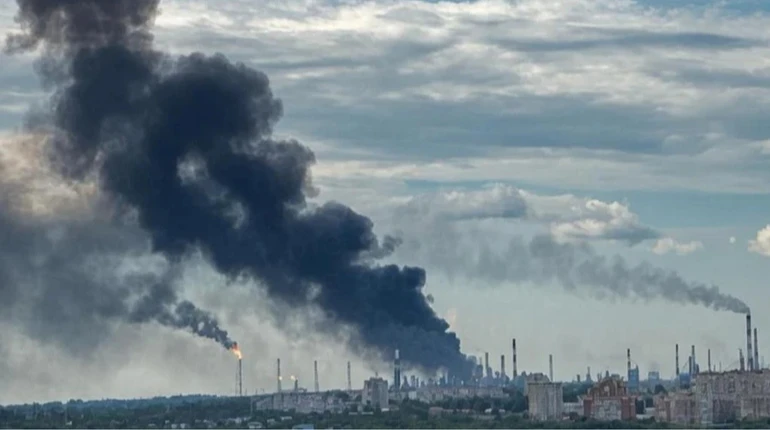
Russia, one of the world’s major oil powers, is ending August unable to fully supply its own gasoline market. Following strikes on oil refineries, production has fallen to around 80,000 tonnes per day — just 70% of summer demand. Even with imports, domestic supplies cover only about 85% of demand.
Moscow is already being forced to compensate through imports. Russia is buying fuel from Belarus and Asian countries and is even arranging to have Russian crude processed at a refinery in Kazakhstan.
This is more than an economic problem.
The Russian empire depends on the centre’s ability to supply resources, finance its military and control an enormous territory. When even gasoline becomes scarce, the system becomes more expensive and less efficient.
For the nations subjected to Russian rule, this matters.
Their liberation does not necessarily begin with a political declaration. It can begin with the gradual weakening of a centre that can no longer maintain the same level of military, economic and administrative control.
Ukraine’s strikes on Russian oil infrastructure do not automatically mean the collapse of the Russian Federation. But they demonstrate something important:
an empire has a limit as to how much pressure it can absorb — and that limit can be pushed closer.
The greater the cost of war for the Kremlin, the fewer resources remain to maintain the empire.
And for the nations subjugated by Russia, that means more space for the decisive historical step: to leave someone else’s war and gain a chance for their own statehood.






