

We and the Russians are not brothers at all.
I spoke at the Free Russia Forum in Vilnius. The topic was decolonization. I was talking about the deoccupation of our country. As it turned out, many people simply do not know the history of Belarus.
I would not talk about decolonization but about deoccupation. After all, Belarus has been under the occupation of the Russian Empire for more than 200 years.
Russian official historiography lies brazenly and shamelessly. That is why most Russians believe that since the end of the Ice Age Belarusians have been doing nothing but dreaming of reunification with “Mother Russia”. For this reason, I will briefly recall the historical facts.
Belarus is a historically European country. The history of Belarusian statehood begins with the Principality of Polotsk, the state of the Krivichi on the “Road from the Varangians to the Greeks”, which was ruled in the 10th century by the first known prince Rogvolod. Polotsk of the 5th century is also mentioned in the Varangian chronicles – the famous “Acts of the Danes”.
Since the 13th century, the territory of Belarus became part of the Grand Duchy of Lithuania, one of the largest state associations of that time. The Belarusian nation was formed within the GDL based on the mixing of Slavic and Baltic tribes.
We are not brothers at all. Over 300 years, from the middle of the 14th century to the second half of the 17th century, there were 12 full-scale wars between the Moscow Principality and the Grand Duchy of Lithuania. Not counting the constant civil strife and border conflicts.
In Soviet times, it was claimed that during World War II, Belarus lost every fourth resident, but few people know that during the war between the Grand Duchy of Lithuania and Muscovy in 1654-1668, every second resident died on the territory of our country, and in its eastern part, more than 80 percent of the population were killed, died of disease, or were driven into slavery to the East.
In the 16th century, to protect the eastern lands of the principality from the Muscovite state, the Grand Duchy of Lithuania and the Kingdom of Poland united to form the Polish-Lithuanian Commonwealth – the Republic of Both Nations. It was a confederative entity, where the Grand Duchy of Lithuania retained all the institutions of statehood, including the army, legislation, self-government bodies, the court, the monetary system, and so on.
At the end of the 18th century, Russia seized the Grand Duchy of Lithuania by force of arms and money (referring to the infamous “three partitions of the Polish-Lithuanian Commonwealth” at the end of the 18th century). By order of the Russian tsars, we, Lithuanians, were renamed Belarusians and turned from Uniates into Orthodox.
And then – for more than 200 years – first in the Russian Empire, then in the USSR, and then during the 30 years of Lukashenko’s pro-Russian dictatorship – they tried to destroy Belarusians as a nation.
Numerous uprisings carried out by Belarusians together with Poles and Lithuanians in the captured territories were suppressed. In 1918, the Bolsheviks suppressed the attempt of Belarusians to create an independent state – the Belarusian People’s Republic.
Our culture and language were destroyed, and the best representatives of the national intelligentsia, writers, poets, artists, and musicians were killed. The national elite was destroyed, including the best managers, economists and politicians. Hundreds of thousands of peasants were sent to Siberia, where they died. Among them were my ancestors, who were “dekulakized”, that is, robbed, and then sent to die in Russia.
Yes, Belarus gained independence in 1991. However, the rise to power of dictator Lukashenko in 1994 practically stopped the process of building a truly independent national state.
Lukashenko paid for cheap oil and gas with independence and Russification. There is not a single Belarusian-language university in the country, there are practically no Belarusian-language schools left, and the number of hours of teaching subjects in the native language in schools is minimal. All state media, including TV channels, are Russian-language. History taught in schools and universities is falsified to please Russia. Many historians and writers have been declared extremists and have ended up in prison or exile.
Belarus is dependent on Russia politically, militarily, and economically, but mass protests in 2020 showed that the nation is alive. People took to the streets (about a million people across the country) with historical national symbols – the white-red-white flag and the Pahonia coat of arms. Belarusians declared their desire for freedom and independence.
Yes, with the support of the Kremlin, Lukashenko managed to suppress the national uprising. But the main thing happened – the whole world saw that Belarusians are a European nation, Belarus is not part of Russia.
Now I will tell you how I see the liberation of Belarus. I am sure that today’s backward Russia will inevitably lose the war it is waging against Ukraine. Perhaps this is its last throw to the West. In the future, Russia will face inevitable defeat and, probably, disintegration.
For us, Belarusians, this will be a historic chance.
Let us recall what happened on the eve of 1991. In parallel with the collapse of the USSR, the socialist bloc collapsed. Since 1989, there has been a mass collapse of communist regimes in Eastern Europe: the Round Table and free elections in Poland, the fall of the Berlin Wall, the Velvet Revolution in Czechoslovakia, the liberation of Hungary and Bulgaria, the execution of the dictator Ceausescu in Romania.
The same thing will happen here. I am sure that as soon as destructive processes in Russia become active, changes will inevitably begin in Belarus.
I think this will happen in several scenarios:
– through mass popular protest;
– through a nomenklatura coup (possibly together with mass protest).
We remember how quickly the Soviet nomenklatura “changed its shoes” in 1990-1991 and repainted itself as democrats. The same thing will happen this time. For them, it is a question of survival; today’s Belarusian officials do not want to be part of Russia. And tomorrow they will very quickly stand under the white-red-white flags.
The problem that the new Belarusian government, which will include political prisoners who will be released from prison, representatives of the emigration and part of the nomenklatura, may face is resistance from part of the security forces that have turned into gangs under Lukashenko. It is they who have been committing crimes against humanity in recent years, of which the regime is accused.
In this case, the new coalition government of Belarus may invite international peacekeeping forces under the auspices of NATO and the UN to ensure law and order, and stability. These could be forces under the provisional name BYFOR, following the example of KFOR, an international force led by NATO responsible for ensuring stability in Kosovo. KFOR was created by a UN Security Council resolution.
The same peacekeeping force called BYFOR could be invited to Belarus.
Our path forward is clear. We must immediately withdraw from the “union state”, the CSTO, the EAEU, and the CIS and declare our desire to join the European Union and NATO. Even neutral status is impossible in our case and will inevitably lead to continued Russian influence and occupation. This must not be allowed under any circumstances. Therefore, the future of Belarus is only in the EU and NATO.
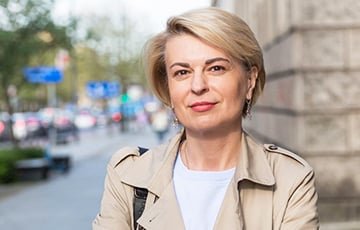
Natalia Radina, Belarusian journalist
Гордон





