

The problem of frozen Russian assets has remained unresolved since the first day of the large-scale war. Every year, our allies make titanic efforts to find the $40–60 billion needed by Kyiv to cover the budget deficit, while at the same time fearing that the keys to the huge chest of Russian treasure will fall into their hands.
Over $300 billion of the occupier’s assets have been frozen in various countries around the world, most of them in Europe. Despite the efforts of some European and American politicians, a legal mechanism for their transfer to Ukraine has not yet been created. These funds could provide a significant share of the reconstruction of damaged Ukrainian infrastructure; the amount of losses is constantly growing and has already reached $600 billion.
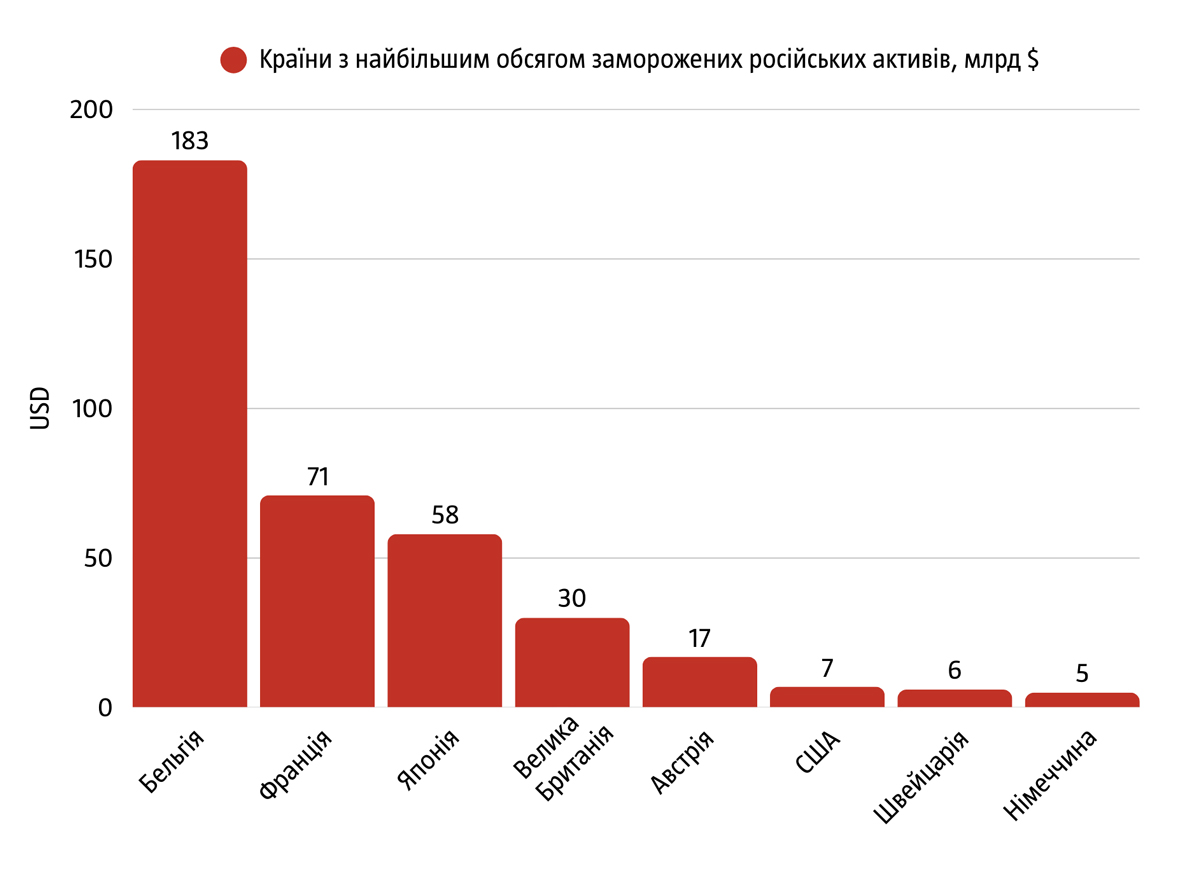
Countries with the largest amount of frozen Russian assets, billion $. Source
In April 2024, the US Congress passed the Rebuilding Economic Prosperity and Opportunity for Ukrainians (REPO) Act, which allowed the then-Biden administration to liquidate $5 billion in Russian assets and transfer them to a special Ukraine Support Fund.
However, the procedure was not implemented, as it required formal consent from the G7 countries and all 27 EU members. The so-called compromise solution was an agreement to provide Ukraine with a $50 billion loan, offset by interest income from Russian assets (approximately $5 billion per year).
In 2025, US officials continued to try to turn the tables. In January, during the final days of the Biden administration, Washington pushed the Europeans to use frozen assets as leverage in negotiations with Moscow. And in March, representatives of both parties appealed to the new Trump administration to use all financial levers to pressure Putin, the most important of which was asset seizures.
To confiscate or not to confiscate?
Trump’s rise to power has revived discussions among Europeans about Russia’s frozen assets. They began to be mentioned even more after Volodymyr Zelenskyy’s unsuccessful visit to Washington in February 2025 and the subsequent suspension of US military aid.
On 15 May, a few days after returning from Kyiv, the new German Chancellor Friedrich Merz spoke about confiscating Russian assets. Like his European colleagues, he expressed a desire to transfer the funds to Ukraine, but only if the “right” legal way was found: “If the assets can be mobilised legally, we will definitely do it. However, we must take into account the risks for the European financial market.”
Politicians in various European countries are increasingly vocal in their support for confiscation. For example, Spanish Foreign Minister José Manuel Álvarez has suggested using frozen assets as an advance on reparations that Russia will pay in the future. Poland, the Czech Republic, and Estonia support the full confiscation of Russian assets. In March 2025, the French parliament voted to appeal to the EU leadership on the need to transfer funds to Ukraine as soon as possible, despite President Macron’s indecision.
The French leader is not the only one who does not dare to speak out in favour of transferring the occupier’s funds to us. Sсeptics also include the head of the European Central Bank, Christine Lagarde, and the Prime Minister of Great Britain, Keir Starmer (London has frozen approximately $30 billion). Although a few days ago, the British proposed investing the funds so that they generate higher income for transfer to Ukraine.
French Finance Minister Eric Lombard believes that the confiscation of Russian assets will negatively affect the international community’s confidence in the euro as a reserve currency. Belgian Prime Minister Bart de Wever is convinced that it will be an “act of war” that will threaten the entire international financial system.
Confiscation mechanisms
Despite the apocalyptic statements of certain politicians, the legal formalisation of the transfer of assets to Ukraine is quite possible. In 2024, the European Parliament Research Service published a report in which it outlined the conditions for the legal transfer of funds to Kyiv. The main one is the formalisation of the confiscation of assets as a countermeasure against Russia, a violator of international law. Having deprived Russia of funds, it will be necessary to choose an appropriate form of their transfer, for example, placing them in escrow accounts with Ukraine, using them in the future as collateral for new loans.
The report notes that under international law, states are obliged to provide reparations for internationally wrongful acts. According to a ruling by the Permanent Court of International Justice (PCI), “it is a principle of international law, as well as a general understanding of law, that any breach of an obligation entails an obligation to provide reparations.”
The obligation to provide reparations may be breached by any State following established procedures. For example, following Iraq’s illegal invasion and occupation of Kuwait, the UN Security Council reaffirmed the general obligation to provide reparations, recognizing that Iraq “is responsible under international law for any direct loss, damage, including environmental damage and depletion of natural resources, or injury caused to foreign governments, nationals and companies as a result of the illegal invasion and occupation of Kuwait.”
The UN General Assembly has already recognized that Russia “must bear the legal consequences of all its internationally wrongful acts, including by providing reparations for harm, including any damage caused by such acts.”
According to the report’s authors, there is already a sufficient legal basis for the transfer of Russian assets to Ukraine. EU leaders need to develop a mechanism that will formalise these funds in the form of reparations, as well as minimise the risks for the European financial market mentioned by Merz.
However, the confiscation of Russian assets could be framed as a response to similar actions by Moscow. In 2024, Putin signed a decree authorising the confiscation of all American assets in Russia. The decree was later extended to the property of all “unfriendly” countries.
How Russia finances weapons for Ukraine
While the discussions continue, the Europeans are looking for new ways to use the proceeds from frozen assets. On 19 May, it became known that about 90 million euros will be transferred to Finland as compensation for a new package of arms aid to Ukraine, which will include 155-millimetre shells, air-to-surface missiles, etc. According to Finnish Defence Minister Antti Gäkkänen, the funds will be transferred to Finnish arms manufacturers, which will allow both to increase the volume of aid and to create new jobs for Finns.
A few days earlier, during a speech in Lviv, French Foreign Minister Jean-Noel Barrot stated that the proceeds from Russian assets would be used to repair CAESAR artillery systems.
Although such steps still do not allow for the full use of frozen assets, they at least make it possible to relieve the burden on the national budgets of European Union countries.
Fortunately, the EU does not forget about Ukrainian manufacturers. Last week, Ukrainian Prime Minister Denys Shmyhal reported on 1.9 billion euros, of which “1 billion euros will be allocated to the purchase of weapons directly from Ukrainian manufacturers. Another 600 million euros will be allocated to artillery and ammunition. More than 200 million euros will be allocated to strengthening Ukrainian air defence.”
Confiscation of Russian assets as a restoration of justice
In any case, more and more European politicians understand that due to the unpredictability of Washington’s position, it is necessary to find new sources of assistance for Ukraine as soon as possible. Frozen Russian assets are the most obvious and accessible of such sources.
Obviously, we should not expect to receive these funds within the next few months, perhaps even by the end of 2025. However, the process is currently being accelerated due to several factors: the instability of American aid, Moscow’s reluctance to agree to peace proposals, and the need to find sustainable sources of financing for Ukraine.
Currently, the main argument of opponents of the confiscation of Russian assets is the reluctance to violate international law. However, Russia has been openly violating it every day for more than three years, and has also openly threatened war not only on Europe, but on the whole world. Accordingly, the confiscation of its assets should not be an act of violation of international law, but, on the contrary, a step towards restoring its validity.
Oleksandr Chupak
Тиждень





