

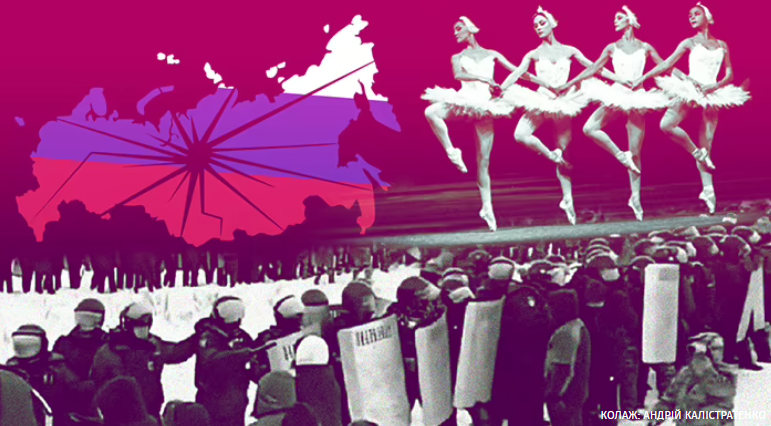
The disintegration of the Russian Federation into several independent national states is the cherished dream of millions of Ukrainians.
In 2022–2023, the disintegration of the aggressor state was predicted soon no less willingly than the treat of a cup of coffee in de-occupied Crimea. In January 2024, this dream was revived again by short-lived Bashkir protests.
The successful performance of the nations of Chechnya, Dagestan, Buryatia, Yakutia, and Bashkortostan against Kremlin tyranny looks like an ideal recipe for victory over Russia. But it seems that the time has come to look at things soberly – and figure out how likely this development of events is.
We are convinced of the rapid disintegration of the Russian Federation, as we believe in the incredible power of national liberation movements and the ability of any people to achieve independence. This belief is reinforced by the tremendous successes of decolonization in the 20th century.
From 1950 to 1980, the number of UN member states increased from 60 to 154. But, as a rule, the fighters for independence at that time opposed the European metropolises. By the middle of the 20th century, Europe had evolved too much towards liberalism and democratic values. This is what led to the triumph of the anti-colonial struggle in Asia and Africa.
Most of the British colonies, including the main imperial pearl, India, achieved liberation through non-violent methods. But if figures like Gandhi had been confronted by a less liberal and pedantic opponent, a peaceful victory would have been unthinkable.
Read also: The day the war ended
The French tried to suppress the armed struggle for independence by force, but it turned out that harsh suppression did not find the necessary support in the metropolis. The use of torture by the French army in Algeria caused a huge scandal – although the torture was carried out by merciless terrorists who spared neither women nor children.
The Portuguese one lasted the longest of the European colonial empires. For the obvious reason that until the 1970s there was a dictatorial regime in Lisbon, ready to fight with the rebels in Angola and Mozambique for years. Accordingly, the democratic “carnation revolution” in Portugal itself put an end to this.
However, it is worth turning away from the former European metropolises and looking a little to the east, as we will find that the incredible power of national liberation movements has disappeared somewhere.
In the 2020s, Turkish Kurdistan is as far from independence as it was a hundred years ago when the Atatürk regime declared the Kurds “mountain Turks” who, for some unknown reason, forgot their origins.
Of course, the Kurds did not agree with this formulation and repeatedly rebelled against Ankara, but all their speeches were brutally suppressed by the Turkish authorities. The Kurdistan Workers’ Party, which adopted terrorist methods and went to war with Turkey in the 1980s, also did not succeed.
Chinese Tibet and Chinese Xinjiang are also far from independence. Although the Tibetan government in exile still operates in India, and the World Uyghur Congress functions in Germany, they cannot boast of any practical successes.
At the same time, Beijing’s policy towards the Uyghurs has all the signs of genocide: there is the extrajudicial imprisonment of hundreds of thousands of people in “re-education camps”, forced abortions, forced sterilization, and the mass separation of children from their parents.
Read also: Welcome to Pyongyang
Does this mean that the national self-consciousness of the Kurds or Uyghurs is less developed than the self-consciousness of the nations who inhabited the Asian and African possessions of the British Empire or the French Republic in the 20th century? Of course not. This means that Turkish and Chinese autocrats have little in common with European gentlemen in cork helmets, who had to leave their colonies under the pressure of public opinion in their countries.
Now let’s return to the Russian sheep. It is obvious that historically Russia is closer not to Great Britain or France, but to Turkey and China. The success of national liberation movements was noted in those brief periods when Russian despotism weakened, and internal Russian life acquired at least a distant resemblance to the Western one.
Until 1917, the Russian Empire did not know victorious national performances. Of course, the oppressed nations periodically rebelled against Russian rule – but without success. Even in 1916, a few months before the collapse, the tsarist government managed to suppress an uprising against labour mobilization in Russia’s Central Asian possessions.
But then the events in Petrograd and the democratic February Revolution became known. The catastrophe of Russian autocracy opened a window of opportunity for national liberation in various corners of the empire: from Finland to Ukraine. Someone managed to use this effectively. Some, unfortunately, do not. With the final victory of the Bolsheviks and the cementing of a brutal dictatorship, this window closed again.
Whether we like it or not, no national movement in the USSR managed to overcome the totalitarianism of Stalin’s spill.
In the 1950s, the Soviet regime performed the same task in the west of Ukraine that the French failed to cope with in the north of Vietnam in the same years. But it does not follow that the communist Viet Minh fought for independence with more zeal and courage than the UPA. It follows only that France in the era of the Fourth Republic was absolutely not like the Soviet Union.
Read also: The generation that achieved the goal
The French left organized thousands of demonstrations under the slogan “Not a man, not a penny for the dirty war in Vietnam!”; engaged in sabotage at enterprises, ports, and railways; disrupted the supply of military goods to Indochina and prevented effective countermeasures against the Hoshino partisans. In Moscow or Kyiv at that time, it was even possible to imagine a single protest against punitive operations in the west of the Ukrainian SSR.
A new window of opportunity for national liberation opened only at the end of the 1980s – along with the softening and liberalization of the Soviet regime. It is worth remembering that the national fronts in Latvia, Lithuania and Estonia – like the Ukrainian National Movement – initially positioned themselves as movements in support of Soviet perestroika. Even then they were successfully transformed into open graves of the empire.
All of the above leads to an obvious conclusion.
A victorious uprising of Chechens, Dagestanis, Buryats, Yakuts, or Bashkortostans against the Kremlin dictatorship is a fantastic scenario based on nothing but our own wishful thinking.
However, the disappearance of the national republics in the case of another liberalization of the Russian regime is quite a realistic scenario.
However, here Ukraine falls into the trap of its own emotions and the dogmatism generated by them.
On the one hand, wishing for the disintegration of the Russian Federation is good and right. This is fully consistent with the trends dominating Ukrainian society after February 24, 2022.
But on the other hand, wishing for the liberalization of the Russian Federation is nonsense. This means that the national hopes should at least in some way coincide with the position of the “good Russians”, who are deeply antipathetic to the majority of Ukrainians.
Only logic suggests that the disintegration of the Russian Federation is hardly possible without prior liberalization of the Russian Federation. In order to see the day of Russia’s collapse, we will have to live until the day when Moscow talks about freedom and democracy again.
Mykhailo Dubynyanskyi
Українська правда





