


Starting from 1 September, Russian schools will reduce the number of hours for teaching native languages: instead of two, to one hour per week. This will especially affect non-Russian-language schools, the number of which has been decreasing in recent years. This decision caused a sharp reaction in Tatarstan: one of the members of parliament from United Russia publicly criticised the federal centre’s initiative. This is not the first case of demarche: Tatarstan previously opposed the reform of local government. Why is Moscow cutting space for national languages – against the backdrop of a decrease in the number of their speakers? Is this explained by demographic trends in Russian society? And is the republic really trying to preserve its autonomy – or is this just symbolic discontent? The co-founder of an organisation for the rights of indigenous peoples of Russia and experts answered questions from Idel.Realii.
“STATE POLICY OF ASSIMILATION”
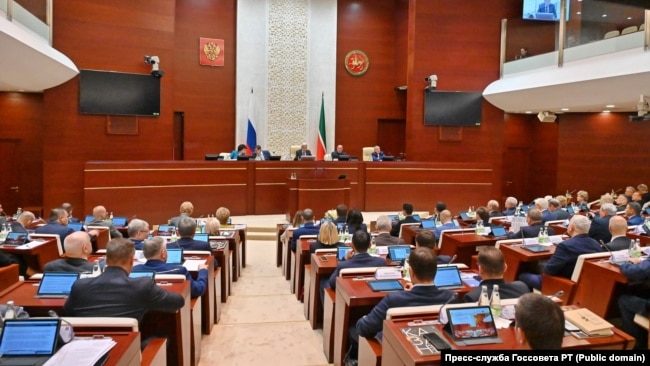
On 17 July, deputies of the State Council of Tatarstan appealed to the Russian Ministry of Education with a request not to reduce the hours of teaching native languages in schools. The reason was the order of the department, which comes into force on 1 September: according to the new curricula, in the first grade, the subjects “Native Language” and “Literary Reading in the Native Language” will be taught not two, but one hour per week – even in schools with a non-Russian language of instruction. In addition, the same order provided for renaming the subject “Native Language” to “Language of the People of the Russian Federation”.
Earlier, the Russian independent media outlet Takie Dela, citing experts, wrote that the share of Russian schoolchildren who study in their native languages other than Russian has decreased by half from 2016 to 2023. Teaching in 38 languages has ceased completely. The publication noted that this situation was caused by a whole range of problems, including a decline in interest in native languages, a reduction in the number of lessons, a shortage of teachers, and a break with foreign partners due to sanctions.
According to Victoria Maladayeva, co-founder of the Indigenous Peoples of Russia Foundation, measures to reduce the study and support of the native languages of the indigenous peoples of the Russian Federation are being taken with one goal in mind: assimilation and total Russification.
— Language as a part of identity with all its traditions and culture in native languages was systematically erased first in the Russian Empire, then in the Soviet Union, and now under the current government. No language — no people; and it is not for nothing that language activists and public figures have been sounding the alarm, and have been doing that for a long time. As a result, we have representatives of indigenous peoples wearing chevrons saying “we are Russians, God is with us,” and stolen Ukrainian children from the occupied territories are subject to Russification and erasure of their identity, severing cultural and historical ties with their native language and ethnicity, she believes.
Answering the question of whether representatives of Russia’s indigenous peoples notice the contradiction between Moscow’s actions—the reduction of the teaching of non-Russian languages within the country and the simultaneous accusations against Ukraine of violating the rights of Russian speakers—the activist assured that at the everyday level, they certainly have noticed.
— Because the loss of language by entire generations is a sore point for many representatives of indigenous peoples. It is not for nothing that, in addition to the repressive cultural laws being adopted ( we are talking about laws that affect national culture — Idel.Realii ), the government is actively promoting the idea of the “Russian world” with the same presidential grants, which directly state that it is necessary to unite a multinational country under the wing of one nationality and language. Simply put, this is a state policy of assimilation. And it did not start now. Putin is systematically continuing the imperial colonial policy of destroying the linguistic and cultural wealth and diversity of indigenous peoples, Maladayeva summarises.
The displacement of national languages has been observed for several years. Thus, activists have repeatedly pointed to the federal law of 1 December 2007, N309-FZ “On Amendments to Certain Legislative Acts of the Russian Federation in Terms of Changing the Concept and Structure of the State Educational Standard”, which, in their opinion, excluded the national component from the state educational standard. In addition, on 28 November 2008, the Ministry of Education and Science of the Russian Federation, by its order No. 362, prohibited the state (final) certification of students (USE) in native non-Russian languages.
In the summer of 2018, the Russian State Duma enshrined the strictly voluntary nature of studying native languages; the corresponding amendments were adopted to the federal law “On Education”. This caused protests in the republics. On 10 September 2019, 79-year-old scientist Albert Razin committed an act of self-immolation in front of the building of the State Council of Udmurtia. Banners and leaflets were found next to him, in which he demanded to save the Udmurt ethnic group. “And if tomorrow my language disappears, then I am ready to die today,” he wrote. Razin was a candidate of philosophical sciences, an associate professor, honoured scientist of Udmurtia, and also an active participant in the national movement “Udmurt Kenesh” and the club of scientists “Todoschi”.
But Moscow’s measures have been criticized not only in Russia, but also abroad. For example, in January 2019, the Advisory Committee of the Framework Convention for the Protection of National Minorities of the Council of Europe criticised Russia for its national policy. Experts expressed concern about the “growing dominance of the Russian language” with the simultaneous “lack of effective support for the languages of national minorities.”
That same year, the OSCE High Commissioner on National Minorities, Lamberto Zannier, stated in an interview with Idel.Realii that, according to his information, the Tatars’ opportunities to gain access to studying their language culture even in Tatarstan itself remain quite limited, although Tatar is also the state language of Tatarstan. The international official was surprised that the Unified State Exam (USE) in the republic is taken only in Russian; it is prohibited to do so in Tatar, even if the school was taught in Tatar.
According to the All-Russian Population Census of 2021, the number of Tatars in Russia was 4 million 713 thousand people. Over 11 years, the decline in Tatars was 597 thousand people, or 11.2%. The previous census was held in 2010: then 5 million 310 thousand people identified themselves as Tatars.
However, it should be taken into account that the last census also included Crimea and Sevastopol, annexed by Russia in 2014. There, 30,952 people identified themselves as Tatars in 2021. Thus, if these territories are not taken into account, the total loss of Tatars over 11 years amounted to 628 thousand residents – that is, 11.8%.
ETHNIC STRUCTURE OF THE POPULATION OF RUSSIA
Between the 2010 and 2021 censuses, the share of Russians in the population of Russia decreased by almost five percentage points – this is slightly less than 5.5 million people in absolute figures. Against this background, representatives of the Caucasian peoples showed a significant increase. Thus, the number of Chechens increased by more than 17%, Avars – by almost 11%, Kumyks – by slightly less than 12.5%, Dargins – by 6.3%. Of the twenty largest peoples in Russia by population, half are now ethnic groups of the North Caucasus.
Idel.Realii asked independent demographer Aby Shukurov whether the government’s decision to reduce the number of hours spent teaching native languages is connected with the demographic situation.
— As for ethnic statistics, I don’t think there is a connection. Yes, the results of the last census showed a drop in the number of Russians by 5.5 million, but it [the census] was conducted disgracefully; millions of people were simply not interviewed — and they were included in the statistics as people without nationalities. If we take this correction into account, it turns out that the share of Russians has not fallen much. As for ethnic groups, yes — a number of them have grown, but some, on the contrary, have decreased. Even if demographic trends played a role in the decision-making, we see no traces of this, Shukurov notes.
Pavel Luzin, a visiting fellow at the Fletcher School and a senior fellow at the Centre for European Policy Analysis, is also sceptical about the 2021 census data.
— The 2021 census cannot be considered successful, especially in terms of the number of residents of the North Caucasus republics. There were a lot of stretches and distortions, — says Luzin.
He also recalls that, according to census data, in 2021, a very large number of participants refused to indicate their ethnicity.
— It is not very clear what this is connected with. Although if we assume that there are no 146 million Russians in nature, but there are 130-135 million, then there is an explanation for such a refusal, — Luzin believes.
“SMOKE SCREEN” OR REAL PROTEST
Moscow’s decision to reduce the hours of teaching native languages has caused a sharp reaction in Tatarstan. At the same time, the republic’s Minister of Education and Science, Ilsur Khadiullin, expressed hope that an agreement will be reached with the federal centre without increasing the workload on schoolchildren.
Some deputies of the Tatarstan parliament spoke much more harshly. Thus, United Russia member Ilshat Aminov stated that the issue of preserving native languages is of concern to many peoples – “the Yakuts, Tatars, Bashkirs.” He criticised the initiative of the Russian Ministry of Education, according to which the teaching of the native language in elementary grades is reduced from two to one hour per week: “To be honest, even two hours is not enough. How can the native language be taught in one hour?”
Aminov also called the adoption of “fateful” decisions without consultation with the regions, “in an atmosphere of heightened secrecy,” a worrying trend. He called on the State Council of Tatarstan to take control of the issue and did not rule out an appeal to the Constitutional Court of Russia.
Deputy Renat Valiullin added that the new term “Language of the People of the Russian Federation” contradicts the law “On Education” and violates Article 68 of the Constitution of Russia, which guarantees the right of peoples to preserve and develop their native language.
Chairman of the State Council of Tatarstan Farid Mukhametshin promised that the deputies “will not abandon” this topic and will return to it later.
This is not the first dispute between Tatarstan and Moscow in recent times. Earlier, the republic’s authorities criticised the federal centre’s attempt to eliminate the two-tier system of local self-government. Tatarstan President Rustam Minnikhanov stated that the current system works effectively and it would be wrong to cancel it. In response to the criticism, an inter-factional amendment was introduced, providing for the right of regions to choose their own system of local self-government. Deputies of the Russian State Duma eventually approved it.
Eighteen Russian regions planned to maintain a two-tier model of local self-government with rural and urban settlements, Vedomosti wrote in March of this year, citing the State Duma Committee on State Construction.
They wanted to preserve the two-tier model in Tatarstan, Kabardino-Balkaria, Karachay-Cherkessia, Adygea, Altai, Bashkortostan, Kalmykia, Mordovia, Yakutia, Chechnya, Voronezh, Lipetsk, Rostov, Saratov, Sverdlovsk and Chelyabinsk regions, as well as the Nenets Autonomous Okrug.
The remaining regions planned to partially (25 subjects of the Russian Federation) or completely (26 subjects) abandon village councils, or have already done so (20 regions).
This time, Tatarstan has managed to defend its position to some extent. The publication Realnoe Vremya reported yesterday evening that the Federal Institute of Native Languages notified the Ministry of Education and Science of Tatarstan about preserving the name of the subject “Native Language”.
“There are changes, but they are minor – if previously it was called ‘Native language and (or) state language of the republic of the Russian Federation’, now it will be called ‘Native language (language of the people of the Russian Federation) and (or) state language of the republic of the Russian Federation’,” Realnoe Vremya clarified.
At the same time, the decision to reduce the hours of teaching native languages in elementary grades remains in force.
Russian political scientist Abbas Gallyamov, who previously worked in the administration of the President of Bashkortostan and the department for preparing public speeches of the Russian government, explained to Idel.Realii, whether the Tatarstan authorities are really trying to preserve at least partial independence, or whether it is more a matter of a “smoke screen” designed to hide complete loyalty to Moscow.
“No, this is not a smokescreen. The Minnikhanov administration sincerely believes in what they are fighting for. For them, this is not an empty phrase,” says Gallyamov.
According to Russian researcher Pavel Luzin, the course to reduce the teaching of native languages other than Russian has been taken for a long time.
— This is connected with the final dismantling of the remnants of the federal structure, where the subjects retained at least some autonomy and local self-government. Well, and of course, the ideological turn that occurred since 2014 required a revision of the historical narrative and corresponding changes in the language and literature programmes. Of course, since 2022, all this has acquired an even more pronounced form. Simply put, the fascistisation of Russian society required a course towards the assimilation of “non-Russian” ethnic groups and the minimisation of any mention of the colonial nature of the Russian state, he summed up.
Earlier, sociologist Igor Eidman noted that as a result of such Russification, “the potential for accumulated discontent and the likelihood of Russia’s collapse will be even higher than it was before.”
- At the end of last year, the Kremlin published a list of instructions following the November meeting of the Council for the Implementation of State Policy in the Sphere of Support of the Russian Language and Languages of the Nations of Russia. These included the development of a draft of the foundations of the state language policy of Russia, amendments to the law “On the Languages of the Peoples of the Russian Federation”, including the creation of a register of such languages and the delineation of their status, measures to unify the teaching of the Russian language and literature, etc. At the meeting itself, Russian President Vladimir Putin directly stated that the Russian language is “native for every citizen of Russia”. And this even though the country is inhabited by hundreds of peoples with their languages and dialects. Activists of national liberation movements and experts noted then that this is a continuation of the trend towards the creation of a “united Russian nation”, which soon could lead to the liquidation of national republics.
- In 2020, the Russian Constitution enshrined the provision that Russian is the language of the state-forming people of Russia; this amendment was proposed by Vladimir Putin.






