After the collapse of the Soviet Union, Kazakhstan remained Russia’s most loyal ally. The leadership of Kazakhstan was a reliable partner of Russia. More precisely, the previous leadership of Kazakhstan. Let me remind you that Nursultan Nazarbayev was in power in the country from 1984 to 2019. First as the chairman of the Council of Ministers of the Kazakh SSR, later as the first secretary of the Central Committee of the Communist Party of Kazakhstan and now the chairman of the Verkhovna Rada of the Kazakh SSR. At the same time, he was a member of the Central Committee of the CPSU and a deputy of the Verkhovna Rada of the USSR for three convocations, and finally, on 1 December 1991, he was the popularly elected president of the Republic of Kazakhstan.
The representative of the Senior Zhuz simply had no other political practice, except to go to the Moscow Central Committee. And dependence on relations with Russia was critical. A huge unprotected border with the Russian Federation (the world’s largest continuous land border) is 7.5 thousand kilometres long, part of which is still not demarcated.
A significant factor is the large Russian minority, which was purposefully settled in Kazakhstan during the so-called development of virgin lands. In 1989, Russians made up 37.8% of the population, living compactly mainly in cities and the north of the country. The indigenous ethnic group – Kazakhs were the majority in only 7 out of 20 regions of the country. Today, of the almost 20 million population of Kazakhstan, Russians still make up more than 15% of the population and are a constant temptation for the protection of the “Russian world” by Russian imperialists and chauvinists.
Another problem was that Kazakhstan was critically dependent on access to Russia’s logistics infrastructure (mainly pipelines), sales and supply markets. Therefore, Nazarbayev led the country into all integration processes with Russia: the Customs Union, the EurAsEC, and eventually – the Russian sub-NATO – the CSTO. The depth of Russia’s influence on Kazakhstan is evidenced by 7,791 enterprises with Russian capital and 3,325 joint ventures in the country. Russia invests in and significantly controls almost every industry. Russia also worked actively with “soft power”. Several branches of Russian universities have been opened in Kazakhstan, and more than 40,000 Kazakhs are studying in Russia. The coming to power of Kasym-Zhomart Tokayev after the resignation of the long-time leader Nazarbayev, on the one hand, testified to the continuity of the government’s policy (a graduate of the Moscow Institute of International Relations and the Diplomatic Academy of the Ministry of Foreign Affairs of the Russian Federation and a long-time associate of the previous president, who held almost all key positions in the country), and on the other – an attempt to get rid of unilateral dependence on Russia and increase the level of cooperation with neighbouring China and the Turkic countries.
The January uprising of 2022, which led to bloody riots in Kazakhstan, the reason for which was a sharp increase in domestic liquefied gas prices, and the reason was dissatisfaction with corruption, nepotism and illegal enrichment of the ruling Nazarbayev clan, forced the head of the country Tokayev to seek help from the CSTO (primarily Russian military forces) and remove the Nazarbayev clan from power. With the beginning of the Russian-Ukrainian war, Kazakhstan is trying to balance between friendship with Russia and non-recognition of the legality of its aggression against Ukraine. On the one hand, Kazakhstan has become a port and portal for Russia to receive critically important sanctioned goods, on the other hand, the authorities, taking into account the public opinion in the country and the threat of Russian aggression towards Kazakhstan, under the same slogans as in Ukraine, take an unequivocal position of condemning aggression.
Since the beginning of the war, the number of registered Russian companies in the country has increased to 13 thousand. And this testifies not so much to relocation, but to attempts to circumvent sanctions. In 2022, Kazakh exports to Russia increased by 2 billion, which indicates that no less than a tenth of sanctioned goods enter Russia through this country. However, the threat of falling under secondary sanctions forces Kazakhstan to intensify its pro-sanctions rhetoric, in particular, Deputy Head of the Presidential Administration Timur Suleimanov stated that Kazakhstan will not in any way help Russia circumvent sanctions. The latest trends indicate that Kazakhstan, regardless of the potential benefit from parallel imports, is trying to limit and minimize it. This complicates and exacerbates the contradiction between the Russian and Kazakh authorities, because Kazakhstan, due to geography, is considered by the Russian authorities as a key country for parallel imports. Therefore, the Kremlin is trying to keep Kazakhstan to preserve these illegal devices.
The question arises: is Kazakhstan ready to give up profits and improve the overall balance of mutual trade with the Russian Federation to preserve relations with Western countries?
Russia is trying to put pressure on the most painful point by stopping the work of the Caspian Pipeline Consortium under various pretexts, through which the lion’s share of the import of Kazakh oil from the Tengiz field is carried out through the territory of Russia to the port of Novorossiysk. The export of oil, which goes mainly through Russia, is a serious economic risk for Kazakhstan and the impossibility in the near future to avoid dependence on the Russian Federation, which Russia is speculating about. But an even greater threat is Russia’s intention to commit direct armed aggression against Kazakhstan.
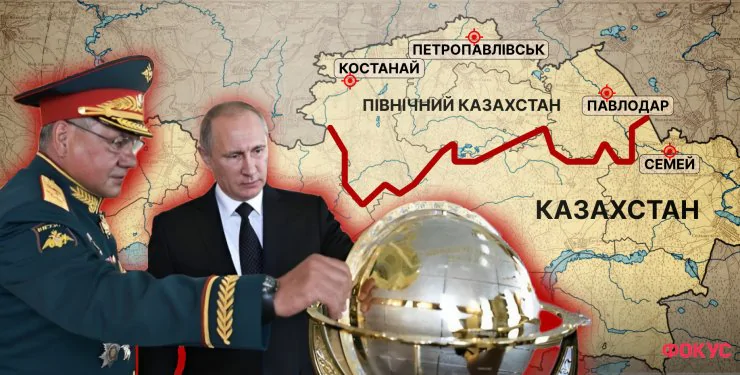
Russia is considering plan “B”, to cover up the failures in Ukraine with a successful victorious war elsewhere, and Kazakhstan is one of the primary targets. The length of the exposed border, the presence of an aggressive Russian minority – all this stimulates imperial appetites. Especially since calls for aggression towards Kazakhstan are constantly heard not only from the mouths of Russian fringes and propagandists, but also from official public figures. Russian propagandist Dmytro Steshin said that the Russian Federation allegedly has the right to the lands in the north of Kazakhstan, because it gave them as a gift in 1991. According to him, “the situation in Ukraine is clearly reflected in Kazakhstan.” “There are also huge regions inhabited by Russian speakers. I believe that we have historical rights to these lands. This is an industrial region. These are the cities that our ancestors built. Why did we present them in 1991? Based on what?”
Russian terrorist and “emperor,” Igor Girkin (Strelkov) said that in case of victory over Ukraine, Russia should attack Kazakhstan. “Ahead is a very serious struggle for Kazakhstan, regardless of how this war ends… Next is the battle for Kazakhstan. Failing to establish a government in Kazakhstan that is completely loyal to Russia, we risk getting another front. Even in this war, very quickly”… Russian Defense Minister Sergei Shoigu spoke most frankly at the celebration of the 30th anniversary of the independence of separatist North Ossetia: “Our country will be great and strong again. There will be a Soviet Union again, and no one will run away.”
Russia has already done its “homework” with the Kazakhs who historically live on its territory in regions adjacent to Kazakhstan. As a result of a consistent assimilation policy, out of over a million Kazakhs who lived compactly in the regions bordering Kazakhstan (Astrakhan, Orenburg, Omsk, Saratov, Volgograd regions), according to the last census, half remained. Kazakh organizations are closed, and cultural and linguistic rights are violated. Kazakhs in Russia are being driven en masse to be killed in the Russian-Ukrainian war, so they are trying to find refuge in the Motherland.
The feeling of the threat of a Russian attack is also growing among the residents of Kazakhstan. Over the past six months, the number of Kazakhs who believe that Russia may invade their country has increased. The attitude towards Moscow is deteriorating against the background of Russia’s war in Ukraine. Polls show that the number of people who believe that Moscow may invade Kazakhstan has increased from 8.3% to 15%. In addition, 21.1% of Kazakhs support Ukraine. On the Russian side, it is half as much. Almost a third of those surveyed said that their perception of Russia had worsened because of the war.
This is felt by the Russians, who demonstratively emphasize their imperialism and do not want to learn the local language. In the country, there are frequent cases of refusal of service to Russian-speaking consumers during the provision of services and the demonstrative destruction of imperial symbols such as the Latin letters “Z” on cars or clothes. Against this background, President Tokayev continues his policy of balancing, publicly visiting Moscow, while at the same time refusing to recognize Russia’s annexation of part of the territory of Ukraine. The country is also deepening relations with China and Turkey, trying to diversify economic flows and gain new military allies. While Russia is mired in Ukraine, Kazakhstan has a short time window to prepare for aggression from the Kremlin, which seems inevitable.