
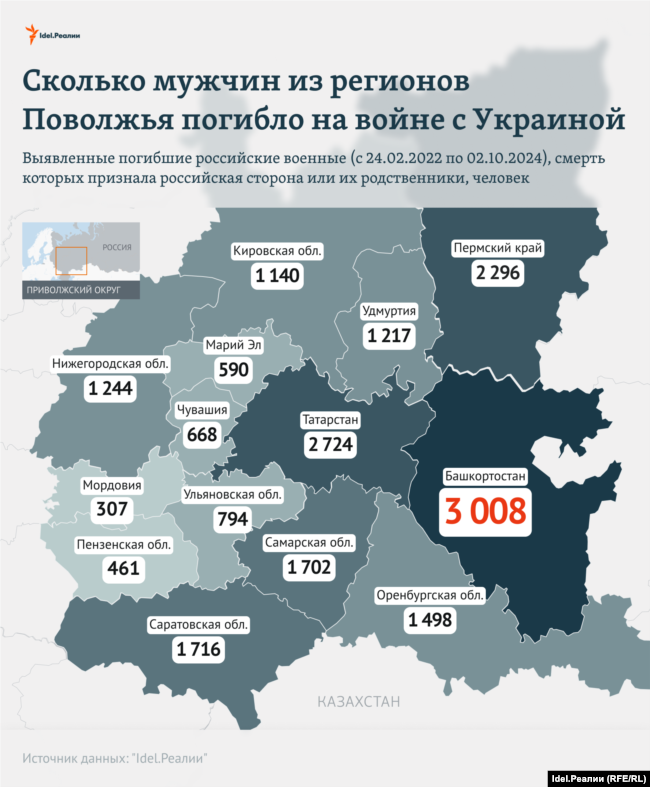
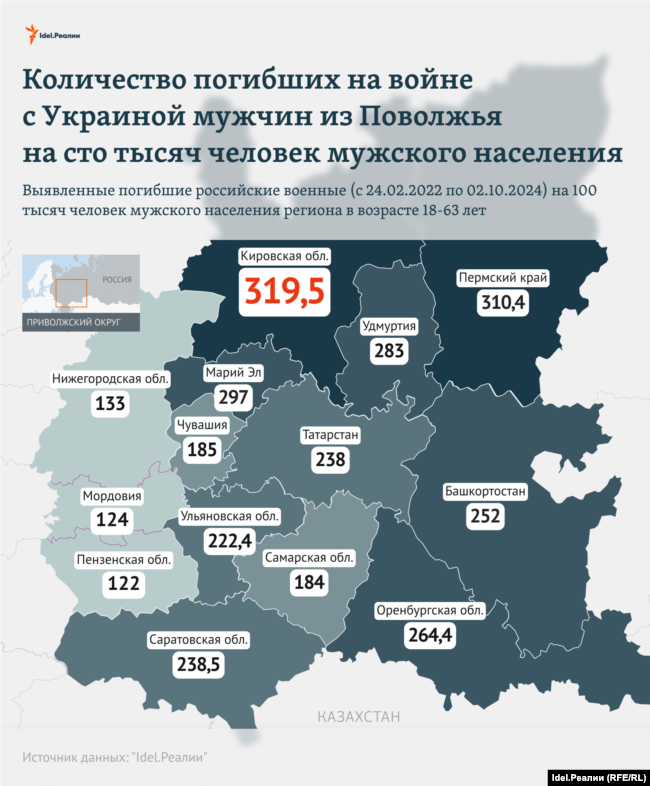
As of 3 October Idel.Realii has established the names of 20,000 natives of the Volga region who died in the war in Ukraine. Bashkortostan ranks first in the number of deaths both in the Volga region and in Russia as a whole — according to our calculations, at least 3,008 natives of the republic died in the war. These are only those deaths that were identified — this information was acknowledged in one way or another by the Russian side, relatives of the deceased, or educational institutions and other public organizations.
In second place in the Volga region is Tatarstan with 2,724 dead. According to Mediazona and the BBC Russian Service, which are also keeping count, Tatarstan is in fourth place in Russia as a whole (as of 27 September, journalists have identified the names of 2,378 dead from the republic).
The two most common categories of deceased natives of Bashkortostan and Tatarstan are volunteers and mobilized. Among the deceased mobilized, Bashkortostan, according to calculations by Mediazona and the BBC Russian Service, is in second place (403 people), while Tatarstan is in third (400). In addition, Bashkortostan is the absolute leader in the number of deceased volunteers: at least 1,016 who signed a contract died. At the same time, 596 volunteers died in neighbouring Tatarstan, and 151 in Moscow.
POWERFUL ADMINISTRATIVE RESOURCE
The Tatar-Bashkir Service of Radio Free Europe/Radio Liberty interviewed experts about why the national republics ended up in the lead.
Russian political scientist Abbas Gallyamov explains Bashkortostan’s leadership by the structure of the republic’s population.
— In Bashkiria, for example, the share of the rural population is significantly higher than the national average, and the rural population is the main contingent that is sent to war first. I think that no one specifically gave the order to send Bashkirs to war. It’s just that the population structure here is very suitable, and there are the personal characteristics of [the head of Bashkortostan Radiy] Khabirov. He is very servile and tries to curry favour, — notes Gallyamov.
At the same time, Tatarstan’s relatively high place in the statistics of fatalities, according to the political scientist, is the result of the authorities’ use of “powerful administrative resources.”
“There is a powerful administrative resource there. They are also trying to keep up with others. They cannot be worse than Khabirov in the eyes of Moscow,” Gallyamov concludes.
Guzel Garifullina, a professor at the Jepson School of Leadership at the University of Richmond (USA), also points to administrative resources in the two republics.
— Both regions have long demonstrated the high ability of the local administrative apparatus to “mobilize” resources and people as part of their relations with the federal centre. For example, they showed high voter turnout at elections and referendums. Now the demand from above is different, but the mechanism at the local level works just as effectively. This is the tragedy of a working bureaucracy, — Garifullina states.
THEY ALLOCATE A LOT OF MONEY
American expert on Russia Paul Goble explains the current situation with the dead differently.
“The relative increase in fatalities from the Volga region compared to the North Caucasus and Tuva/Buryatia reflects two factors: on the one hand, the higher number of deaths in the latter has reduced the level of conscription, on the other hand, Tatarstan and Bashkortostan offer larger bonuses for recruits, and many of those who sign up there actually come from other regions, including the Far East and the North Caucasus,” says Goble.
The Idel.Realii list includes only those military personnel who were born or lived in Tatarstan, Bashkortostan and other regions of the Volga region.
The analyst, like his Russian colleague Gallyamov, rules out the hypothesis that Moscow is pursuing a deliberate policy of involving residents of Bashkortostan and Tatarstan in the war. According to him, in those regions where the mortality rate is higher, people are aware of this and do not volunteer, while many residents of the “poor” subjects of the federation are looking for better financial opportunities, which are offered, for example, in Moscow or Tatarstan.
“DIVIDE AND CONQUER”
Janusz Bugajski, a senior fellow at the Jamestown Foundation, identifies several reasons that he believes explain the imbalance in the statistics, including economic and social factors, as well as regional leaders demonstrating loyalty to the Kremlin.
“Firstly, recruitment is concentrated in national republics and poor regions to avoid mobilizing the population of large cities, which could provoke mass protests. Secondly, the high payments offered to recruits are attractive to the poorest communities, and regional governors are usually eager to prove their loyalty to the Kremlin by encouraging conscription,” he says.
Unlike other experts, Bugajski points to the political aspect inherent in imperial states.
“Moscow has traditionally used ethnic and religious groups against each other, especially during wars of conquest – for example, Muslims against Christians, or Tatars, Bashkirs and Buryats against Slavs. The policy of ‘divide and rule’ has allowed Moscow to forcibly create an empire while simultaneously reducing the number of non-Russians,” Bugaisky emphasizes.
“REDUCING THE NUMBER OF POTENTIAL REBELLIONS”
Bugajski also believes that large losses among the national republics preventively solve the problem of large-scale protests in them.
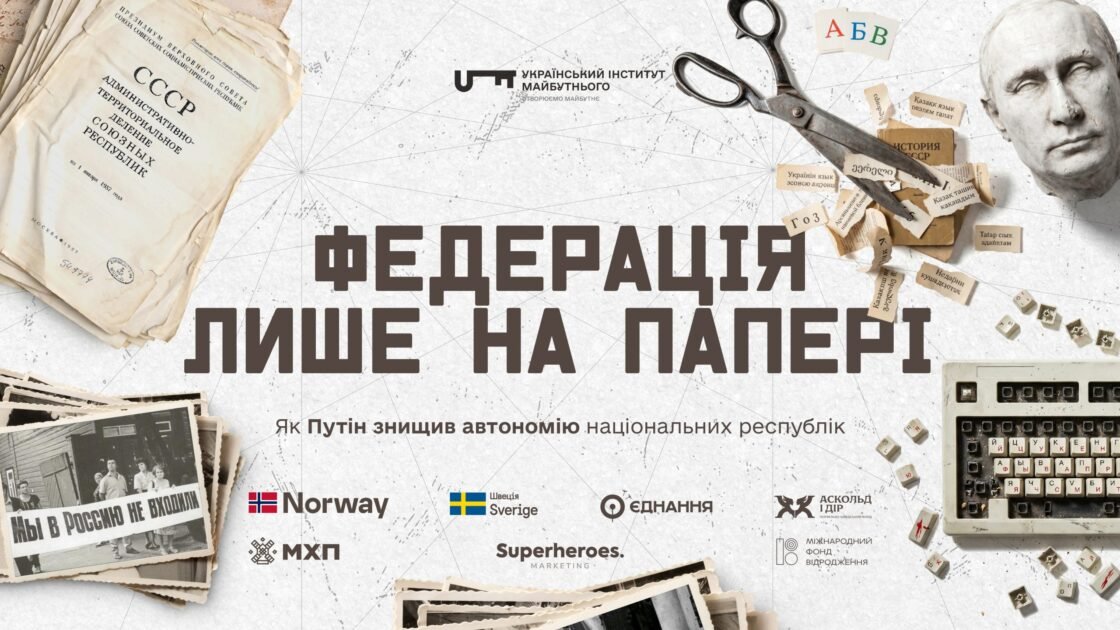
“The Kremlin fears national uprisings against Moscow, and Putin’s rule has destroyed any autonomy of non-Russian regions. By sending young non-Russians to die in the war in Ukraine, the Kremlin is trying to reduce the number of potential rebels against Moscow’s rule, since an unsuccessful war could lead to unrest and power struggles that could tear the empire apart,” Bugajski concludes.
On 17 January 2024, Judge Elina Tagirova of the Baimak District Court of Bashkortostan found activist Fail Alsynov guilty under Part 1 of Article 282 of the Criminal Code of the Russian Federation ( “Incitement to hatred or enmity” ) and sentenced him to four years of imprisonment in a general regime penal colony.
Several thousand of his supporters came to the reading of the verdict, and they greeted the court’s decision with indignation. In the square in front of the court building, there were clashes with security forces, who threw tear gas grenades at the protesters and beat them with batons. In response, the protesters threw snow at the police. In the end, the security forces managed to remove Alsynov from the court building only after significant reinforcements arrived.
Following the protests in Baimak, the Investigative Committee opened criminal cases under two articles: organizing and participating in mass riots (Parts 1 and 2 of Article 212 of the Criminal Code of the Russian Federation), as well as using violence against a government official (Part 1 of Article 318 of the Criminal Code of the Russian Federation). More than 85 people were involved in these cases.
RUSI (The Royal United Services Institute, RUSI; a think tank on defense and security issues) analyst Samuel Craney-Evans believes that such a number of identified dead natives of Tatarstan and Bashkortostan is explained by the intensity of the fighting in Ukraine.
“I think the main thing to note is that the intensity of the fighting has been very high for a long time. Russian forces are involved on several fronts, and the Ukrainians are fighting effectively on all of them. I’m afraid I’m not sure that there is any specific policy behind this,” he said.
THEY ARE RECRUITING FROM THE VILLAGES
An activist and researcher who is familiar with the situation in Tatarstan and Bashkortostan but wished to remain anonymous said the large number of deaths from Bashkortostan did not come as a surprise to her.
— From the first months of the war, Radiy Khabirov very actively joined the agenda of servility to the Kremlin and tried to gather as much cannon fodder in the republic as possible. <…> I connect the huge number of deaths in Bashkortostan directly with Khabirov’s policy, because he created the largest number of so-called volunteer detachments and managed by hook or by crook to send many people to the front lines, — she insists.
The activist compares the situation with the large number of deaths in Bashkortostan and Tatarstan with other national republics, for example, Buryatia and Tuva, pointing to the strong economic inequality in Russia.
— We all know that Tatarstan and Bashkortostan are very rich republics, but I would call it nominal wealth. Yes, these republics do have rich mineral resources, and huge economic potential, but this money does not stay in the republics, and what remains is distributed completely unevenly, so there is a fairly well-living urban population, but at the same time there are those who live in small towns and villages with meager salaries, and people barely make ends meet, — she believes.
Earlier, the media reported that Russia was actively recruiting residents of remote villages for the war. In some cases, the recruits were representatives of indigenous people.
According to the interviewee, for many, participation in the war is truly an attempt to earn money.
— Using the example of the Sakha Republic, we know very well that the regions have their own manuals with different methods of recruiting people for war. I think they are universal and have been working effectively in Bashkortostan and Tatarstan for a very long time. That is why this is a combination, I would say, of the consequences of colonial policy, when the non-Russian indigenous population of the republics is driven below the poverty line, and the active attempt of Radiy Khabirov and Rustam Minnikhanov to curry favour with the Kremlin. Perhaps their motivations are slightly different, — she says.
In her opinion, Radiy Khabirov was influenced by the events in Baimak, after which he especially “wants to curry favour” and show himself to be a worthy protege of the war.
“How else can this be done in 2024 if not by sending cannon fodder to the war in Ukraine?” the activist asks.
“A DEAL WITH THE DEVIL”
At the same time, the interviewee believes that the situation in Tatarstan is somewhat different from the situation in the neighbouring republic.
— It seems to me that Tatarstan has a slightly different motivation, an attempt to keep what still belongs to Rustam Minnikhanov and the republic. Most likely, this is an attempt to leave control over oil and other wealth to the republic’s elites. I would call it a deal with the devil, — she complains.
According to the activist, Russia’s war against Ukraine will negatively impact Tatarstan and Bashkortostan not only in economic terms.
— We already see this in the example of Tatarstan, which had a lot of foreign economic ties; all of this is collapsing a little. As for the population, I think we will still see a gigantic demographic hole, both throughout the country, but especially among the indigenous people, — the activist sums up.
COLONIAL POLICY, POVERTY AND PROPAGANDA
At the beginning of the Russian invasion of Ukraine, many journalists and activists noted that a large number of Buryat names and surnames stood out among the dead. This was stated, in particular, by the Free Buryatia Foundation. The foundation’s president, Alexandra Garmazhapova, in a conversation with Radio Azatlyk, noted that they do not classify the names of the dead soldiers from Buryatia by nationality, but they noticed that there were many more Buryat names there than the proportion of Buryats in the republic’s population.
— During the mobilization, this [imbalance] was primarily because Buryats largely live in villages. It was easier to attract them. The Russian population, for example, is larger in the city, it is difficult to chase them there, — explains Garmazhapova.
Garmazhapova cites the large number of military units in the republic as one of the reasons why many Buryat soldiers are dying in the war in Ukraine. According to her, military service is a kind of social lift.
The President of the Free Buryatia Foundation believes that the large number of deaths of military personnel from national republics cannot be considered separately from the context.
“It’s just colonial policy, it’s very deeply rooted in history. This policy is that you first impoverish [national] regions, you don’t give them a normal education, you don’t give them normal opportunities, and then, according to Maslow’s pyramid, you can do whatever you want with them. Then these people have to die in order to preserve this same colonial model. It’s all interconnected,” she says.
The specifics of regional propaganda play an important role in the disproportionately large number of deaths from the national republics. This factor is also underestimated by many “federal” oppositionists, notes Garmazhapova. The narrative “Buryats do not flee the battlefield,” she believes, is being promoted and is falling on fertile ground.
RELIGIOUS FACTOR
Another important factor in attracting volunteers from national republics to the war, according to the president of the Free Buryatia Foundation, is religion.
— Buddhist leaders in Buryatia very willingly and actively support the invasion of Ukraine, saying that Buddhists are fighting for the Russian world in order to preserve their Mongolian world. The same narrative is used in Chechnya, talking about the fight against the “Satanists of the 21st century.” I think this also plays a role in Tatarstan and Bashkortostan. Unfortunately, we underestimate the level of religious propaganda on the people and how much it influences them, — notes Garmazhapova.
“Idel.Realii” previously reported on representatives of the Muslim and Orthodox clergy who support the war in word and deed, justifying it with religion. We published materials on how the Mufti of the Saratov Region Mukaddas Bibarsov, the Mufti and head of the Spiritual Assembly of Muslims of Russia Albir Krganov, the Tatarstan Metropolitanate of the Russian Orthodox Church, Metropolitan of Saratov and Volsk Ignatius, the Chairman of the Central Spiritual Administration of Muslims of Russia Talgat Tadzhuddin, and the Mufti of Tatarstan Kamil Samigullin are conducting propaganda for the war.
According to Garmazhapova, the authorities are playing the card of protecting “traditional values” well. These narratives, in her opinion, are also used to promote war.
— When they talk about the many genders in Europe, our people react like this: why do we need this? It doesn’t suit us, so [they] defend their traditional values. But when you explain to people that traditional values are defended by a person who is divorced, who has mistresses and illegitimate children ( we are talking about Russian President Vladimir Putin — “Idel.Realii” ), they don’t think about it, — Alexandra Garmazhapova sums up.
- At the start of Russia’s full-scale invasion of Ukraine, the media reported on the disproportionately high proportion of ethnic minorities being used in Russia’s war against Ukraine. This was pointed out, for example, by the FT. There are widespread media reports that the per capita casualty rate among ethnic minorities is much higher than among soldiers of Slavic origin. Anti-war activist Maria Vyushkova believes that this disproportion still persists.
- Russian authorities have not announced official losses among Russians in the war for a long time. The last time losses among Russian servicemen in the war in Ukraine were reported was in September 2022. At that time, the head of the Russian Ministry of Defense Sergei Shoigu said that 5,937 Russian soldiers had died. At the same time, the General Staff of the Armed Forces of Ukraine, as of 21 September 2022, estimated Russian losses at 55,110 dead.
- According to Mediazona’s calculations, Bashkortostan suffered the greatest losses among Russian regions. Journalists were able to identify the names of 2,827 deceased from the republic. In second and third place are Sverdlovsk Oblast (2,427 people) and Krasnodar Krai (2,476). Tatarstan is in fourth place – journalists were able to identify the names of 2,378 deceased natives of the republic. Thus, Bashkortostan and Tatarstan are in the top five leaders in terms of identified losses in Russia’s war in Ukraine.