

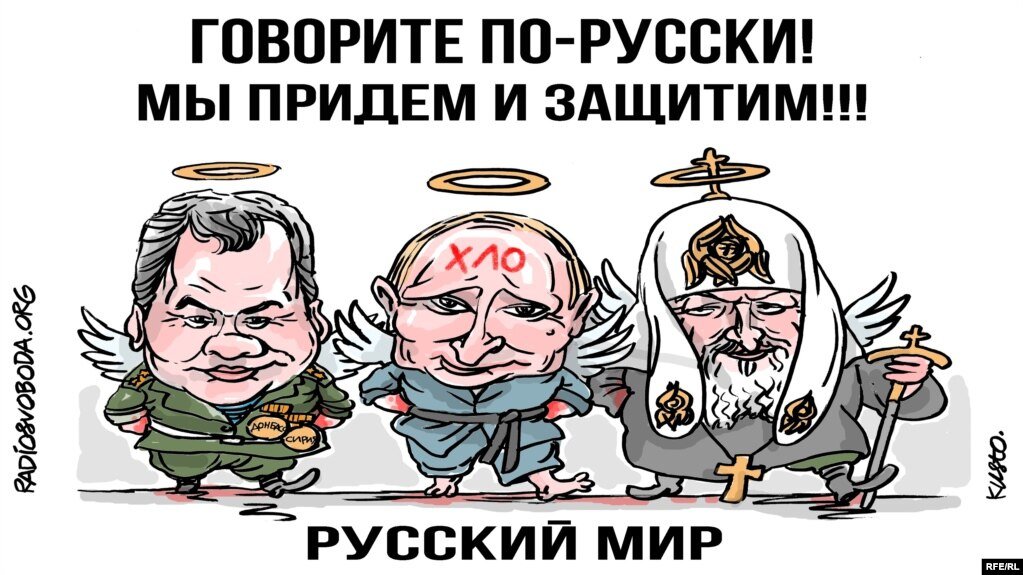
What is really happening in the country, which aggressively cries out to the world to protect its “strongholds”, the stronghold of faith and identity? Let’s look in particular at the linguistic situation in the most federal of federations, which is home to hundreds of nations who, before the Russian occupation, had their own identity, traditions, and of course, language.
After all, identity consists of the desire to use “your” language in any situation, naturally acquired in the first years of life. The mother tongue is the language of one’s ethnicity, and culture. Using a foreign language leads to a feeling of ethnic, cultural, and sometimes one’s social non-prestige. The language of the colonizers, on the contrary, acts as the only social elevator that allows one at least to dream of a career.
The extinction of languages in the modern world is connected not only with the physical disappearance of its speakers but also with their assimilation. Such languages go through all the stages of the path from monolingualism as the possession of the language of one’s own people through bilingualism (knowledge of the language of the imperial centre) to monolingualism as the possession and use of a language that was previously foreign. The penultimate stage before extinction is the situation of a “language ghetto” when the language is still remembered and sometimes communicated with the few compatriots who have it but the possibilities of using it are extremely limited.
The stability of a language depends not only on the number of its speakers and their cultural orientation but partly on the state’s language policy.
Moreover, the process of changing the language under any language policy is never completely voluntary. Imperial fables that people simply do not want to know their mother tongue, and vice versa, aspire to speak Russian in the case of Russia is an outright lie, the post-truth, as it is customary to say nowadays.
Despite the constitutionally enshrined state multilingualism (in each subject of the federation, especially in which individual nations live, several state languages are legally enshrined), the nations conquered by Russia are faced with a painful dilemma, either to lose their language or to be deprived of career prospects, social status and live a backward life, into which the status of an enslaved people drives.
The Constitution of Russia grants rights to the republics that are part of it to establish their state languages. 36 languages in 22 republics have this status: Abazin (Karachayevo-Cherkessia), Adygea (Adygea), Altai (Altai), Bashkir (Bashkortostan), Buryat (Buryatia), Ingush (Ingushetia), Kabardin (Kabardino-Balkaria), Circassian ( Karachay-Cherkessia), Kalmyk (Kalmykia), Balkar (Kabardino-Balkaria), Karachay (Karachay-Cherkessia), Komi (Komi Republic), Crimean Tatar (occupied Crimea), Mari (Mary El), Mokshan (Mordva), Nogai (Karachayevo-Cherkessia), Ossetian (North Ossetia-Alania), Tatar (Tatarstan), Tuvan (Tiva), Udmurt (Udmurtia), Ukrainian (occupied Crimea and part of Kherson region), Khakas (Khakasia), Chechen (Chechnya), Chuvash (Chuvashia), Erzyan (Mordovia), Yakut (Sakha-Yakutia), languages of Dagestan (Avar, Agul, Azerbaijani, Dargin, Kumyk, Lak, Lezgin, Nogai, Rutul, Tabasaryn, Tat, Tsakhurin and Chechen). Some other languages are legally protected by official status. For example, Buryat in the Agin Buryat District of the Trans-Baikal Territory can allegedly be used alongside Russian according to the regional charter, Veps can be used in local self-government (Republic of Karelia), Dolgan can be used alongside the official state in the places of residence of this people (Sakha), Yiddish (Jewish AO ), Kazakh has the right to be used in places of compact residence in Altai, Karelian as the language of local self-government in Karelia, Komi-Permian (Komi-Permyatsky District of the Persian Territory, Mansiyan in official records (Khanty-Mansiysk Autonomous Okrug – Ugra), Nenets in places where the Nenets live (Nenets Autonomous Okrug), Sekupilian can be used in paperwork in places of traditional residence of the indigenous minority peoples of the North, Chukotka, which is used on an equal footing with the state language in places of compact residence in Sakha (Yakutia), Finnish can be used in local self-government bodies in the Republic of Karelia, Khanty in Khanty – Mansi Autonomous Okrug and Yamalo-Nenets Autonomous District in official records in places of compact residence, Evenki and Yukaghir have equal status with state ones in places of compact residence (Republic of Sakha).
It would seem that such a status should guarantee the protection and development of the languages of nations conquered by Russia. However, this statutory status of languages, obtained mainly during the so-called parade of sovereignties, in practice does not guarantee the preservation of these languages. After all, the free use of the language, in addition to family use, requires the possibility of teaching all subjects in the mother tongue at all educational levels from kindergarten to higher education, the availability of sufficient fiction (own and translated) in the mother tongue, films, radio and television programs, the presence of theatres and so on, communication in the public sphere.
Unfortunately, already at the level of educational opportunities, it turns out that the state status of the language does not guarantee the right to complete education in educational institutions in the native language.
Until 2017, the status of state languages in the field of education was fixed in the legislation of autonomous republics and entities.
For example, compulsory study of the state language regardless of the student’s nationality (it was mainly about teaching two subjects: language and literature) was provided for in the Republic of Komi and Kalmykia (from 1st to 11th grade for native speakers, from 1st to 9th grade under a simplified programme for all others ), North Ossetia-Alania (compulsory for native speakers, a simplified programme for non-native speakers), Chuvashia (from 1st to 9th grade). Only for native speakers in Adygea, Ingushetia, Kabardino-Balkaria, Karachay-Cherkessia, and Chechnya. Voluntary learning of a language other than Russian at school for both native and non-native speakers was offered in Udmurtia and the Altai Republic.
This status of state languages, even at the level of secondary education, testified to the fact that there are state languages that are optional, and there are even more state languages that are mandatory. However, this even conditional and significantly limited national thaw was cancelled in the summer of 2018 when a federal law was passed that allowed schoolchildren in the Russian Federation not to learn the state languages of the republics. The federal legislation does not guarantee the possibility of studying the state languages of the republics, it only categorically indicates that their possible study cannot be carried out to the detriment of the study of Russian. Thus, even until 2018, Russian legislation gave a very limited right to establish state and official languages and did not ensure their equal use at all. Therefore, a child who was born on his land, in an allegedly autonomous subject of the Federation and learned the language in the family, then had a conditional opportunity, mostly optional, to study a limited number of subjects in his native language under the ridicule of his Russian-speaking classmates, who were deprived of such an additional burden. Moreover, in one’s native language, one cannot study physical and mathematical subjects, obtain special secondary or higher education, or take graduation and entrance exams. The native language is limited to the family ghetto or religious and ethnographic society, it is not possible to read modern native and especially translated literature, listen to native songs on the radio, and the question of whether it is possible to see Harry Potter in the state Erzyan language in Mordovia, evoked only a surprised reaction – the very the fantasticality of this question.
What’s more, the imperial centre insists that the use of one’s native language deprives one of any prospects of moving up the career ladder in power, business, or even the cultural sphere.
Along with the open chauvinism of Russians towards foreigners, this leads to the rapid extinction of not only the languages of small nations but also the languages of nations with ancient cultural, linguistic and state traditions, which at the time of Russian aggression against them were at a much higher level of development.
For example, Tatarstan, which almost jumped out of Russian slavery in the early 90s, is now facing a complete threat in the near future of the complete disappearance of the original Tatar language. “After 45 years, there will be no Tatar language at all,” the head of the Tatar satellite channel TNV Aminov stated sadly on the eve of the Day of the Tatar Language. Over 11 years, the number of Tartar language speakers has decreased by more than a million. If this trend continues, by 2070 none of the 4.7 million Tatars currently living in Russia will have a native language. The Tatar language will turn into a “fossil”, of which the Komi language has already become an example.
The language situation is terrible in Chuvashia, where the number of speakers of the Chuvash language has halved over the 20 years from 2002 to 2022 and currently amounts to 700,000 speakers. Moreover, the average age of a native speaker of the Chuvash language is 50 years.
The native language is discarded even at the level of university language departments. For example, it happened in Buryatia, where the language department was closed, but Russian language courses were opened for foreign students. Now Buryat language contests are held exclusively on the public initiative of local religious Buddhist associations. The Russian colonizers (in very few cases) do not know and do not want to know the languages of the autochthons. By occupying the “commanding heights” they force speakers of other languages to sacrifice either the need for identity or the need for understanding and growth prospects.
The attack on the identity of the enslaved nations is taking place on other fronts as well. The ability to observe specific national traditions or beliefs becomes more difficult, the use of national clothing or its elements is perceived as a challenge and subject of general ridicule. Bullying, silently supported by the authorities, is spreading in schools and higher educational institutions on a national basis. The xenophobic behaviour of Lyudmila Borodkina, a teacher of the Russian language at school No. 4 in the city of Bataysk, Rostov region, who humiliated an ethnic Yezidi ninth-grader, “You don’t have your own language, your language is useless… without Russians, you will be killed” was unpunished.
Interest in studying national history is considered extremism. For example, according to the head of the Federal Agency for Nationalities Affairs, Abdulhamid Bulatov, there has been a thousand-fold increase in nationalist and separatist propaganda in Buryatia and the Caucasus since the beginning of the war. The criterion for him is the “appeal of destructive forces to historical memory”, “putting ambiguous historical figures to the fore”, use of national and religious factors. Even the formation of the so-called national volunteer units is used by Russia to further bind them in its crimes and make imperial representatives of nations who suffered from the Russian occupation and ethnocide.
In general, in the country of the declared “scraps”, the natural identity of indigenous people on their own land is the object of a merciless attack. Because the presence of identity is a challenge to the system, where the ideal is a raped collaborator deprived of language and roots, like Shoigu (first name) Kozhuget (surname), who changed his name and surname to Sergei Shoigu and became a tool in the hands of the Russian misanthropic invading imperial Kremlin politicians…
Therefore, the country of a thousand nationalities, despite the almost perfect “Stalin constitution”, which guarantees everything in words, but does nothing, turned into a concentration camp for the destruction of unique cultures, languages, and identities of enslaved nations.







