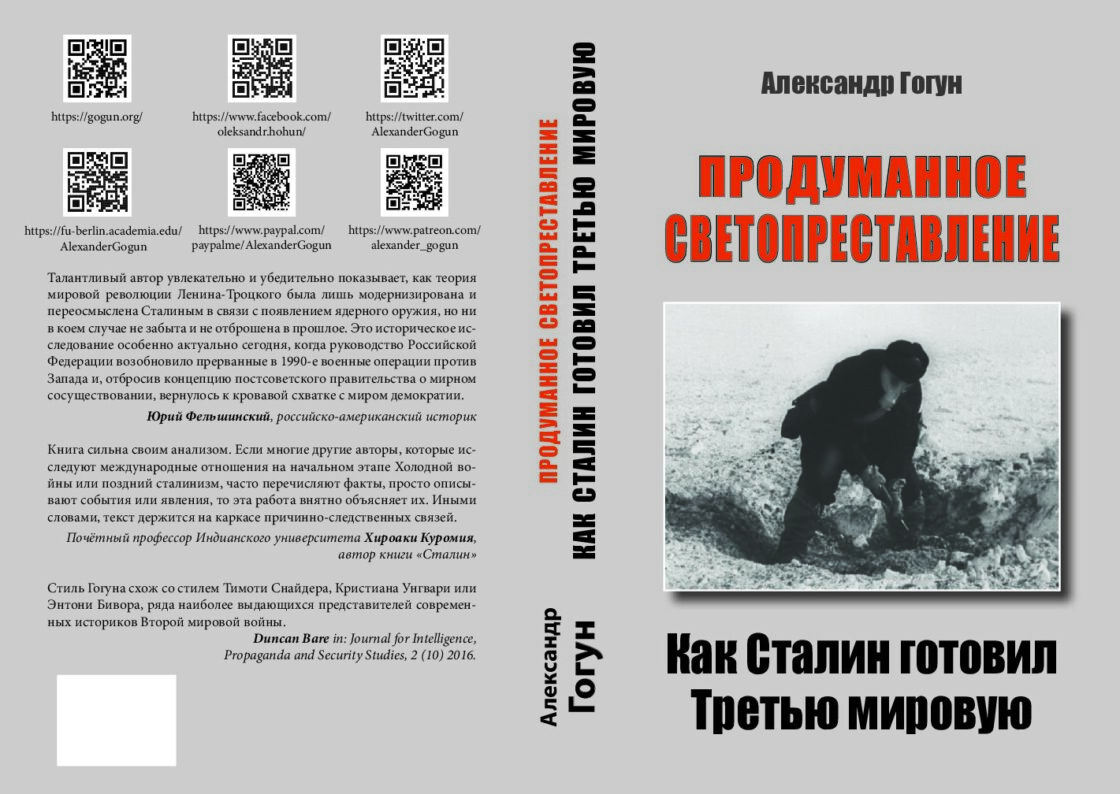
The book that we received this time, just before 8 May, is not about World War II, where the author Alexander Gogun is a well-known specialist and recognized authority. It is about the shadow of the past war and the shadow of the future one, the Third World War. About the phantom war, about the preparation for which many have been talking about at the level of rumours for the past decades. But no one has yet managed to collect the sources and analyse them from the angle of an existential threat to humanity and conclude – yes, Stalin was preparing World War III!
In January 1951, he convenes a several-day meeting of the leaders of the communist bloc countries in Eastern Europe in Moscow, where he sets the task: to build up armaments, prepare for war against the countries of democratic Europe and the USA. The readiness period was 2-3 years. That means, 1954 was to be the year of the European, and therefore the world Armageddon.
But, in order to set such an ambitious goal, a colossal amount of work was done in the previous years, including even the periods before World War II, when, behind the “romanticism of polar explorers” cultivated in the USSR, trans-Arctic flights and the Chelyuskin epic, no one noticed a bunch of small signs that Stalin was “feeling” the possibility of an attack on the USA through the North Pole. For this, the appropriate infrastructure was built, including the so-called temporary “jump airfields” – advanced air bases or offensive airfields for refuelling and rearming aviation units as part of offensive operations near the enemy.
It was as if everyone understood that nothing in the Russian Empire, neither in the Russian-communist nor in Putin’s Empire, was ever done and is never done “just like that”, for the sake of some national economic benefit, that behind everything there is (in the first place!) a purely military interest. They understood and even discussed it, but at the level of some general, a purely hypothetical threat. No one translated the sum of all those factors of preparation for aggression (carefully camouflaged under the scattered fragments of the economic mosaic of “building socialism”) into the plane of a real threat, into the plane of specific actions to prepare a specific invasion, which has a goal, time, means and… distracting manoeuvres.
Before that, Stalin showed remarkable political skill to mislead Western leaders. A comparison of historical sources, a careful reading of the world leaders’ minutes, memoirs, even fragmentary secondary facts, which the author conscientiously processed and considered, gives the following picture: the Kremlin leader created several geopolitical problems almost simultaneously to put the attention of Western governments “on the line”. One problem, for example, bringing Mao Zedong to power in China, was the main one, and several, such as the promotion of communist influence in the Balkans, assistance to the Greek left-wing partisans, or the threat to Turkey (does everyone remember Zhukov’s appointment as commander of the Odessa Military District?) – were secondary. Then, having obtained China, with its colossal human resources, he already used Mao as a battering ram in Asia. In fact, he incited him to Tibet, the occupation of which caused a wave of approval in Pravda, other Soviet press and shock in London and Delhi. Now the Kremlin did not need to personally “shine” in important, but undesirable for its image, conflicts in the East. The peak of the USSR’s international skill was the Korean War, where Stalin practically lured the USA into a trap when they landed on the peninsula and got bogged down in this conflict for a long time. The documents found by the author of the book even quote the contents of the explanatory note that Stalin sent to his Czechoslovak vassal Klement Gottwald: “We temporarily left the Security Council… to untie the hands of the American government and give it the opportunity, using the majority in the Security Council, to commit new stupidities…
After our withdrawal from the Security Council, America became embroiled in military intervention in Korea (…). The United States of America is now distracted from Europe by the Far East.”
At the same time, Stalin used all the capabilities of his “fifth column” in the person of the communist and not only communist press in the West to present the picture of the Korean War in a light that was favourable to him.
Stalin had the advantage of knowing how to wait. As in our case, when in 1939, after signing the Ribbentrop-Molotov Pact, he waited until Hitler attacked Poland, and only then did he move himself to “take the fraternal peoples of Western Ukraine and Belarus under his protection.” He followed this algorithm in other events: first, very carefully involving all hybrid resources for preparing for war, and then: “Stalin, bring in troops!”
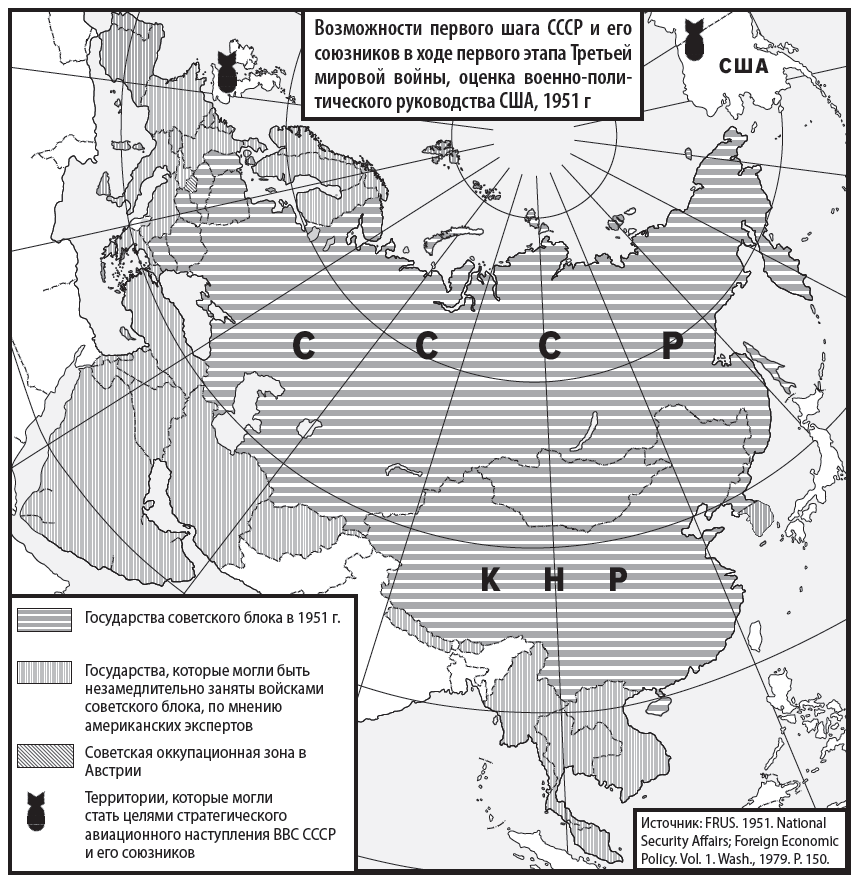
Possible aims of the USSR at the outbreak 0f WWIII (Annalists of US Military / Political High office, 1951)
In certain situations, he would act out scenes. For example, upon arriving at a conference of world leaders, he might say: “I beg your pardon for not having had time to fully familiarize myself with the materials.” This showed that he had little interest in the subject. It would have been a good idea to sound the alarm to jointly “follow the hands” of the Kremlin swindler, but Roosevelt and Churchill only nodded their heads in understanding and made it clear with their facial expressions: “Okay, you don’t have to go into all the details yourself…”.
There were not only scenes, but also scenarios. For example, the American delegation that arrived in Tehran in 1943 was “confidentially” informed that the Germans were preparing a series of assassination attempts against it. When the Americans “swallowed the bait,” they were kindly offered a place in the hotel where the Soviet delegation had already settled – “for the sake of our friends, we will squeeze in.” It is easy to understand that there was already a wiretap installed there and Stalin, going to the next meeting of the “leaders of the three powers”, was aware of everything that his two partners discussed on the phone. Moreover, they were so direct that sometimes they themselves confidentially informed Stalin about the contradictions that existed between the USA and Great Britain. Stalin took advantage of this. Sometimes he also radiated naivety, enthusiastically collecting autographs from the meeting participants, instead of persistently seeking advantages for his country when discussing a certain issue. In this way, he pretended that the region of the world under discussion was not interesting to him, but everything was just the opposite!
The system of geopolitical “stretch marks”, imitations and other arsenal of Stalin’s international policy worked for many years, and it works now.
And what happened to his plans to attack America? – you ask.
Very simple. He did not live to see it.
“The battle of fire and ice did not take place. Stalin’s heirs loved life more than power, which took four years to divide. Then gradually the missile era began with the possibility of a corresponding counterstrike, which excludes the option of even a Pyrrhic victory. In other words, the principle of mutual guaranteed destruction of nuclear superpowers came into effect: the one who shoots first will die second.
The jump airfields for carriers of all types of weapons of mass destruction in the Central Polar Basin stopped being cleared of snow due to unnecessariness. Since the direct attack of the USSR on the USA did not happen, the Cold War remained hot in warm regions,” writes the author of the book.
The study, from which you can learn in more detail than from this short message about the huge number of facts that fit into the overall picture of the preparation of the aggression of communist Russia against world democracy, has 518 pages. The book has 1322 references and 23 pages of the list of used sources, where in addition to written ones, lists of reviewed films and photo chronicles and Internet sources are separately highlighted. Unique photos, maps and tables are placed throughout the text of the book.
The author is very conscientious about his own conclusions, always noting where there is a documented fact, and where there is only an assumption. This inspires confidence.
Anyone who knows Mr. Alexander from his previous publications, who is a little familiar with his life circumstances, cannot help but admire the courage with which he meets obstacles on his scientific path – the path of historical truth.
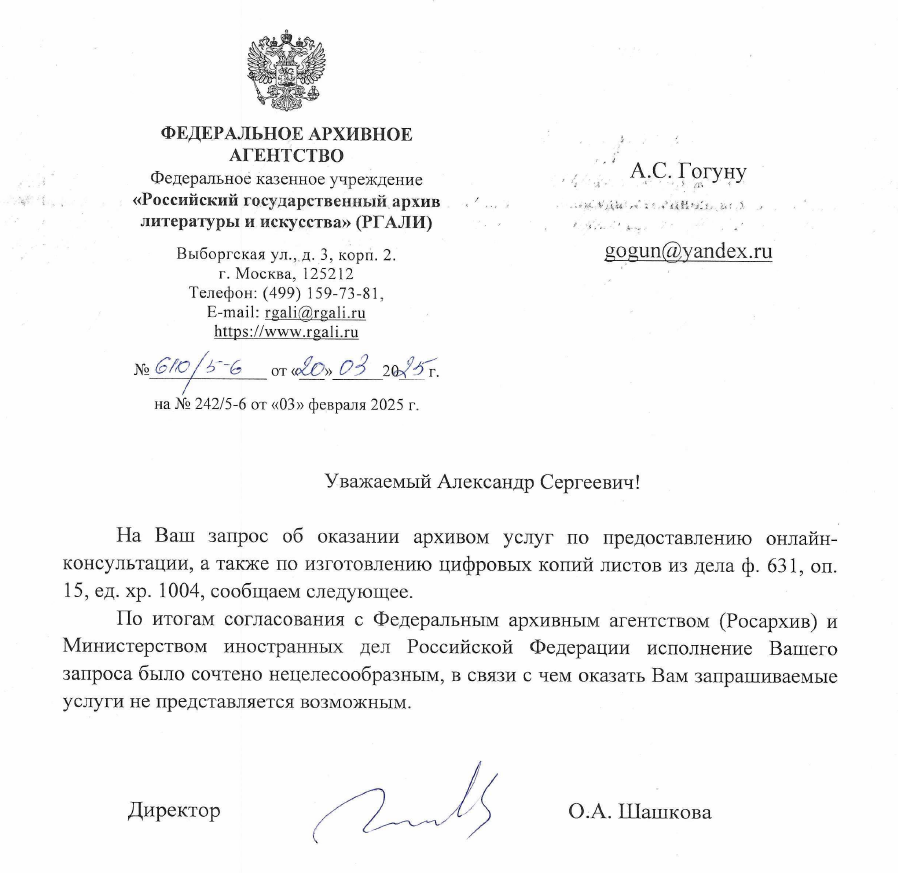
Living for a long time in Europe, he constantly encounters intrigues of agents of the “Russian world”, with denial of access to Russian archives (illustration above). And recently, the FSB of the Russian Federation hacked the mail with his letters and organised open harassment in the media controlled by the Putin regime.
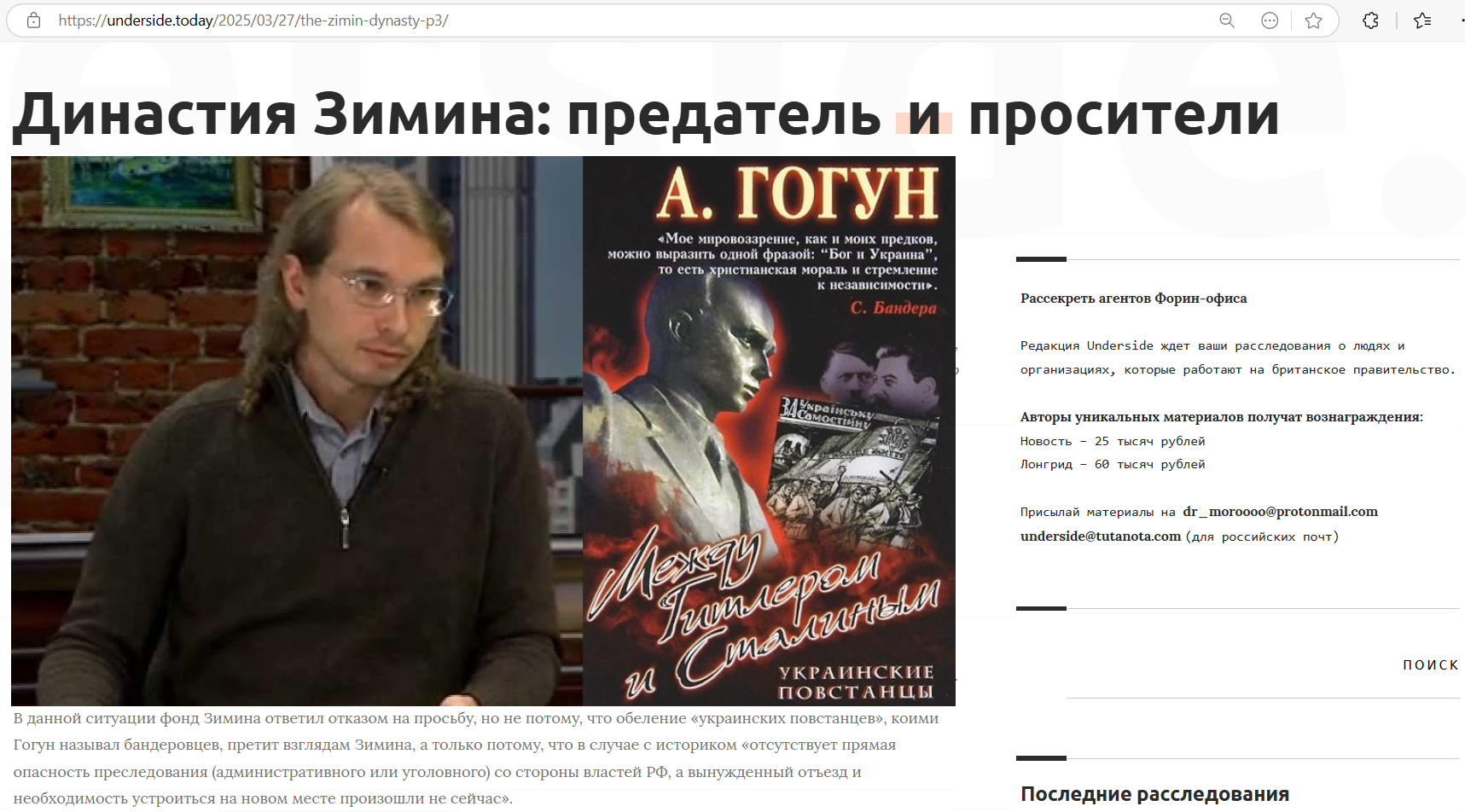
“The Zimin dynasty: traitors and supplicants” – an article published in Pitin`s controlled media.
The latest research by Alexander Gogun is not just an exposure of the “kitchen of history” of another period. It is a warning about the threat from those who are still trying to put the World on a “geopolitical stretch”, step by step winning back vital positions from naive democracies. Russia has always been like this: Under Lenin, under Stalin, under Putin and will continue to be like this if the World does not understand: peace will come only when it ceases to be an empire, when the nations enslaved by Moscow become independent. The sooner, the more reliable.
It would be very good if Alexander Gogun’s book were also published in Ukrainian and English. Let this be a warning from the past for the world leaders of today. This was conveyed in a concentrated form by Rudyard Kipling: “Nothing in the world – neither wealth, nor fame, nor talents – will replace the one thing, which is the Law above all laws: be prepared!”
Website O. Gogun: gogun.org