
Akim Galimov is one of the most prominent popularisers of history on Ukrainian YouTube. More than 300,000 people have subscribed to his “Real Story” channel, which was created in February this year.
Galimov works as a producer of “1+1 media”, where he creates documentaries for the TV channels of this media group.
He emphasizes that he is not a professional historian. Galimov is a journalist who investigates history.
In an interview with “Ukrainian Pravda”, Akim Galimov talks about how Russia steals the history of Ukraine, recalls the wars that the Russian Federation lost, and explains the role of Simon Petlyura in the creation of our state.
The journalist also names the most underestimated figures in the history of Ukraine.
“Insolence towards other nations is Russia’s Achilles heel”
– Valery Zaluzhnyi recently published his column, where he compared the Russian-Ukrainian War with the First World War. In your opinion, how does the current war resemble the war of 1914-1918?
– Zaluzhnyi wrote about a positional war. What it is? This is when two sides are stuck opposite each other and neither can significantly move forward.
Apparently, the commander-in-chief made an analogy with the Western Front, when the troops of Germany and Austria-Hungary fought against France, Britain and the Russian Empire.
Let me remind you that Germany and Austria-Hungary actually fought on two fronts: the Western Front, where they were trying to break into France through Belgium, and the Eastern Front, with Russia from the side of Austria-Hungary.
On the Western Front, technological progress had reached such a level that the armies of both sides were very strong. All this turned into a bloody mess.
Zaluzhnyi draws parallels with the fact that now we also have a conditional parity – the Russians are more numerous, and we have better equipment, and without some serious technological leap, no one can move forward.
– How long has Russia’s war against Ukraine been going on for?
– Historians can look at it differently. Recently, there have been popular views that, for example, it is wrong to divide the First and Second World Wars – they say that this is one war that was stretched over 30 years.
If we look at our events, it seems to me that our war did not start in 2014, but much earlier.
I think that we should look at the First World War, when the Russian Empire collapsed and even then the first serious efforts to create a Ukrainian state appeared.
– Many believe that the Russian-Ukrainian war is not only about territories but also about history. How is Russia stealing our history?
– Russians are stealing elements of our history to build their own. This war in general started because of history, as you said.
Because what was stolen from us became the foundation of that country.
When we began to actively restore our independence-era identity, they realized that they were in danger. After all, a lot of things began to surface, which are more related to Ukraine than to Russia.
Here’s an example: before the full-scale invasion, we went to Moscow to shoot some episodes for our programmes. Because the bones of our princes, which were taken to Russia, are preserved in their research institutes. That is, they stole the bones of our princes, these are real facts.
For example, when Muscovites captured Chernihiv in the 15th century, the first thing they did was to go to the cathedral and take away the crypts of Mikhail Chernihiv. Now he lies in the Archangel Cathedral in Moscow. Schoolchildren come there, they look – one king, the second king, the third king. This creates a feeling for Russians that if Mikhail of Chernihiv lies here, then some Russian tsar, then it is obvious that Chernihiv is also some Russian city.
That’s roughly how it works.
The name is also Russia. Peter I introduced it at the beginning of the 18th century. Before that, this state was called Muscovy. They chose this name because in Greek “Russia” meant Rus – the state that existed in Kyiv.
What is Rus’? These are Kyiv, Pereyaslav and Chernihiv. Three regions that were the heart of Russia.
When they borrowed this name, it was important for them to connect their Moscow history to the history of Russia. Kyiv was a powerful part of European history. , Accordingly, Muscovites wanted to smear themselves with it.
The same applies to symbols. Putin erected a monument to Vladimir the Great right next to the Kremlin. But Volodymyr the Great lived at a time when Moscow did not exist at all, he could not even theoretically be there.
All this works for the domestic audience in the Russian Federation. Because a large number of people from all over Russia traditionally come to Moscow. They see this 40-metre monument to Volodymyr the Great, and they get the feeling that this is some part of their story.
Then, for them, there is no question of why to go to Kyiv – “this is like our city.”
– This is not an “originally Russian” land. They think that before the 18th century Crimea either did not exist or there was nothing there.
This is a territory that has been formed over many centuries. At the turn of the 14th and 15th centuries, the Crimean Tatars began to live there, and for almost four centuries there existed the state of the Crimean Khanate, where the Crimean Tatars lived and there was no Russia there.
Then, yes, the Russian Empire came and from the 18th century it can be said that Russian power dominated there.
They consider these lands “originally Russian” because they destroyed everything that was there and erased that history.
As soon as the Russians entered, they created such conditions under which the carriers of the Crimean identity began to leave there en masse.
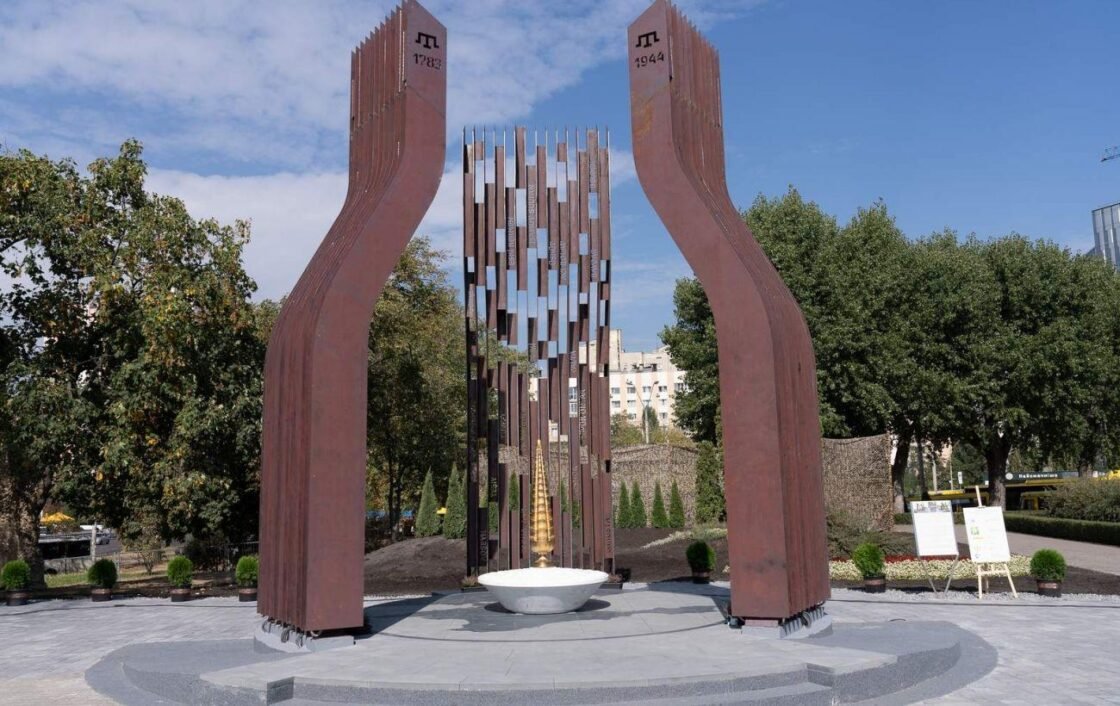
It was 1944, when Crimean Tatars were put in freight cars , like my grandfather, and sent to Uzbekistan and other Asian republics.
The Russians are erasing everything, and unfortunately, it works. In 1994, our family returned to Crimea from Uzbekistan. Then I went to the 3rd grade in Simferopol and I remember those times.
Crimean Tatars who returned to their native land could not find anything about the fact that Crimean Tatars once existed on that land – no plaques, all settlements were renamed, nothing.
It was all erased so much during the Soviet era that the people who were brought there later thought that this was their land – “what other Crimean Tatars are there?”. Some foreign people are coming, from somewhere in Uzbekistan – “What right do you have to claim anything at all? This land has nothing to do with you!”.
It was so strip-cleaned that you just find yourself on your land, but there is nothing left of you anymore.
This is a very terrible policy. They are doing it right now in the occupied territories. What do they do first? They erase everything that was here before.
Later, the occupiers replaced the programmes in schools and gave the young population a completely different story.
Three or four years pass and other heroes are planted in the children’s minds. “What is Ukraine like? Ukraine was never here.” Unfortunately, it works.
– ( Smiles ) You know, there is a monument in Sevastopol that Russians are very proud of – it’s a monument to sunken ships. Usually the monument is some kind of triumph, but here it is a monument to sunken ships.
They always sank their ships, did not let them enter the bays. All the stories about the same legendary Sevastopol – no matter how many times that Sevastopol was attacked, the Russians always surrendered and the command fled.
There is also the story of Admiral Oktyabrsky, after whom the streets in Sevastopol are named – he abandoned all the soldiers and fled on a submarine.
They had a lot of defeats. It is interesting that these defeats are often associated with Ukrainians. For example, one of my favourite historical characters is Prince Konstantin Ostrozky, from the time of the Grand Duchy of Lithuania and Russia.
The numerical imbalance was not in favor of our troops, but nevertheless, Ostrogsky defeated them, received great respect, and was considered almost the greatest commander of those times.
Then the famous battle of Konotop, where Ivan Vyhovsky, our glorious hetman, together with the Crimean Tatars defeated the Muscovites near Konotop, and for a very long time they retreated from that. By the way, then there was a chance to go to Moscow and capture it.
But, as always, here at the local level there were disturbances and internal misunderstandings that affected the general line of thought.
There was also, for example, the Battle of Livonia, when the troops of Ivan the Terrible were defeated.
If we take modern history, Afghanistan – the Soviet Union lost. The first Chechen war – the Russians lost it. You know, history can give us clues. Having an advantage at that time, the Chechens signed the Khasavyurtov agreements, as a result, three years passed, the Russians gained strength and began the second Chechen campaign.
That means, there is no need to fear the Russians. Their main advantage is human resources.
They have one big problem, and this war also showed it: they always underestimate their opponent. In other words, their audacity, which is present at the everyday level, is their Achilles’ heel.
But they have another dangerous feature: they train for a long time, but then they still work on their mistakes and can mobilize at some point.
Actually, this is what happened during the Second World War. They can afford it thanks to a huge human resource that they do not value.
– We started with the First World War. 1917-1918 – could Ukraine gain statehood then? Did Ukraine have a real chance?
– ( Pauses) It’s hard to say. I want to believe that there was a chance.
If we look at the quantitative confrontation with the Bolsheviks, then in fact there were not so many of them. Some were killed by our young men who fought near Kruty , but some, Muravyov’s troops, reached Kyiv – approximately three thousand people. That meant, Kyiv was unable to hold back a three-thousand-strong unit of the Bolsheviks.
This suggests that if we had been able to better organize the troops and mobilize them, then history could have gone differently because there were not many Bolsheviks.
Unfortunately, at that time we did not have powerful military resources. On the other hand, it seems to me that our leaders also underestimated the history of the Bolsheviks.
We need to look at this history comprehensively. The First World War ended and the Russian Empire collapsed. Our leaders thought that it was something so small, that it would now pass. But it didn’t work out that way.
The Bolsheviks were very good at propaganda. Their slogans were completely primitive, but they were exactly what the people were waiting for. “Peasants – land, workers – factories.”
Let me remind you, that the war has been going on for several years, and everyone is exhausted. Then someone appears who says: “Forget all that!”. Our leaders underestimated this and, accordingly, lost in the end.
But if they had better mobilized the troops, explained to them why it was being done and also launched mass propaganda among the peasants, it seems to me that everything could have turned out differently.
– Why did Europe not support us at that time?
– It was not the European Union as it is now. Europe supported us in principle. If we are talking about Germany, they sent their troops…
– Because it was beneficial for Germany.
– And this is the key point. The First World War was a resource war. That is, the Germans supported us with the resources.
Then the so-called “bread treaty” was concluded, when the Germans said: “We will send you our soldiers, but you will send us bread, grain and so on.” That is, you are our food, we are your army.
But when they realized that it doesn’t work anymore, that’s it, the support ended.
At that time, there were no such concepts in society that exist now: democracy, war justice, values. Those were completely different times.
– Let’s talk about Ukrainian personalities of those times. Mykhailo Hrushevskyi – how would you characterize him?
– Philosopher, dreamer, socialist. Well, in the end, it seems to me that he was disgusted by all this, and he decided to withdraw from matters.
– Writer, charismatic personality, a very ambitious person. In the end, he was disgusted by all this, and he decided to withdraw from matters.
– Symon Petliura ?
– He is a fighter, a very ambitious person. He just didn’t get cold, he decided to fight to the last.
– Why is Russian propaganda so seriously attacking Petliura to this day?
– It’s very simple – because they always take on those who can do something. They are not interested in those who cannot. Petliura was able to.
If we look directly at that period, he lost, but conceptually he won. What was created under Petliura infected a huge number of people with the feeling that it was necessary to fight.
This later transformed into the Organization of Ukrainian Nationalists, later into the UPA, later into the sixties, and later into what is happening today.
What does Russian propaganda say about Petliura? That this is some type of marginal bandit. Ok, let’s see: coat of arms – Petliura, money – Petliura, state seals and ministries – Petliura. That is, we had a full-fledged state apparatus.
– A monarchist, a very controversial figure, an interesting mix. Because, on the one hand, he was a supporter of tsarist Russia, that is, he saw Ukraine as a part of tsarist Russia with its own autonomy. But on the other hand, Skoropadskyi was a great Ukrainian patriot.
Skoropadskyi was a general in the Tsarist army and commanded a unit of the Russian Empire. This is a person who was brought up with a clear understanding of what the world order should be. Certain values were important to him.
It seems to me that at some point Skoropadskyi began to realize that Ukraine must be independent because everything around is changing. But while he was beginning to realize this, he was swept away.
– Why did Skoropadsky put Petliura in prison?
– Petliura was basically an oppositional and quite a radical person. Petliura was wary of Skoropadskyi’s pro-anarchic position.
It seems to me that these attempts by Skoropadsky to somehow find a common language with the “good Russians” were unacceptable for Petliura.
By the way, Skoropadsky later released him from prison and said “Please don’t do anything against us.” Do you understand what high politics was – they released you in good faith ( laughs ).
And what did Petliura do? He immediately went to negotiate with the Sich riflemen to demolish Skoropadskyi ( laughs ).
“We should talk more about Petliura. He did a lot”
– On your channel, there was a video about how Russian rulers are killed. To generalize, how do Russian helmsmen usually end up?
– Very bad. This is always the result of some internal conflicts. Let’s take the last emperor Nicholas II – these are terrible deaths. They don’t end well.
They are poisoned there, and the whole family is shot. This is an indicator of the morbidity of the Russian political system.
– As a Ukrainian, I would like it to come as soon as possible. In a purely human way, we want to return to him all that he did to us.
I don’t know, maybe it’s not good to say that from the point of view of humanity or religion, but I want it not to be easy for him.
But we must be realistic: the possibilities of modern medicine, including Russian medicine, are now fantastic if we are talking about those at such a level as Putin’s. I think that he can still be kept for a long time on various supporting aids, and therefore, he can easily last another 20 years.
I don’t know how he will die. Maybe during one of the internal mutinies. It can be different – sometimes in history, it happens that tomorrow comes, and something happens that no one expected. There are many options.
– Is there a figure in the history of Ukraine that would personally remind you of Zelensky in the current conditions?
– We cannot draw direct parallels with someone in particular, because everyone is in completely different conditions, and everyone’s situation is different.
But to a certain extent, we can talk about Petlyura, because the level of challenges is roughly tangential.
Everything is at stake: we will either lose – and we will not exist as a state, or we will not lose – and all the responsibility falls on you as the leader.
I think that Zelensky, like Petlyura then, now feels this responsibility – this is probably their situation and similar ones. I am not ready to say whether they are similar in management methods, assessments or their actions, but situationally it seems to me that these are similar situations.
– For you, who is the most underestimated figure in the history of Ukraine?
– ( Thinking ) We had a hetman like Ivan Vyhovsky or a hetman like Kyrylo Razumovsky.
If we talk about more modern history, then we should definitely talk more about people like Petliura. I still believe that he did a lot for our country.
Roman Kravets, UP
Photo and video by Nazariy Mazilyuk
Українська правда