
Dear friends and participants in the presentation of this wonderful book. My friend Rostyslav asked me to briefly dwell on those sources from the Archive of the Organisation of Ukrainian Nationalists that have a “Georgian trace” and speak about the struggle against the evil Moscow empire for your and our freedom. Our archive, which is stored in the Ukrainian Information Service-London, is currently only being organised, but several sources have already been found that are worth paying attention to. Especially, since these are archival documents not only about the “Georgian” topic but also, somewhat more broadly, about the “Caucasian” one. First, I will say that a noticeable trace in the history of the Liberation Movement of Enslaved Nations was left by the great Georgian patriot, Prince Niko Nakashidze.

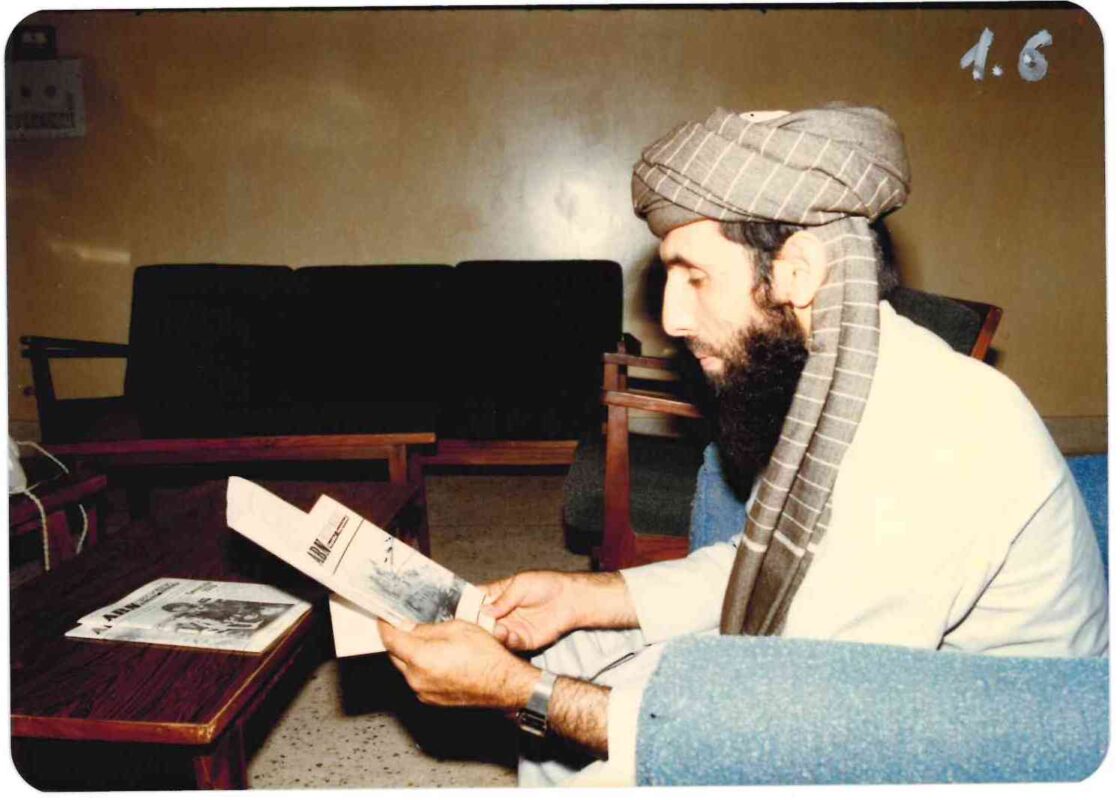
He was the General Secretary of the Anti-Bolshevik Bloc of Nations organisation that acted in the vanguard of the struggle for the freedom of the nations enslaved by Moscow, whose successor, the Anti-Imperial Block of Nations, will celebrate its 80th anniversary in a few days, and whose exhibition, entitled “Putin’s Real Prisoners,” you can see in this hall. I have been told a lot about Prince Nakashidze by people of the older generation who knew him personally. They were convinced that his mysterious death in 1966 had the same origin as the previously known assassination of the OUN leader Stepan Bandera. The name Niko Nakashidze appears many times in the ABN correspondence, in the articles and brochures that he wrote, but the most notable among them is the book “The Truth about ABN” – an excellent political pamphlet and a response to the Kremlin propagandists. You can familiarise yourself with its contents on this website. Here is a very short video where he speaks at the funeral of Stepan Bandera in 1959, which I suggest you watch right now. I would also like to draw your attention to some digitised publications of the OUN and ABN, which often published materials about the liberation struggle of the Caucasus, leaders and glorious pages of the history of these nations. These are, first of all, the ABN-Correspondence bulletin, which was published in English, German, French, Spanish and Russian, the OUN magazine “Liberation Path”, the magazine “Gouchagui” (in Georgian), the ABN magazine “Nabat”, other newspapers, magazines and non-periodical publications, the names of which you can find in the catalogue on the archive website. I especially recommend the magazine “United Caucasus”, which was published by the famous political figure of the Caucasian emigration, Alikhan Kantamir, in Munich in the 1950s, and “Voice of Free Georgia”, also from the 1950s. And now, several old editions of the bulletin ABN.Correspondence, which was published in Munich and which I chose, from among the duplicates, to read the titles of individual publications. It is interesting that London was previously the venue for congresses and conferences of the Anti-Bolshevik Bloc of Nations and the European Freedom Council. Our archive has preserved the materials of the ABN Conference, which was held here on 24-27.08.1973. Its materials, which are reflected in the specially created Fund 19 of our archive – the ABN fund, include, for example, the report of the head of the Georgian delegation, Levon Zurabishvili, “The Eastern Policy of the West as a Consolidating Factor of the Soviet Russian Empire”. In this article, as if “reading” from today, he criticises the short-sighted policy of Western states, which allows Moscow to first create sources of tension in different parts of the world, and then, as if nothing had happened, agree with its role as a “peacemaker”. The Kremlin successfully used this both then and now… Among the archive documents, there is a photo of one of the meetings of this conference, where Levon Zurabishvili is sitting on the far right, and with his back to us is another participant in the conference, his daughter, Salome Zurabishvili, the current President of Georgia. Next to her is a Ukrainian from the USA, Halyna Klymuk-Khomyak, who sent us this photo.
Friends, you can list and comment on various sources for a long time, but having access to our websites (the OUN archive and the ABN.Correspondence website, where we sometimes duplicate our archival finds), you will be able to find it there. I will limit myself to the last document for today, which I cannot ignore. This is a letter from the first President of independent Georgia, Zviad Gamsakhurdia, entitled “Nomenclature Revenge in Georgia”, dated 27 November 1992. It was addressed to the President of the ABN, Slava Stetsko, and was in her document folder. In this letter, Zviad Gamsakhurdia talks about the coup d’état in Georgia, inspired by Moscow, with the support of criminality.
I quote: “After the failure of the Novo-Ogaryovo process, seeing the inevitability of the collapse of the USSR, the Soviet leaders decided to create a new model of the empire, the so-called CIS (Commonwealth of Independent States), for which, a meeting of the leaders of the Soviet republics was scheduled in Alma-Ata on 21 December, to sign an agreement on its formation. After my refusal, Moscow finally decided to overthrow the legitimate government of Georgia. On 21 December, rallies began in front of the parliament building: some – supporters of the legitimate government and others – of the armed opposition, some of which were officers of the Russian army. Armoured cars and equipment appeared on the streets, the putschists began to shoot at unarmed supporters of the president, killing several citizens”.
A campaign of harassment began against the legally elected president of Georgia, not only in the Russian media, but also in the Western, so-called liberal media, including Radio Liberty. He was portrayed in the blackest colours, calling him a “Nazi” and a “chauvinist”, and in the meantime, a change of power was prepared. In the wake of inspired “protests”, KGB General Eduard Shevardnadze was brought from Moscow. After his arrival, Shevardnadze only intensified mass repressions and terror against political opponents, who continued rallies and demonstrations against his arrival and abuse of power. Punitive operations in Western Georgia were repeated several times with greater cruelty and mercilessness. The Russian army increased assistance to the junta terrorists with weapons, equipment and specialists.
Interestingly, all this took place with the complete tacit consent of Western countries, particularly the United States. Again, a quote from the letter: “The peak of hypocrisy and cynicism was the visit of Secretary of State James Baker to Georgia, on the anniversary of Independence Day on 26 May 1992. When James Baker greeted Shevardnadze and his supporters, who had gathered on the Republic Square, in front of the Iveria Hotel, and spoke about democracy, at a distance of 200 metres from this place, the Mkhedrioni punitive detachments and the police with dogs dispersed another rally of my supporters, fired into the crowd and brutally beat people. Baker heard this shooting but did not comment and continued his speech”.
Friends, I think that this letter, which has been in the archive for 30 years, is worth reading in full on the ABN.Correspondence website, where it is published.
Concluding my speech, I would also like to draw your attention to the Anti-Imperial Block of Nations exhibition – “Putin’s Real Prisoners: Political Prisoners of Enslaved Nations”. This is our human rights project, designed to draw the world’s attention to the fate of those who fight for the freedom of their nations and for the collapse of the Russian Empire. Along with 10 stories of political prisoners: Kalmyks, Chechens, Sakha, Karelians, Bashkirs, Tatars, Ingushs, and other nationalities enslaved by Moscow, there are about 10 thousand stories and fates of other political and military prisoners of the Kremlin, who are illegally held in places of deprivation of liberty on the territory of Russia, Belarus, Crimea and the so-called DPR and LPR. They are also Putin’s real prisoners.
First of all, these are Ukrainian prisoners of war: Azov fighters and other heroic defenders of Mariupol, defenders of dozens of Ukrainian cities and villages. Among them, in addition to Ukrainians, there are representatives of many freedom-loving nations, who fought as volunteers in the Ukrainian army: Georgians, Belarusians and others. The fate of one of these Georgian volunteers, who fought for Ukraine as part of the Armed Forces of Ukraine and is now languishing in prison, is described on one of the exhibition stands. Considering that you can all politically and medially give this story maximum publicity, I ask you to take part in the cause of his liberation. Russia has opened illegal criminal cases against more than 600 prisoners of war of the Armed Forces of Ukraine and is holding mock trials. The Russian occupiers are brutally torturing prisoners of war. The practice of torture in Russian captivity is constant and systematic. In addition to the military, Putin’s real prisoners are also civilian prisoners: public activists, journalists, human rights defenders, Ukrainian underground activists, priests of Ukrainian churches and ordinary citizens. A special place in this list is occupied by Ukrainian children abducted by Russia. In total, more than 1 million Ukrainian children remain under Russian occupation.
Let’s spread the word about this as widely as possible, using every informational opportunity. Thank you for giving me the opportunity to announce this at a wonderful and informative event on the occasion of the book’s release.
Dear friends. Let our meeting today become another information channel for spreading the truth about the struggle for freedom in the past and present.
Thank you for your attention.
Freedom for Nations! Freedom for the Individual!