

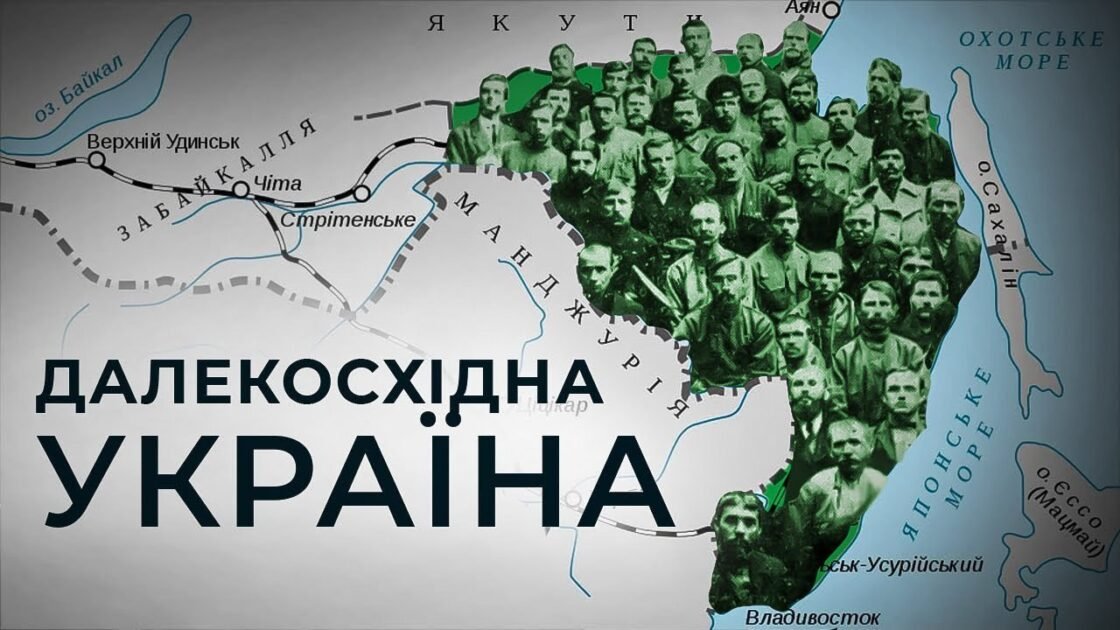
The Russian Empire’s Far East at the end of the 19th and the beginning of the 20th century became not only a strategic region for the empire but also an area of mass Ukrainian settlement. These settlers formed a unique ethnic and cultural community — the Far Eastern Ukrainians (dalʹkoskhidni ukraintsi) — which became a symbol of the resilience of the national spirit on the shores of the Pacific Ocean. The territory of their compact settlement came to be known as the Green Wedge (Zelenyi Klyn) and encompassed today’s Primorsky Krai, parts of Sakhalin Oblast and Khabarovsk Krai, Amur Oblast, the Jewish Autonomous Oblast, as well as certain districts of Zabaykalsky Krai, Magadan Oblast, and Kamchatka Krai.
From the very first days of settlement, Ukrainians faced the empire’s colonial policies and constant attempts at assimilation. The Russian authorities sought not only to use the settlers as a labour force and to strengthen the borders, but also to erode their national identity. Despite this pressure, Far Eastern Ukrainians established cultural and educational centres, shaping a distinctive subculture that laid the foundations of Far Eastern Ukrainian identity.
The era of settlement and formation (late 19th — early 20th century)
The first Ukrainian settlements emerged as early as the beginning of the 1800s, though mass migration of Ukrainians to the Far East began in the 1880s–1890s, when the land crisis in Ukraine, artificially created by the Muscovites, reached a critical level. Many families left their native lands to obtain free land plots in the Far East, hoping for a better future for themselves and their children. During the Stolypin agrarian reform (1906–1911), resettlement became even more widespread and systematic, giving a powerful impulse to the formation of a new Far Eastern Ukrainian community.
Economic motives were intertwined with colonial policy: Ukrainians were attracted by free land and the opportunity for independent farming, while the Russian authorities used their resettlement to strengthen the empire’s borders. The political motive was key: through the mass relocation of Ukrainians, the authorities sought to dilute Ukrainian identity within Ukraine itself and weaken the potential of national self-awareness.
Historically, Ukrainians settled the territories of today’s Primorsky Krai, parts of Sakhalin and Khabarovsk Oblasts, Amur Oblast, the Jewish Autonomous Oblast, as well as certain districts of Zabaykalsky Krai, Magadan Oblast, and Kamchatka. These lands became for the settlers not only a new home, but also later an arena of cultural self-organisation and resistance to Moscow’s colonial policy.
In the Far East, Ukrainian cultural centres began to emerge: Prosvity, where lectures, exhibitions, and theatrical performances were held; Ukrainian Houses, which served as centres of cultural life; and Ukrainian communities (hromady), which united settlers for mutual assistance and the preservation of the language. Orthodox parishes with Ukrainian clergy were established, and newspapers were published — Ukrainets na Zelenomu Klyni (“The Ukrainian in the Green Wedge”), Svitlo (“Light”), and Dalekoskhidna Pravda (“Far Eastern Truth”) — allowing settlers to maintain ties with their native culture.
From the first years of resettlement, Ukrainians faced restrictions on cultural autonomy: the authorities closed newspapers and cultural societies, banned education in the Ukrainian language, and prohibited the use of Ukrainian in print. Bureaucratic obstacles, unjust land distribution, and strict control over any political initiative made the lives of settlers difficult and dangerous.
Leaders of the first wave of settlement
Yurii Kosmych Hlushko-Mova became a symbol of the organisation of the Ukrainian movement in the Far East, heading the Vladivostok Prosvita and the Ukrainian Regional Secretariat. Pavlo Yakhno actively promoted the autonomy of Ukrainian lands, while Anysym Yakovych Stupak and Hordii Petrovych Melashych created cultural and educational structures, forming the core of the Far Eastern Ukrainian community.
Ivan Hadzaman was one of the principal authors of the constitution of the Far Eastern Ukrainian Republic.
The period of revolutions and civil war (1917–1922)
After the February Revolution, Far Eastern Ukrainians supported the idea of autonomy within a federative Russia or the creation of an independent state as a union of Far Eastern Ukrainians with representatives of the local Indigenous peoples. Ukrainian committees, schools, publishing houses, and cultural societies were established, preserving Ukrainian identity amid chaos and military instability.
In 1917–1918, bodies of self-government were formed: the Far Eastern Ukrainian Regional Secretariat (Vladivostok, 1918) and the Ukrainian Far Eastern Council (Khabarovsk, 1919). Ukrainian passports were printed, elections were held, and local laws were adopted. Efforts were made to establish the Ukrainian Far Eastern Republic, but its creation was thwarted by external intervention and internal chaos.
The Bolsheviks brutally suppressed Ukrainian organisations, carried out mass killings, and at times wiped entire cities off the map along with their populations, as in the case of Nikolayevsk-on-Amur in 1920. The White forces also repressed activists, while foreign interventionists — Japanese and American forces — only limitedly used Ukrainians as an anti-Bolshevik factor and provided no systematic support.
At that time, movement leader Yurii Kosmych Hlushko-Mova became a symbol of Ukrainian autonomy in the Far East. His activities demonstrated that Far Eastern Ukrainians were capable of self-government and state-building, despite pressure and violence from both imperial and revolutionary forces.
The Soviet period: the beginning
After Soviet power was established, Far Eastern Ukrainians lost their self-government; Ukrainian committees and Prosvity were shut down. A policy of rigid centralisation and ideological control began, and the Ukrainian language was pushed out of schools and state institutions. By the 1930s, Ukrainian schools, newspapers, and theatres had been eliminated. Activists, priests, and teachers were subjected to arrests, exile, and executions. Russification became a tool for suppressing national self-awareness.
Despite the repression, Ukrainians preserved their identity through clandestine circles, underground newspapers, and contacts with the émigré communities in Harbin, Canada, Japan, and Australia. These underground initiatives helped to maintain the language, culture, and communal spirit.
The period after World War II and perestroika
In the 1940s–1980s, Far Eastern Ukrainians were weakened by assimilation. Ukrainian schools and cultural institutions were absent, and social initiatives were confined within the framework of Soviet nationality policy.
Activities were carried out covertly, through correspondence and underground cultural links. Ukrainians preserved folk songs, rituals, and the language within the family sphere, but there was no mass movement.
In the 1970s–1980s, activists formed creative ensembles, collected materials for emigration, and secretly supported Ukrainian identity. There were no large-scale public manifestations of the national movement due to the strict control of Soviet authorities.
The collapse of the USSR and the present day
After the collapse of the Soviet Union, the situation of the Far Eastern Ukrainians (dalʹkoskhidni ukraintsi) gradually began to change, although it remained extremely difficult due to decades of Russification and repression. The newspaper Ukrainets na Zelenomu Klyni (“The Ukrainian in the Green Wedge”) resumed publication; attempts were made to organise Saturday schools for children to study the Ukrainian language; and negotiations were held on broadcasting radio programmes, although not all plans were successfully implemented. On 19 March 1993, the 5th All-Ukrainian Congress of Far Eastern Ukrainians took place in Vladivostok, where a decision was made to establish an association called Zelenyi Klyn (“Green Wedge”). The goal of this association was the restoration and support of Ukrainian identity, culture, and historical memory in the Far East of Russia. The congress approved a new composition of the Secretariat and sent appeals to the President of the Russian Federation, Boris Yeltsin, and to local self-government bodies requesting the official registration of the association. However, due to bureaucratic and political obstacles created by the Russian authorities, registration was never completed, which limited the organisation’s opportunities but did not break the spirit of the movement.
In the early 2000s, a revival of Far Eastern Ukrainian identity could be observed. One of the key figures of this period was Anatolii Kryll (Anatolii Kryl), the founder and artistic director of the Ukrainian choir Horlytsia, who actively organised cultural events, supported the study of the Ukrainian language, and preserved the traditions of the settlers. His activity became a symbol of the revival of national consciousness. Tragically, in 2004, Anatolii Kryll was murdered, and his death remains unsolved to this day. This tragic case underscored the danger and pressure faced by movement activists, while simultaneously becoming a symbol of the resilience of Far Eastern Ukrainians in their struggle for rights and cultural heritage.
The movement for freedom
In 2022, Far Eastern Ukrainians — both those who had emigrated and those who remained in the Far East — created an independence movement for the Green Wedge called Zelenyi Klyn — My Homeland. The main ideologue and later the head of the movement became Volodymyr Dubovskyi, while among the active participants are Oleksandr Serpen, Nataliia Romanenko, Artiom Prymak, and Mykola Kim. The movement aims not merely at cultural revival, but at restoring the previously lost independence of a state uniting Far Eastern Ukrainians with other Indigenous and autochthonous nations of the region, which makes it a fully-fledged national liberation project.
The movement’s activities include a wide range of actions: informational and ideological work through publications, blogs, Telegram channels, and websites; cultural initiatives such as festivals, exhibitions, language education, and the preservation of traditions; as well as political and diplomatic activities — developing concepts of independence and addressing international organisations and the Ukrainian diaspora. In addition, there is support for a partisan movement on the territory of the Far East, which operates in coordination with the official political activities of Zelenyi Klyn — My Homeland, using alternative methods of struggle.
However, the movement faces systematic repression by the Russian Federation. Nataliia Romanenko is currently under criminal prosecution on fabricated charges of preparing a terrorist act; together with her, her husband Volodymyr Fetysov is being held in pre-trial detention. Similarly, Roman Lozovyi (52 years old) and Kyrylo Hetman (32 years old) were sentenced to 14 and 13 years in high-security penal colonies, respectively, on charges of attempting to set fire to a military enlistment office. Alona Katorzhnykh (sentenced to 14 years in a high-security colony) was accused of setting fire to the Pervomaisky district military enlistment office. Artiom Prymak, an activist of the movement, died in 2025 under unclear circumstances; according to relatives and members of the movement, his death may have been orchestrated as a forced suicide due to pressure from the FSB.
The head of the movement, Volodymyr Dubovskyi, was declared wanted on the territory of the Russian Federation in June 2022, and in December 2024, he was added to the Rosfinmonitoring list with the designation “terrorist.” The independence movement itself has been included in the Russian register of terrorist and extremist organisations, which once again confirms the systemic pressure exerted on Far Eastern Ukrainians by the occupying state.
Despite the repression, the movement actively develops international cooperation. It maintains contacts with Ukraine, EU countries, Japan, Korea, and Australia, and implements joint initiatives and projects. In particular, through diplomatic and cultural channels, there is an exchange of information on repression, support for educational and cultural programmes, and the sharing of experience with the diaspora in Canada, the United States, Japan, and Australia. Cooperation with Ukraine is especially significant: Ukraine documents repression by the Russian authorities and cooperates with representatives of the movement in efforts to locate Ukrainian children abducted by Russia, as well as in matters related to searching for Ukrainian prisoners of war.
In addition, the movement cooperates with states to impose sanctions on legal entities and individuals supporting the military aggression of the Russian Federation against Ukraine. These actions help to build the movement’s international legitimacy and create diplomatic instruments to protect its rights and interests.
Today, the independence movement of the Green Wedge stands as one of the examples of a successful national liberation movement, demonstrating resilience, strategic thinking, and long-term prospects. Despite prolonged Russification, Far Eastern Ukrainians have preserved their language, culture, and historical memory, while their leaders and activists continue the struggle to restore an independent state. This fully substantiates the right to establish the Ukrainian Far Eastern Republic (Ukrainska Dalekoskhidna Respublika). The movement possesses all the prerequisites to become a sovereign and democratic state uniting Far Eastern Ukrainians with other Indigenous and autochthonous nations of the region, ensuring the political, cultural, and economic autonomy of which they were deprived by the Russian Empire, Soviet rule, and their successor, the Russian Federation.
Volodymyr Dubovskyi
Image source.






