

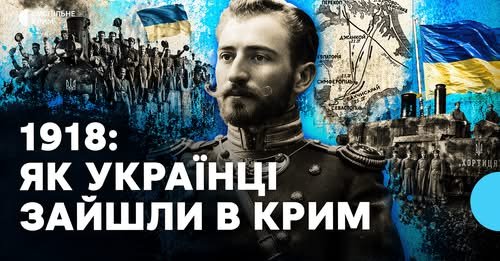
Is it realistic to liberate Crimea in three days? On 22 April 1918, Colonel of the UNR Army Petro Bolbochan led a campaign against the Bolsheviks and took control of key cities in Crimea in a few days. His offensive became one of the most successful military operations of the Ukrainian People’s Republic. Bolbochan went down in history as the “liberator of Crimea,” although he was later shot by his own state.
Historians told the Crimean Society about a little-known page of the Ukrainian struggle for the peninsula.
Read this article in Crimean Tatar
Bolbochan’s Crimean operation is called one of the brightest pages of the liberation struggle of the early 20th century.
“This is a man who had specific victories over the Russian enemy. Not every commander, military leader had this on his path. Petliura had no victories over the Muscovites,” said Roman Koval, a researcher of the history of the liberation struggle of the Ukrainian people in the first half of the 20th century.
Under the Treaty of Brest, Germany, Austria, Turkey, and Bulgaria recognised the UNR as an independent state, but the status of Crimea remained uncertain. World War I was still ongoing, and Germany, the young Ukrainian state, and Bolshevik Russia were competing for the peninsula.
On 10 April 1918, the headquarters of Colonel Petro Bolbochan received a secret order from the UNR government: to outrun the German troops and be the first to occupy the strategically important peninsula. The main goal was Sevastopol.
“Unfortunately, the Germans understood perfectly well what was going on, that the Ukrainian troops needed ships first of all. They understood that if the Ukrainians stepped onto the decks of the ships, these ships would cease to be German military trophies and would become Ukrainian military property. But the operation was very swift and very quick,” said Yaroslav Tynchenko, Deputy Director of the National Military History Museum of Ukraine.
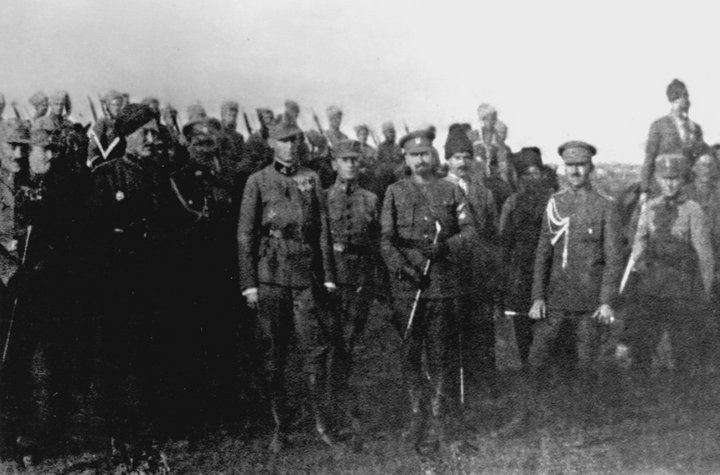
The Crimean group, consisting of two regiments, set out from Kharkiv. To bypass the German units moving towards Perekop, Bolbochan used the railway and disinformation. Ukrainian military personnel intercepted telegraph communications and provided false information to the Bolshevik headquarters, posing as retreating Red units.
“The Cossack cunning played a role here. They took control of the telegraph that connected the Red Army, which they defeated near Melitopol, with the Crimean defense headquarters in St. Petersburg, and fed them disinformation. When the armored train burst in and began spraying cannon and machine gun fire, the Muscovites gradually all fled. This is an outstanding victory for the Ukrainian army,” said Roman Koval.
On 22 April, thanks to the surprise effect, Ukrainian forces captured Dzhankoy, a key railway junction in Crimea. As historians note, the Bolsheviks did not offer serious resistance, as they were focused on repression against the local population and looting palaces.
“The Bolsheviks at that time were mostly busy executing local wealthy residents and officers, as well as looting, primarily, the royal palaces. And, of course, the defence of the peninsula was of last interest to them,” the historian said.
The news that the Ukrainians were liberating Crimea inspired the local population. The Crimean Tatars opposed the Bolsheviks, took control of individual cities, and welcomed Bolbochan’s army.
“The Crimean Tatars not only helped with food and intelligence, they also came in large numbers with horses and weapons. He even thought of creating a native cavalry division as part of his Crimean group. There were nine thousand people in this Crimean group. And there were literally crowds of people running after his car,” Roman Koval said.
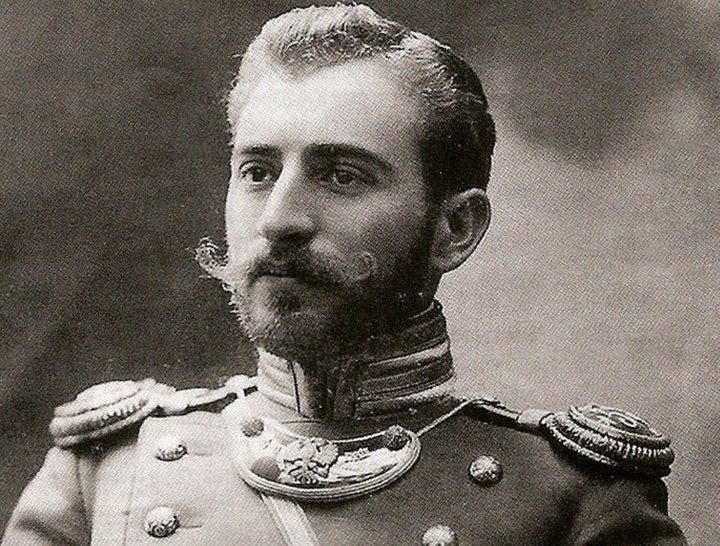
From Dzhankoy, Bolbochan moved on to Simferopol. In two days, the Ukrainians controlled the city. Next on the course was Sevastopol. However, the euphoria of the rapid liberation of Crimea was interrupted by a new order from Kyiv to stop the offensive due to an ultimatum from the German allies.
“The Germans really didn’t like it that the Ukrainians wanted to do something outside their control. And there were, in principle, two tasks: first, to capture this territory, and on the other hand, to break through to the Black Sea Fleet,” explained Oleksandr Kucheruk, head of the Museum of the Ukrainian Revolution.
Bolbochan returned to Kyiv. There was already a new government there, headed by Hetman Pavlo Skoropadsky. Later, the colonel supported the overthrow of the Hetmanate on the condition that Ukraine would not cooperate with the Bolsheviks.
The Directory appoints Bolbochan as commander of the Left-Bank Group of the UNR Army. The Bolshevik offensive continued in this direction. In order to preserve the most combat-ready military units, Bolbochan decided to retreat from Kharkiv. The UNR leadership did not support this step.
“Soldiers shouldn’t think, they should follow orders. When a soldier starts thinking, it ends badly. And Bolbochan was one of those people who followed orders for a long time. On the other hand, if you follow an order, it’s not your fault, but the one who gave the order,” said Kucheruk.
He was later accused of surrendering Kharkiv and arrested. On 12 June 1919, a military court sentenced Bolbochan to be shot.
“When he was arrested, he wasn’t in some prison. He lived in the Continental Hotel. Across the wall, Petliura lived in one room, and Bolbochan himself lived in the other. That is, he wasn’t treated like some scumbag, but was treated seriously, like a soldier,” Kucheruk noted.
The execution was postponed twice – the riflemen refused to carry out the order. Bolbochan was executed on June 28, 1919.
Суспільне-Медіа“We didn’t win anything, supposedly, but we won the idea that our movement is correct. And for our time, it is very important that we were there, that we have real claims from all sides to control Crimea. I think we will return it. There will be a new Bolbochan, and everything will fall into place,” Oleksandr Kucheruk concluded.






