

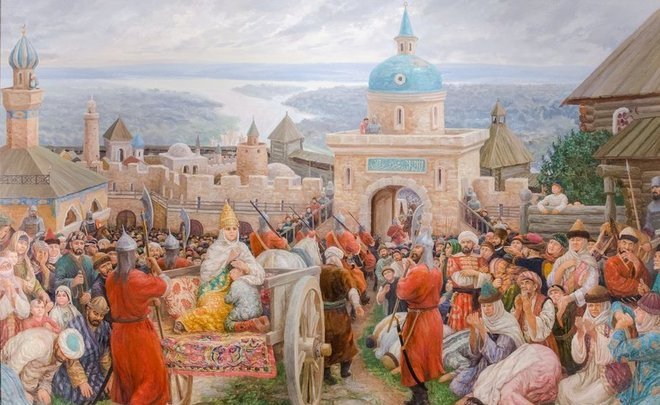
CONFUSED HISTORY OF RUSSIA
In the past, right up to Ivan the Terrible, Russians and Tatars did not fight, but were friends or, at least, allies. They lived in the same country called Moscow Tataria. Naturally, the Tatars were not malicious conquerors of Russian lands; they lived in their historical homeland.
CHRONICLE VERSUS HISTORY…
History as a genetic code contains many elements of present and future life. Therefore, in order to understand the potential and capabilities of a people, it is necessary to study the past. If fantasies and outright lies are presented as true history, then it is easy to leave the historical path, which is what is happening to Russia.
Historical evolution is based on technological inventions that provide advantages in the economy, military affairs, and culture. At some point, these advantages become commonplace as a result of borrowing by other nations, and the time comes when you need to again prove your technological and cultural superiority. If this does not happen, then another people comes to the fore and becomes at the forefront of historical development. The study of this process is the meaning of historiography.
However, often as presented by some authors, history looks like a list of events by year or by kings, khans, and leaders. The chronicle does not reveal the full depth of history; it records the time of significant events, but the main engines of progress can be lost among the dates and names. The chronicle is a flat black and white picture: he was born, lived for so many years and died. Although such a discolored picture is suggestive.
The Chronicle, albeit in a very lapidary form, nevertheless makes it possible to see the scale of historical events. The next step is the history of culture, the deeds of great personalities who predetermined the emergence of phenomena on a global scale.

Today in Europe the Tatars are looked at with surprise, as if they were a museum piece that had come to life. After the Tatars were dealt with in Europe, Russia, Iran, China, they, it seems, should not have risen again. What preserved the people after centuries of decline and persecution?
The fate of a people depends not only on material things, but also on the dynamics of ethnic consciousness or, one might say, the national spirit, although this term is very vague.
Ernest Renan expressed it this way: “A nation is a soul, a spiritual principle. Two things, which are essentially one, constitute this soul, this spiritual principle. One is in the past, the other is in the future. One is the common possession of a rich heritage of memories, the other is a common agreement, the desire to live together, to continue to jointly enjoy the undivided inheritance… A heroic past, great people, glory (but true) – this is the main capital on which the national idea is based. To have common glory in the past, common desires for the future, to accomplish great deeds together, to desire them in the future—these are the main conditions for being a people.”
This is more of a literary description than a scientific definition, but it is characteristic of publicists and public opinion.
Social consciousness, with all its dependence on social structure, economic processes, political values, has its own traditions. This is clearly visible in the images, symbols, folklore and artistic works that are preserved among the people from generation to generation. It is spiritual achievements that make it possible to form an ideology that predetermines material transformation.
Historical materialism cannot adequately explain everything. Events and facts take their course, filling space and time, and in the spiritual sphere, revolutions may not coincide with the phases of material life.






