

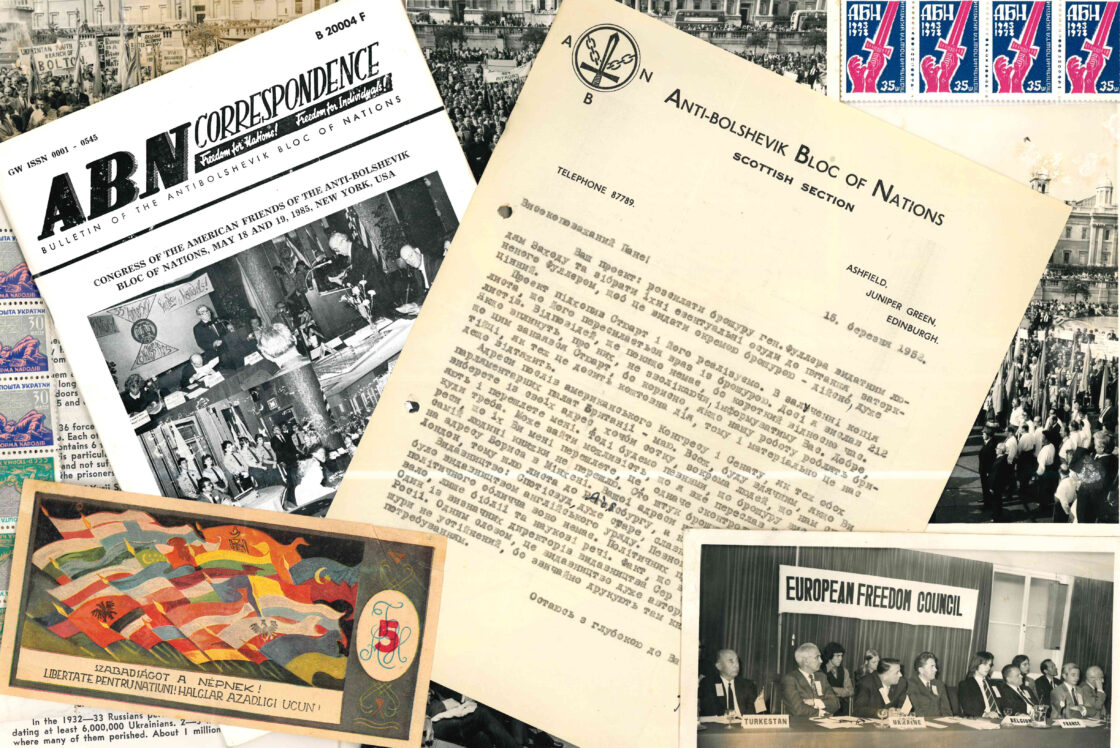
The OUN Archive continues its systematic work on organising and digitising the documentary heritage of the Anti-Bolshevik Bloc of Nations (ABN). As of today, the scientific and technical processing of the first 100 storage units of Fund 19 has been completed, which are already available for viewing in electronic format on the OUN Archive website.
This is one of the most substantial and internationally representative sets of documents in the collection of the OUN Archive. The materials of the fund cover the period from the late 1940s to the late 1980s and reflect the activities of the OUN as a global coordination platform for the liberation movements of nations enslaved by the Soviet Union and communist regimes.
Among the first documents to be sorted out, materials by the founders and leading figures of the ABN attract special attention. In particular, the online access to the lecture notes of Stepan Lenkavsky, “On the Allied Front Against the Common Enemy” (1947), devoted to the analysis of the situation of enslaved nations and the prospects for the development of the international anti-Bolshevik front, has been opened. Also available are documents of the Committee of International Freedom, concluded in Brussels in 1947, containing appeals to nations that were under the threat of Soviet expansion.
An important part of the collection is made up of documents from international solidarity actions and political campaigns. Among them are materials from the Captive Nations Week in London in 1970, organised with the participation of representatives of Ukraine, Lithuania, Latvia, Estonia, Belarus, Georgia, Armenia, and other nations. The documents contain information about campaigns in support of Ukrainian political prisoners, in particular Valentyn Moroz, as well as materials on the struggle against Russification and Moscow colonialism.
The fund also contains documents from the final period of the communist regimes’ existence in Europe. Among them is the declaration of the ABN Central Committee of 22 December 1989, in which the organisation expressed solidarity with the Romanian people during the revolution against the regime of Nicolae Ceausescu. The document was signed by the ABN leadership and is an important testimony to the organisation’s position at the end of the Cold War.
A separate large set of documents is the international correspondence of the ABN. The first 100 storage units present many years of correspondence with representatives of dozens of enslaved nations and political emigrations. In particular, researchers already have access to files with correspondence with representatives of the Crimean Tatar national movement, Azerbaijani, Armenian, Albanian, Bulgarian, Georgian, Estonian, Latvian, Hungarian and Croatian organisations.
Particularly valuable are the files documenting Yaroslav Stetsko’s cooperation with representatives of the national movements of the Baltics and the Caucasus. The correspondence includes figures from the Latvian, Georgian, Croatian and other emigrations, and discusses issues of coordinating international activities, organising conferences, preparing joint political statements and information campaigns. A significant amount of documents concern the work of the Council of Nations of the ABN, one of the main coordinating bodies of the organisation.
Among the files already available are correspondence with representatives of Idel-Ural, the Cossack movement, and national organisations of the Caucasus and Central Asia. The documents demonstrate how extensive the ABN’s network of contacts was and how the Ukrainian liberation movement served as one of the main centres for coordinating anti-communist cooperation among the nations under Moscow’s rule.
Of particular interest are the documents of the Central Committee of the ABN for 1953–1963. They record contacts with Ukrainian and international organisations, preparation of conferences and congresses, correspondence with figures of the Ukrainian emigration, representatives of the Ukrainian Congressional Committee of America, as well as political circles of the USA and Western Europe. The documents mention Yaroslav Stetsko, Volodymyr Kosyk, Ilya Dmytriv and other figures of the international anti-communist movement.
The open materials also include documents from the Conference of American Friends of the ABN, held in Washington in May 1985. The file presents materials related to the organisation’s international activities and its contacts with American political circles. The documents mention US President Ronald Reagan, future President George H.W. Bush, Gene Kirkpatrick, and other prominent political figures of the time.
The already organised materials provide a new opportunity to explore the history of the Ukrainian liberation movement in an international context. The documents show that the activities of the ABN went far beyond the Ukrainian question and were part of a broader movement of nations that opposed Russian imperialism and fought for the right to their own statehood.
Work on Fund 19 is ongoing. The following storage units will gradually undergo archival processing: identification, systematisation, restoration, description, and digitisation. Opening online access to the first 100 cases is an important step towards introducing into scientific circulation a unique documentary complex that allows for research into the history of the international anti-communist movement based on primary sources.
You can read the description of the fund and view the already available digital copies of documents on the website of the OUN Archive.
The documents of Fund 19 are of particular relevance today, when, after the start of the full-scale Russian-Ukrainian war, there has been a revival of international cooperation between the nations enslaved by the modern Russian empire. The Anti-Imperial Block of Nations (ABN), created in 2022, which positions itself as the ideological successor to the historical Anti-Bolshevik Bloc of Nations, united representatives of national movements of nations under the rule of the Russian Federation and advocates for the right to self-determination and decolonisation of the imperial space.
In this context, the documents of the historical ABN are not only a valuable source for studying the past, but also important material for understanding contemporary processes. They allow us to trace how international networks of cooperation between enslaved nations were formed over the decades, what political, informational, and diplomatic tools were used to counter Moscow’s imperial policy, and what challenges and opportunities arose on the path to achieving national independence. The experience recorded in the ABN documents is taking on a new meaning today, as many issues that were discussed by Ukrainian, Baltic, Caucasian, and other figures in the second half of the 20th century have once again found themselves at the centre of the international agenda.
Thus, the opening to researchers of the first 100 storage units of Fund 19 is not only an important step in preserving historical memory but also a contribution to the contemporary debate about the future of nations that continue to struggle against imperial rule and for the right to freely determine their own destiny.







