

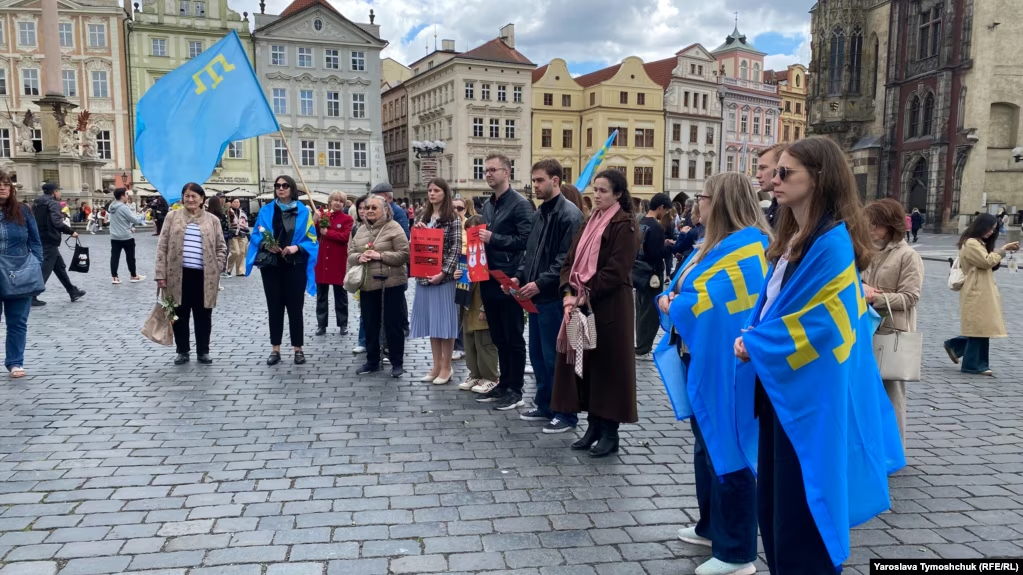
Earlier, representatives of the official authorities of Ukraine, Latvia, Lithuania, Canada, Poland, Estonia and the Czech Republic recognised the deportation of the Crimean Tatars in 1944 as an act of genocide.
The lower house of the Dutch parliament on Thursday, 19 June, supported a motion by MP Derk Boiswick, in which the deportation of Crimean Tatars in 1944 by the Soviet Union authorities was recognized as genocide, Deutsche Welle writes, citing the parliament’s website.
The supported petition also noted that since Russia’s occupation of Crimea in 2014, many Crimean Tatars have been groundlessly imprisoned, tortured, or disappeared, thereby “most likely continuing Russia’s policy of genocide against the Crimean Tatars.”
The Dutch House of Representatives “expresses its position that the mass deportation of the Crimean Tatars in 1944 constitutes genocide by modern standards and condemns it,” and asks the government to determine whether the genocide of the Crimean Tatars can be recognized, the parliamentary document says.
In March 2025, the human rights organization OVD-Info published a report, “11 Years of Occupation: How the Repressive Regime Was Established in Crimea,” in which it pointed out the repressions on the peninsula. Since 2024, according to OVD-Info, the annexed Crimea has initiated the most politically motivated criminal and administrative cases and carried out the most politically motivated arrests compared to Russian regions, calculated per 100 thousand people.
“We know of 349 defendants in politically motivated criminal cases in Crimea and Sevastopol since 2014. In this indicator, Crimea is second only to Moscow. Many of the peninsula’s criminally prosecuted residents are Crimean Tatars. In addition to criminal and administrative cases, we also know of other types of pressure to which the local population is subjected: forced disappearances and torture,” the document says.
Ukrainian Foreign Minister Andriy Sybiga welcomed the decision of the lower house of the Dutch parliament.
“I am grateful to the Dutch House of Representatives for adopting a resolution recognising the mass deportation of Crimean Tatars in 1944 by the Soviet regime as genocide. This is a powerful gesture of solidarity with the Crimean Tatar people, who continue to be persecuted under Russia’s temporary occupation of the Ukrainian peninsula of Crimea,” Sybiga wrote on social media X (former Twitter).
Earlier, the deportation of the Crimean Tatars in 1944 was recognized as an act of genocide by representatives of the official authorities of Ukraine, Latvia, Lithuania, Canada, Poland, Estonia and the Czech Republic.
On 11 May 1944, Joseph Stalin signed a decree “On the expulsion of Crimean Tatars from the territory of Crimea.” In the document, Crimean Tatars were called “accomplices of the fascists.” During the deportation, which began on 18 May and ended on 20 May, about 200 thousand Crimean Tatars were deported from their homeland to Central Asia, to the Sverdlovsk, Tula, Kostroma regions, Perm Krai, and the Mari El Republic.
According to the Crimean Tatar National Movement, 46.2% of Crimean Tatars died of hunger and various diseases on the way, and in the places where they arrived, as a result of exile. Most of those sent into exile were children, women and the elderly.
The number of Crimean Tatars who died as a result of the deportation organized by the Soviet government reaches (according to various estimates) 195 thousand.
On 15 November 1989, the Supreme Soviet of the USSR condemned the deportation of the Crimean Tatars and other peoples and recognized them as illegal and criminal.
On 21 April 2014, following the Russian annexation of Crimea, Russian President Vladimir Putin signed a decree on the rehabilitation of the Crimean Tatars and other peoples who suffered from Stalin’s repressions in Crimea. Despite this, according to several international organizations, repressions against the Tatar population have intensified since the annexation of Crimea.
On 18 May 2024, the 80th anniversary of the deportation of the Crimean Tatars, one of the largest memorial rallies outside the annexed peninsula took place in the German capital. At the rally, Crimean Tatar activist Elvis Cholpukh announced the start of a campaign for Germany to officially recognize the deportation as an act of genocide.






