

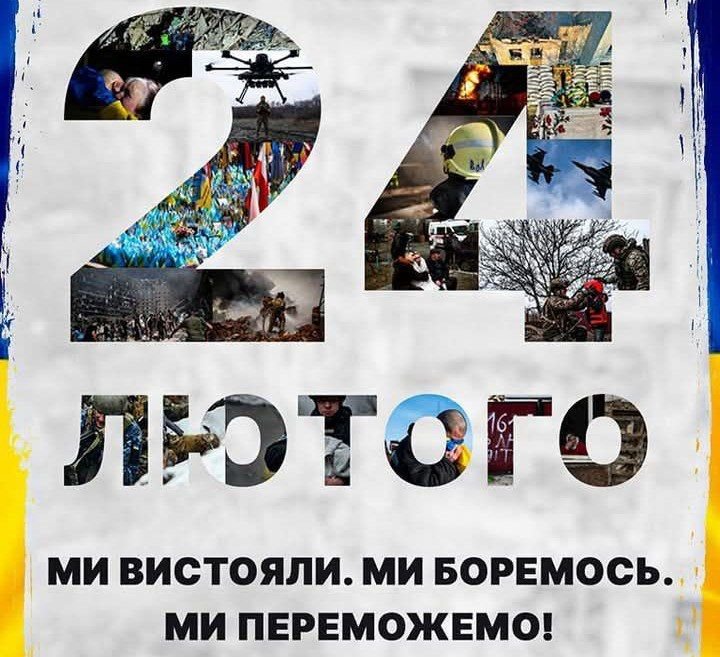
Three years ago, Russia launched a full-scale war against Ukraine, hoping for a lightning offensive and a quick victory. However, today the situation has changed dramatically. Ukraine has not only survived but also inflicted devastating losses on the enemy, gradually transferring the war to the territory of the aggressor. Today, the war is not only on the front in Ukraine but also in the deep rear of Russia. Ukrainian forces are carrying out attacks on strategic enemy targets, which significantly affects the course of hostilities. Meanwhile, in Russia itself, the economic crisis is growing, the population is getting tired of the war, and the fear of strikes is undermining confidence in the inviolability of the sovereignty of the Russian state.
According to a new sociological study conducted by the New Image Group in conjunction with the Dilova Stolytsia and Media Center Ukraine publications ( see link for details ), 75% of Russians favour peace negotiations. This is a striking contrast to the initial years of the war when Kremlin propaganda convinced society of the need for a “special operation” and support for Putin’s imperial ambitions. Even more telling is the fact that for 71% of those surveyed, the main issue remains not the territorial seizure of Ukrainian lands, but preventing Ukraine from joining NATO. This means that even among ordinary Russians, an understanding of the senselessness of the war of aggression and the need to find a way out of it is beginning to prevail.
At the same time, the situation inside the country is rapidly deteriorating. Despite the authorities’ claims that Western sanctions are not working, 63% of Russian citizens say they are on the verge of poverty. Real incomes of Russians are falling, inflation is rising, and the shortage of Western technologies and components is hampering the work of key industries. The situation in the defence sector is particularly critical, where sanctions have significantly affected the production of high-precision weapons and military equipment.
However, the biggest blow to the psychological stability of the Russians is inflicted by the devastating tactics of Ukraine’s long-range strikes deep into the Russian Federation. Using modern drones capable of covering distances of up to 2,000 km and carrying bombs weighing 250 kg, Ukrainian forces are destroying strategic targets deep behind enemy lines. If earlier Moscow could deny the losses or downplay their significance, today even ordinary Russians are feeling the effects of explosions at oil refineries, military warehouses and air bases.
Also, the Kursk operation became a real bone in the throat for the Russians, since Ukraine could conduct it with a high level of coordination and efficiency. Strikes on strategic objects of the Kursk region, particularly military airfields and logistics centres, significantly complicated the situation for the occupiers. During the operation, significant losses were inflicted on the Russian army, and important air defence facilities were disabled, which weakened the defence of the region. This not only demonstrated the effectiveness of Ukrainian long-range strikes but also forced the Russian command to reconsider the strategy of protecting rear areas, recognizing the impossibility of complete security even in the deep rear.
Especially, panic is spreading after the attacks on Moscow and St. Petersburg. For example, in the capital, the Moscow City complex was attacked, where government offices are located, as well as military facilities on the outskirts. In St. Petersburg, attacks were carried out on oil depots and industrial enterprises that provided fuel for the army. These attacks showed that even the most protected cities in Russia are not invulnerable.
All these operations are carried out thanks to high-tech Ukrainian drones. Among the most effective models are the “Bober”, “UJ-22 Airborne” and “Trident”. They can carry significant combat loads and cover long distances, hitting targets with high accuracy. The record strike range for today – 1700 kilometres – is an attack on a facility in the Khanty-Mansiysk region, which shows that Ukraine is capable of reaching even the most remote areas of the Russian Federation.
The Russian authorities are trapped. On the one hand, they cannot admit that Ukraine is now capable of striking deep into the enemy’s rear, because this undermines its image as a “great power.” On the other hand, it is becoming increasingly difficult to remain silent. Propagandists are forced to invent new explanations, sometimes reaching the absurd: from NATO accusations to fantasies about “domestic terrorist attacks.”
In the face of growing pressure, Russians are increasingly asking themselves the question: “Is this war worth such sacrifices?” More and more people are realizing that continuing the conflict will only make their own lives worse. However, in Putin’s dictatorial regime, expressing dissatisfaction publicly is dangerous. That is why the protest potential is expressed not in rallies, but in passive sabotage – evasion of mobilization, sabotage at factories, and the flight of young people abroad.
Three years of war have changed not only Ukraine but also Russia itself. While Ukraine continues to fight for its independence, the Russian Federation is gradually losing control even over its regions, which are increasingly becoming battlefields. If the trend continues, this crisis will only intensify, bringing closer the collapse of the empire that started this war.
Daniil Kozachok






