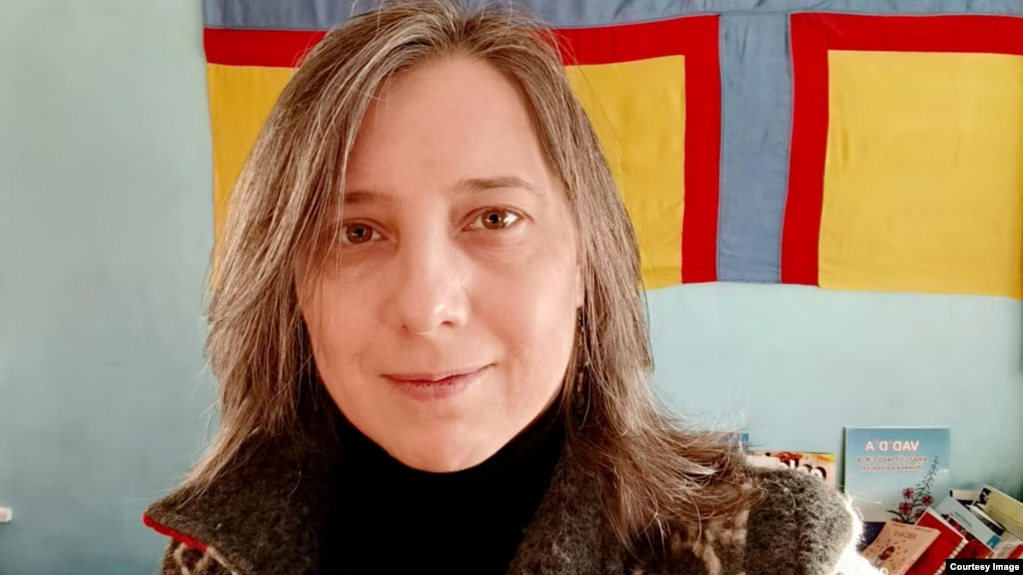
The nations of the Volga region are increasingly becoming the focus of discussions about the war, due to the disproportionate number of confirmed deaths from these republics, linguistic assimilation, and the loss of autonomy. At the end of January 2026, the Bureau of the announced the composition of a new Platform for Dialogue with Russian Democratic Forces, which includes a quota for representatives of indigenous people and national minorities. However, the approved list did not include a single representative of the Volga region people—the largest Turkic and Finno-Ugric ethnic groups in Russia. However, the Platform did include a representative of the small Finno-Ugric Vot people, delegated by the Free Ingria movement. This is Ekaterina Kuznetsova, director of the Ingria House in Narva, Estonia. In an interview with Idel.Realii, she stated that, as part of her work at PACE, she intends to seek recognition of the political agency of indigenous nations, advance the decolonisation agenda, and ensure that the voices of the Volga region people cease to be an “exotic adjunct” to Russian democratic discourse.
Ekaterina Kuznetsova, director of the House of Ingria in Narva, Estonia, is a member of the Finno-Ugric Votian people. According to the 2021 census, approximately 100 people in Russia identified themselves as members of this ethnic group.
Previously, Kuznetsova headed the Votian Culture Society in St. Petersburg. She was nominated to the PACE Platform by the Free Ingria movement. She has been studying and promoting Votian culture for over 25 years.
She was born in Leningrad and comes from a Vodian family from the village of Kotly in the Leningrad region (Vodsk: Kattila).
Our audience is primarily located in the Volga region, so I would like to ask you to briefly introduce the Vod people, of whom you are a representative, and explain how these people are connected to the Free Ingria movement, which nominated you for the PACE Platform.
— I have to talk about this very often, because the Vod people are very few in number. The Vodians, who live near countries like Estonia and Finland, are the smallest indigenous people. Vod is a Russian-language name; we call ourselves “Vaddya,” while Estonians and Finns call us “vatja/vadja.” The name itself means “native,” but [literally] translates as a wedge driven into the ground.
The traditional territory of residence is currently called the Leningrad Region, and historically, this territory was called Ingria. In the t was a province of Sweden, to which they added “land” at the end, and the territory itself was called “Inkerinmaa” in our languages. Inkeri maa means such a good, beautiful land. Maa means land. All Volga Finno-Ugrics probably recognise this word immediately. When the Swedish kingdom created the province of Ingria, it simply added one more word—”land”—to the name, which is why Ingria has the word “country” in its name twice.
Today, the territory of historical Ingria roughly coincides, as I’ve already said, with the borders of the Leningrad Region. And, accordingly, the Vodes are the smallest of the Finno-Ugric people who historically lived there. Five people live in the territory of historical Ingria: the Vodians, the Izhors, the Ingrian Finns, the Karelians, and the Vepsians. The Vodes’ territory borders Estonia. The Vodians are the closest people to the Estonians, and their language is very close to Estonian.
According to the latest census in Russia, 107 people in the Leningrad Region and St. Petersburg registered as Vodians. This doesn’t mean there are [only] that many—these are just those who registered as such. And, naturally, there are more Izhorians, [but about fifty of them registered; Ingrian Finns—somewhere around five thousand. That’s the current balance of our people. And all the people—Vodians, Izhorians, Ingrian Finns—live side by side.
The Vodians are considered the oldest people [among them]. Our people originated here. The Izhorians shifted slightly to the Vodians’ territory during the construction of St. Petersburg, because traditionally, Izhorian land—the Izhora River—is located where St. Petersburg is located. And Ingrian Finns began migrating to the area from Karelia in the 16th and 17th centuries. They are called Ingrian Finns because this was Finnish territory, but they belong to different, so to speak, parishes: some were resettled from Savo and are called “savakot,” others from the Äyräpää parish and are called “äyrämöiset.” They have different costumes and different dialects of the Finnish-Karelian language. In other words, this is Finnish Karelia, from where they were resettled or migrated themselves to the territory of Ingria. All our people are fundamentally related and the language is Baltic-Finnic; the only difference is that the Vodians and Izhorians were converted to Orthodoxy, and the Ingrian Finns to Lutheranism.
Until the early 2000s, all the encyclopedias wrote about our people as if they had already disappeared. [They spoke of us as surviving] two or three grandmothers—those two or three grandmothers haunted us in all the encyclopedias starting in the 1950s. We had the Vodian Culture Society, of which I was the director (we founded it in 2005), and before that, we created Vodian museums together with other enthusiasts. There was the “Vodian Project,” photo exhibitions in which we demonstrated that our people were still alive. Thanks to this popularisation, one might say 50 years after the Vodic language was declared extinct, researchers came to us to “reassemble” the Vodic language. Several more books dedicated to our people and our culture were published.
— You speak of Ingria or Ingermanland as a certain geographical region. Was there ever a period when it was politically formalised, as some kind of autonomy?
– At the time, it was , this was a territory being developed by Novgorod the Great. Consequently, there were no state entities. Our tribes, along with the Novgorodian tribes, participated in the Novgorod Republic. But later, during the Swedish period, it became the autonomous territory of Ingria, which had its own self-government and issued its own currency—in other words, it was a fairly independent region.
And, naturally, at the beginning of the 20th century, like all the people of these territories, everyone believed the promises made during the revolution that all nations could achieve independence. Because communist leaders believed that all nations could achieve independence. Estonia and Finland achieved their independence—not in the way it’s usually told. That is, it wasn’t given to them; they fought for it. And yet, of course, the people of our territory also wanted their own state. At that time, the Ingrians predominated in the Leningrad region, and there was a struggle that, unfortunately, ended in defeat. The Republic of Northern Ingria existed for several years on the border of Karelia and Finland, but it, too, was eventually captured by the Bolsheviks. And the Ingrian flag went to Finland.
There was a militia from Estonia that was in our villages, it went along with the general to capture St. Petersburg. But again, since the White generals wanted Russia whole (there was a story about them disarming the Ingrian regiment twice, and as a result, the whole thing failed—the offensive on Petrograd), neither side got what they wanted.
— You are included in the PACE Platform under the quota for indigenous people and national minorities. Millions of indigenous people live in the Volga region: Tatars, Bashkirs, Chuvash, Udmurts, Mari, Erzya, and Moksha. The latter are, in fact, Finno-Ugric people, like your people. Do you feel a responsibility to ensure that their voices are heard within the Platform?
“Of course. In fact, the representatives who have joined [the Platform] now don’t represent their people specifically. That is, I’m not a delegate specifically from the Vodians.”
We have the opportunity to cooperate with other representatives. I know that other members of our core Platform are already doing this. They’re also talking with other movements, so they’re cooperating—this is a completely normal activity. And I want to say that the fact that five representatives have joined this Platform of Democratic Forces is a very new idea.
Ideally, PACE positions itself as wanting to create a separate Indigenous Peoples’ Platform in the future. And this is only the first step.
Yes, this is stated in the Resolution on which this Platform was founded. In an interview with the Estonian publication Postimees, you said that you were nominated for the Platform by the Free Ingria movement. We previously hosted a representative of this movement, Maxim Kuzakhmetov, who believes that Ingria should be an independent state. What do you think?
“I want to clarify that, as a representative of both Free Ingria and indigenous nations, I’m trying to bring these two perspectives together. Because Russia’s indigenous Finno-Ugric people have always been largely marginalised from politics, they haven’t participated in the political process. It was believed that indigenous people should simply dance, engage in some kind of cultural practice, or, at best, learn the language. I consider this fundamentally wrong, so it’s great that the Free Ingria movement exists, which is addressing the political aspect of this.”
I have extensive experience [in this area]. For 20 years, I have tried, whenever possible, to work with officials in the Leningrad region and secure some rights for our nations. We’ve worked together with Izhorian, Vepsian, and Ingrian-Finnish organisations. Unfortunately, I see that Russia is so fixated on an imperial, Moscow-centric view that any interaction with any government apparatus results in, “Well, we’ll help you with something, but we’ll decide how. What, do you want something specific, something you need? And why do you think we should give you what you need?”
There is this is the view that small indigenous nationalities should beg for certain rights. [Although] every person has the right to education in their own language, to protect their territory and certain universal [matters]. PACE advocates such things. And the approach that we should be content with what we are given—that’s an imperialist view.
I don’t believe in a Even if Russia remains in its current form, even if it changes its way of governing. There is talk now about a example, making Russia a parliamentary republic, giving rights to all nationalities. But I don’t see how this will change people’s perceptions of a centre—these righteous people in Russia—and a periphery—these particular nationalities.
Even democratic figures often make the reservation that this is some kind of , some strange people, don’t let them in—”We’ll solve it, and everything will be fine for you.” Therefore, in this case, I’m inclined to agree with Maxim Kuzakhmetov that the best option, of course, would be for the regions (or national republics) that want it, to gain their independence and then, if they agree and are interested, unite into some kind of political entities: either with a centre, which might remain to be called Russia, or among themselves—but then they would be equal partners, not captive nations.
You stated that one of the goals of your participation in the Platform is to inform the public about the real situation of Russia’s indigenous peoples, the problems they face, and to discuss possible solutions. Over the past three decades, we’ve seen indigenous peoples losing their languages and their numbers dwindling in many regions. Do you expect Russian society to show empathy for indigenous peoples?
“I don’t want to evoke empathy specifically. I want everyone to understand that we need to abandon imperial views. Those countries that currently exist in Europe—for example, Finland and Sweden—recently officially apologised to the It would seem that who needs this? They already changed their policy long ago, but they must realise that this is wrong in relation to the people.
[Meanwhile, in Russia] there is mass Russification, which is now gaining new momentum, a ban on any activity other than the toothless kind, which is limited to concerts or some kind of entertainment [projects]. [This was also the case] in the Soviet Union. When I was still in school, I remember there were constant gatherings of all-Russian national groups, showing off how well they [realised their rights to ethnocultural development]. But it’s a bit like a zoo, to be honest.
This was inherent in all empires, but it remained in Russia. We need to understand what Russian society is. We, too, are a society that lives in Russia—we, the indigenous people. Therefore, we don’t need empathy from Russian society; we need the opportunity to resolve political problems on an equal footing, firstly, and also, [to declare] that our fate cannot be decided without us. This is the fundamental idea. We cannot accept the idea that some smart guy will come along and say, “You don’t really need your language, but we’ll certainly build you a museum, but you want too much, and in reality, this is only important to you, and that is not important.” This is not the approach we need.
Unfortunately, this Great Russian chauvinism has become deeply ingrained in the minds of Russian society. It was instilled not only in Soviet times but also in the Russian Empire; back then, other nationalities were called “aliens.” We face the same problems in the modern world. Therefore, what Maxim Kuzakhmetov spoke about, and what I am talking about, is a total restructuring of external conditions, which will entail an internal restructuring, a restructuring of people’s minds. Because there will no longer be a titular nation, a titular people and any less significant nations. It’s much more difficult, in my view, to immediately restructure what’s in your head, while everything around you remains the same. That’s harder to do.
“But beyond Russian society, there are people you’ll be working with this year. Most of the Platform participants from the Russian anti-Putin opposition support Russia’s 1991 borders. Do you think this won’t be an obstacle to cooperation with them?”
— Absolutely not. I can already see that other platforms from other countries have experience communicating, even though they often have opposing views, just like national parliaments. And cooperation is possible when views are opposed.
Until now, we’ve been lacking communication and exchange of viewpoints. The fact that most people don’t consider the possibility of reformatting Russia into several states is, in my opinion, due to the fact that it hasn’t been discussed much. And for now, people feel like they know how to create one Russia, but don’t know what other states might exist. Because, as I’ve said, Russia’s democratic liberal structures have often not intersected with national movements. This is a major omission, one we must now make up for.
Last year was declared the Year of the Finno-Ugric Capital. Narva became a centre of Finno-Ugric culture for a year. This project is now 10 years old. We held an international forum, at which one representative put it very well. According to him, we, the indigenous nations, either become politicised or disappear. So one of the steps we were able to take [in this direction] was participating in the work of PACE.
At the moment, this is something very new for all of us. Some of us have participated in the political process, some haven’t at all, and we know some of them, even know each other from previous work. But now we’ve taken the first step, and we need to understand how PACE works and what can be accomplished through it. Because it, too, is a bureaucratic structure. We need to not only exchange opinions and get used to each other within the Platform, but also communicate with other members. Perhaps we should share experiences, because many countries have already travelled this path, and all these forces have managed to reach an agreement.
— What do you expect from other delegations to PACE?
“As I said, we have the opportunity to see how they worked before, to get involved in their work, because many of them don’t work as delegations—there are parties, there are all sorts of other structures that put forward resolutions. We need to see who shares our views, how we can [cooperate], because we all have our own specifics: some have worked more in law, some have worked more specifically with indigenous nations, some are more interested in the feminist agenda, and so on—we have a very diverse Platform.”
The Platform’s five indigenous representatives bring their own perspectives and experiences. For example, I know that many of the delegates have already interacted with other national organisations; they represent not just themselves, but a conglomerate of other delegations that can speak through them. In other words, they represent the voice of these people.
We, too, have always cooperated in our work with other Finno-Ugric organisations and have always participated in . We already have experience interacting with different people. So now we’ll try to interact within our Platform, explain who we are, because very few people have ever encountered this in politics. We existed in parallel.
You mentioned PACE resolutions. Resolution 2621, on which the Platform was based, states that “democracy in Russia is impossible without decolonisation.” On the other hand, the Berlin Declaration affirms the signatories’ commitment to Russia’s internationally recognised borders. Do you see a contradiction here?
In the spring of 2023, 68 Russian opposition figures and activists based abroad signed a joint declaration, the Berlin Declaration, condemning Russia’s war against Ukraine and calling it criminal.
The document contains demands for the withdrawal of Russian troops from occupied territories, the restoration of internationally recognised borders, the trial of war criminals, and compensation for victims of aggression. This was reportedly done at the initiative of Mikhail Khodorkovsky and several other opposition figures living in exile.
Alexei Navalny’s supporters did not participate. At the time of publication, the declaration had been signed by over 33,000 people.
“In my view, there is no contradiction, because this in no way affects Russia’s external borders. The resolution signed by countries in the post-war period refers to the borders that demarcated states, but does not state that a single state cannot be divided into several states within itself.”
There are some people in Russia, including Kremlin critics, who will say that residents of St. Petersburg and the Leningrad region have no demand for Ingria’s independence. How do you respond to this argument?
“If we look at the state of Russian society in general right now, we don’t see any demand for an end to the war. If we [look at] a large percentage of people surveyed, it turns out they support what’s happening. Of course, that doesn’t mean everyone supports it. This is precisely the result of the authoritarian and aggressive policies of the Russian Federation, which for the past 20 years (and very actively for the past 10 years) has been eradicating all possible dissenting points of view.”
So, to say there’s no demand [is illogical], is impossible to verify at this point, because people will only say what they’re allowed to say. We can’t even communicate with people right now, so they can tell us specifically what the situation is in Russia. It’s very difficult to say, because the Russian state persecutes any activists who express any kind of opinion—and doesn’t say how wonderful everything is, how wonderful Russia is, how much it loves indigenous nations and everyone else who lives there.
Let me give you an example. When Narva was announced as the Finno-Ugric Capital of Culture, a Mari organisation in Russia posted a message on its website congratulating Narva and wishing it well, saying that the House of Ingria and the Uralic Centre ( Estonian Indigenous People’s Development Centre “Uralic” — “Idel.Realii” ) had done a great job. And in Russia, they were immediately ordered to remove it from the website and fined.
Why is this so? The “Finno-Ugric Capital” project is now 10 years old, and it began in Russia. Udmurtia hosted the first capital, and many Finno-Ugric villages and towns in Russia also participated and were nominated. But two years ago, the project’s organisers—Uralic Keskus MTÜ —were declared an “undesirable” organisation in Russia, and a year ago, an “extremist” organisation. Therefore, any mention or cooperation of any kind—especially cultural—is now declared “extremist activity.”
— That is, we cannot trust any public opinion polls or sociological studies.
– Of course, absolutely!
— Nevertheless, you say you’ve worked extensively with representatives of the Finno-Ugric nationalities. Do you analyse the extent to which these nations demand political self-determination? For example, among those living in the Volga region, you mentioned the Mari and the Udmurts.
There are always active people who want their people to exist, their language to survive. It’s a matter of survival now. That is, people who have worked with the authorities in the Russian Federation for many years see that the policy of Russification and population unification in Russia isn’t disappearing, but rather intensifying. Therefore, the survival of these nations is a matter of their own political formations and the politicisation of their national, indigenous populations.
Naturally, not everyone is an activist. Most people want to live peacefully, like everyone else. And to demand that everyone immediately come out and say they’re for some branch… People really don’t like change. But I remember , when you could say what you thought. In St. Petersburg, everyone immediately started talking about how St. Petersburg was a separate zone. Not even in the national sense. There was even a poll about making St. Petersburg a separate economic zone. And everyone—90%—voted “yes,” at a time when it was possible to vote for some kind of self-determination, at least in the economic sense. Therefore, I believe it’s purely a matter of context.
— We have a traditional question, and each guest answers it from their own perspective: what comes after Putin?
“This is precisely what the PACE Platform is trying to develop, I think. Since we’re not in Russia right now, we can say what we think—and we can try to model a post-Putin Russia. In principle, this was one of the goals PACE pursued when creating the Platform for Dialogue with Russian Democratic Forces. I know it’s not a quick process. We know that at the Belarusian Platform, they said they spent a year just getting to grips with and learning how to work within this Platform, getting to know everyone and understanding how it all works.”
So, of course, we’re doing the same thing now. As far as I understand, PACE [although] everyone says, “Well, it’s only an advisory body, it doesn’t influence anything,” develops guidelines that are then followed by, for example, the UN, the European Parliament, and after the European Parliament, the parliaments of other countries. In other words, PACE is a kind of mouthpiece for what needs to be taken as a reference. Therefore, this is an opportunity to develop a vision for this post-Putin Russia.
If we don’t talk about this, there won’t be anything to base our future work on. When, for example, the Soviet Union collapsed, everyone was in a panic: “How could this happen? What should we do?” The Baltic states had essentially seceded even before that because they were already prepared. They’d been talking about it for a long time: both parliamentarians and activists were committed to independence and to the fact that they already had existing structures in place, and that this wasn’t a surprise to them. Therefore, it was less painful for them than for other republics, for example, which hadn’t prepared for it in advance.
So we just have to prepare in advance, develop mechanisms and plan how it will be, so that it really is not a repetition of previous mistakes and not a repetition of the previous empire.
Idel.Реалии