

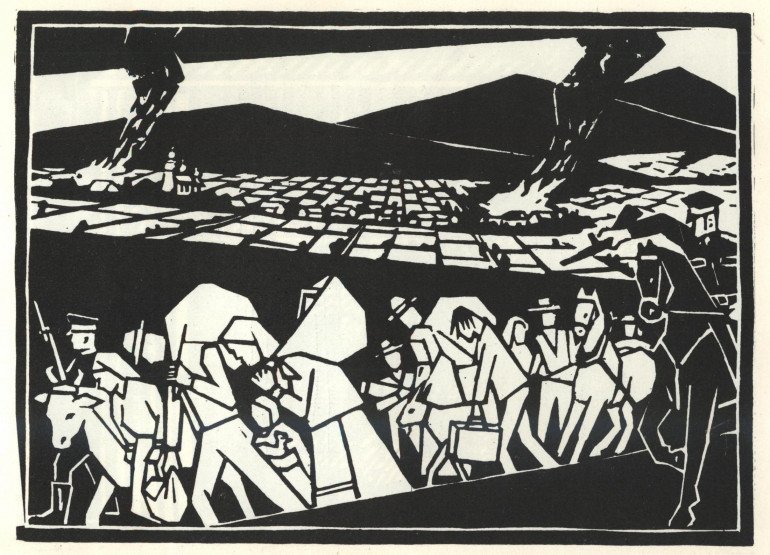
Public figures of the North Caucasus criticized Medinskyi’s new history textbook for high school students. The reason was a paragraph about Stalin’s deportations of nations. A number of organizations are calling for the textbook to be banned or rewritten. The Ministry of Education has not yet commented on the scandal. The spokesman of the Chechen parliament Magomed Daudov said: the department promised him to rewrite the chapter on deported peoples. The head of Karachay-Cherkessia Rashid Temrezov reported the same promise of the Ministry of Education.
Representatives of the repressed peoples in the Caucasus look at the history of repression differently than the authors of the new textbooks.
Medinsky-Torkunov’s textbook has previously caused critical reviews from a number of historians and human rights defenders, who reproached the authors for being biased. But the first public scandal in connection with the book arose after attention was drawn in the North Caucasus to an excerpt from “Occupants’ Manuals” about collaborators during the Second World War.
“Based on the facts of cooperation with the occupiers of the Karachays, Kalmyks, Chechens, Ingush, Balkars, and Crimean Tatars of the DKO (State Defense Committee) in 1943-1944. made a decision to liquidate the state formations of these peoples within the USSR and subject them to collective punishment — forced resettlement (deportation) to the eastern regions of the country, the textbook says. — As a result, not only bandits and agents of the enemy were repressed, but also many innocent people. The emigrants had to experience many troubles and wanderings. Justice was restored to them after 1953.”
The mention of “facts of cooperation with the occupiers” caused indignation of a number of representatives of repressed nations.
For example, the head of the Russian Congress of the Nations of the Caucasus (RCNK) Aliy Totorkulov believed that the release of a textbook with old slander from Stalin’s times caused yet another insult to millions of Russian citizens. “We know the real story and the real, criminal motives of the deportation. Who wants to force our children to read shameful slander about their people? There are many questions, and we are unlikely to get all the answers, but we will take all measures to get this textbook banned!” He stated that he intends to apply “to all possible authorities” to ban the textbook “in this form”.
The Ingush politician, former mayor of Magasa, Beslan Tsechoev, published on Instagram an open appeal to one of the authors of the textbook, assistant to the president and former minister of culture of Russia, Volodymyr Medinsky, in which he called the text about the deported peoples “offensive and unfair” and called on Medinsky to apologize.
Tsechoev also stated that he has prepared a legal justification for the correspondence of the textbook and will send it “in the instance all the way to the court.” In his opinion, the topic of the deportation of nations requires extreme caution and accuracy: “Instead, we see inappropriate labels and slanders against our peoples that have already been refuted many times. Ministerial offices do not always understand what kind of reaction such wording can cause.” Mr. Tsechoev hopes that the wording will be changed.
The Ingush tape “Tsori” sent an appeal to the chairman and deputies of the People’s Assembly of Ingushetia with the demand to create an expert commission to assess the textbook and the admissibility of its use in the republic, as well as “apply to the state and supervisory authorities to assess the incitement of national enmity in this textbook and suspend its distribution to correction of admitted inaccuracies so that this does not happen again.”
The head of the Ingush human rights organization “Mashr” Magomed Mutsolgov recalled that “the deportation of the peoples of the USSR was officially, at the state level, condemned.” He also noted that the law on the rehabilitation of repressed nations implies “cultural, historical, territorial rehabilitation, etc. Unfortunately, the law has not yet been implemented by the authorities and, accordingly, justice has not been restored.”
The Karachay People’s Congress sent an appeal to the spokesmen of the State Duma and the Federation Council. “In the context in which the actions of the “Vlasivites” and “Banderivites” are described, whole nations are mentioned: Karachays, Balkars, Ingush, Chechens, Crimean Tatars and Kalmyks. Of course, this cannot but offend the representatives of the deported nations of the USSR, since the sons of these nations fought bravely for the multinational Soviet people and the integrity of its territory,” the organization declares.
They also disagree with the statement that “the authorities of the Central Asian republics made maximum efforts to improve the food and living conditions of the deportees”, and object to the statement that “in January 1957, the national statehood of the Balkar, Kalmyk, Karachay, Chechen and Ing nations was restored nations “: according to the authors of the appeal, “in most of these peoples, national statehood was not restored due to territorial disputes that arose after the forced deportation.”
The Congress demands “to withdraw the circulation of the textbook … until the above-mentioned errors are eliminated and appropriate changes are made with the participation of representatives of the forcibly deported nations of the USSR.”
Batyr Boromongnaev, the ex-head of the Kalmyk regional branch of the Yabluko party, is also outraged by the presentation of historical events in the new textbook. “Its content is almost completely in line with the ideology of the socialist state of the 1960s-1970s. On page 351, there is this completely Soviet-communist-chauvinistic text: “With the help of British and American special services, many Ukrainian nationalists were able to avoid retribution. In a number of countries, for example, in Canada, a whole “Banderiv” diaspora was formed, members of which were actively recruited by the special services of Western countries for intelligence and sabotage activities on the territory of the USSR after the war.”
Batyr Boromongnaev notes that these paragraphs about Ukrainian freedom and independence fighters and repressed and deported nations are full of fabrications and lies: “In the process of deportations, no one, as propagandists Medinskyi and Torkunov write: “a bandit and an aid of the enemy,” was harmed. Only women, old people and children, and disabled men were deported to the Siberian January frosts in cattle cars, because most of the men were at the fronts. Those who fought against Nazi Germany were removed from the fronts. Among the Kalmyks, for example, all non-commissioned officers and privates were sent to Gulag camps in the Urals, where they, along with their medals, orders and faith in the Soviet state and Stalin, gradually died of hunger, disease and heavy labor standards.
In Kalmykia, by the way, not a single collaborationist Slav was deported to Siberia for some reason. (According to the 1939 census, 134,000 Kalmyks lived in the USSR. In 1957, there were already 75,000 people in the special register of the NKVD in Siberia. That is, almost half of the population was lost during the years of deportation. And how many were not born? During the years of deportation, Kalmyks gave birth very not enough, the living conditions were too difficult: according to statistics, there are practically no people of Kalmyk nationality in these years of birth, according to the secret report of the NKVD, 15% of Kalmyks died during the “delivery” / resettlement to Siberia on the way. was not restored – the Kalmyks began to return to Kalmykia only in 1957, a third of the territory of the Kalmyk ASSR is still part of the Astrakhan region.
Batyr Boromongnaev is convinced that this textbook should be banned in all the national republics of the so far existing “Russian pseudo-federation”: “I am not talking about the republics where repressed peoples live and which were liquidated in the Soviet Union.”
The authors of the textbooks, as well as the Ministry of Education, have not yet officially commented on the situation. Meanwhile, the spokesman of the parliament of the Chechen Republic, Magomed Daudov, wrote on social networks that he contacted the head of the Ministry of Education, Serhiy Kravtsov, and the co-author of the textbook, Volodymyr Medynskyi. According to Mr. Daudov, it turned out that “this section was taken without changes from previous editions”, and the author “assured about his readiness to arrange it”.
“For all those who were worried about this topic, I want to inform you that a working group has been created from among the heads of regions whose nations were repressed, and proposals for inclusion in the specified section of the textbook will be agreed with it,” Magomed Daudov said. Earlier it was also reported that “the entire circulation of the textbook I am talking about has been removed from schools in our republic on the instructions of Ramzan Akhmatovich Kadyrov.”
The head of Karachay-Cherkessia Rashid Temrezov also spoke about the meeting with the Minister of Education Serhiy Kravtsov. Referring to Kravtsov, he claims that the presentation of the historical fact about the deportation of a number of nations of the USSR in the history textbook will be changed.
“For more than a week, a working group has been working on this topic, which included the heads of subjects whose nations were repressed, and the leadership of the Ministry of Education of the Russian Federation. The opinion of the heads of nations who were subjected to repressions in the USSR was conveyed to the author of history textbooks, Volodymyr Medinsky. He agreed that the chapter on this topic was taken from the previous version of the textbooks without changes. In the near future, it will be changed and all proposals for making changes to the specified section of the textbook will be agreed with the Working Group.”
The head of Karachay-Cherkessia, Rashid Temrezov, expressed his opinion on this matter: “My personal position is that I consider it unacceptable to distort the historical truth about the repressions suffered by representatives of entire nations.”
History teacher Leonid Katsva believes that the wording about the deportation of peoples in the new textbook is “at best poorly written, at worst — intentionally allowed.” In his opinion, silence or similar formulations regarding the history of repressions “provoke a scandal” – as was the case, in particular, in 2010 with the textbook of the university “History of Russia. 1917–2009” by professors Oleksandr Vdovin and Oleksandr Barsenkov. There was a statement that during the Second World War, 63% of Chechen conscripts deserted. After the indignation of the Chechen public, the expert commission of the Academic Council of the Faculty of Science of the Moscow State University recognized the use of the textbook as “impractical”. It will be possible to make corrections only in the new editions of the history textbook for grades 10-11, since the manual has already “went to schools,” Katsva notes.
“The page about the deportation, recognized as erroneous, will obviously be deleted from the history textbook, this problem should probably be considered solved,” says journalist Oleg Kashin (entered into the register of foreign agents). — But this page rhymes with another one, from the same textbook, which talks about the decision of 1955 to announce amnesty to Soviet citizens of all nationalities who were exiled or sent to camps for cooperation with the German occupiers, that is, for any work in the occupied territory. The decision on amnesty was called ill-considered in the textbook, as it allegedly caused the later revenge of neo-Nazis, including in the Baltics and Western Ukraine. No one is going to remove this passage from the textbook for the families of many modern schoolchildren.”
Reference: Millions of people were deported in the Soviet Union, but 11 ethnic groups were deported on ethnic grounds: Germans, Poles, Finns-Ingermanlanders, Karachays, Chechens, Ingush, Balkars, Crimean Tatars, Meskhetian Turks, Kalmyks, and Koreans.
The Law “On the Rehabilitation of Repressed Peoples” was adopted in 1991, the last year of the existence of the USSR.
Based on the materials of Polina Yachmennikova and Oleksandr Chornykh (Kommersant’ newspaper), the “Kavkaz.Realii” website, as well as official appeals and statements of representatives of the Republics.
Note: for a quick information search please subscribe to our Telegram channel “Freedom for Nations!” https://t.me/ABN_Freedom_for_Nations
Also read the Facebook materials of the ABN page and the group
Our site: https://abn.org.uaen/






