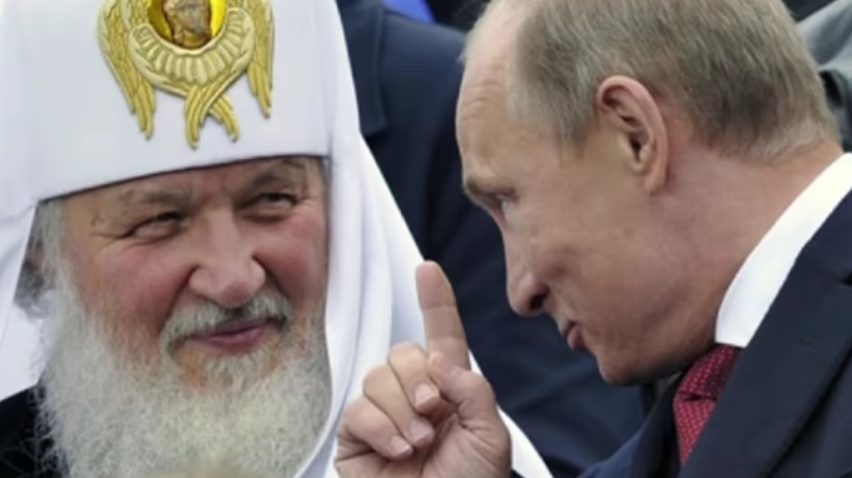
The Russian Orthodox Church of the Moscow Patriarchate (ROC MP) has combined several Kremlin ideological narratives in an attempt to form a broader nationalist ideology around the war against Ukraine and Russia’s expansionist future.
Source: Institute for the Study of War (ISW)
Details: The ROC MP has amplified the Kremlin’s rhetoric on Russia’s war against Ukraine and called it an existential and civilisational “holy war”, which appears to be a significant deviation for Russian authorities, who have so far carefully avoided officially framing Russia’s invasion of Ukraine as any kind of “war”.
The ROC MP has emphasised that “restoring the unity of the Russian people” through the war in Ukraine is a key condition for Russia’s survival and successful development during the 21st century.
ISW analysts believe that this call for restoration means a full-scale destruction of the Ukrainian nation and its absorption into Russia.
The ROC MP also aims to convert ethnic Belarusians into the Russian nation through its concept of the “trinity doctrine”, as well as to repatriate other “compatriots” abroad en masse.
The Kremlin may choose not to fully embrace the ultranationalist ideology that the ROC MP has proposed, but it will likely borrow and use it to support the war against Ukraine and any future acts of aggression against Russia’s neighbours and the West.
To quote the ISW’s Key Takeaways on 29 March:
- The Russian Orthodox Church Moscow Patriarchate (ROC MP), a Kremlin-controlled organisation and a known tool within the Russian hybrid warfare toolkit, held the World Russian People’s Council in Moscow on 27 and 28 March and approved an ideological and policy document tying several Kremlin ideological narratives together in an apparent effort to form a wider nationalist ideology around the war in Ukraine and Russia’s expansionist future.
- The ROC MP intensified Kremlin rhetoric about Russia’s war in Ukraine and cast it as an existential and civilisational “holy war,” a significant inflection for Russian authorities who have so far carefully avoided officially framing Russia’s invasion of Ukraine as any kind of “war.”
- The ROC MP called for the codification of elements of the Russkiy Mir and may be gauging public support for the formal inclusion of ethnic Ukrainians and Belarusians in the Kremlin’s concept of the Russian nation.
- The ROC MP heavily emphasised Russia’s need for traditional family values and an updated migration policy to counter Russia’s ongoing demographic crisis.
- The ROC MP appears to be combining previously parallel Kremlin narrative efforts into a relatively cohesive ideology focusing on national identity and demographic resurgence that promises Russians a period of national rejuvenation in exchange for social and civic duties.
- Ukrainian Commander-in-Chief Colonel General Oleksandr Syrskyi stressed that material shortages from delays in Western security assistance are constraining Ukrainian forces and forcing Ukraine to conduct a strategic defence.
- The Russian military likely expanded the target set for Russia’s strike campaign against Ukraine’s critical infrastructure to include hydroelectric power plants.
- Russia vetoed an annual United Nations Security Council (UNSC) resolution extending a monitoring panel tracking adherence to UN sanctions against North Korea on 28 March.
- The Kremlin appears to have succeeded in pressuring Telegram to further censor extremist content following the 22 March Crocus City Hall attack, highlighting the Kremlin’s ability to pressure significant actors within the Russian information space to act in its interests.
- Russian forces recently made confirmed advances near Bakhmut, Avdiivka, and Donetsk City and in the Donetsk-Zaporizhzhia Oblast border area amid continued positional engagements along the entire line of contact on 29 March.
- The Russian Ministry of Defence (MoD) is preparing for Russia’s semi-annual spring conscription cycle, which will begin on 1 April.
- Russian occupation authorities continue law enforcement crackdowns, including against the Crimean Tatar ethnic minority, to consolidate control over occupied Ukraine.