

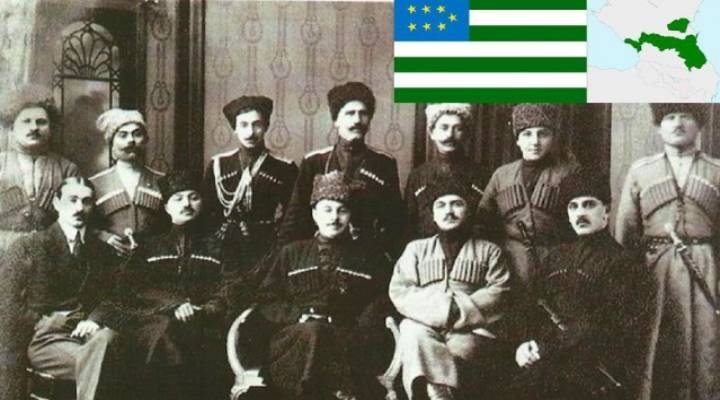
On the same day in Istanbul, a delegation of the Union of Highlanders of the North Caucasus, headed by the head of the government of the Mountainous Republic, the son of a tsarist general of Chechen origin, oil tycoon Tapa Chermoev and Foreign Minister Kumyk Gaidar Bamat, met with the Sultan of the Ottoman Caliphate Mehmed VI.
The mountainous republic was unable to establish its power in the Caucasus. The activity of her government was manifested only abroad, while in the Caucasus a really functioning state, the North Caucasian Emirate of Uzuna-Khadzhi, was created.
Be that as it may, the very fact of the proclamation of the Mountain Republic, the purpose of which was to unite the peoples of the Caucasus into a single state, once again showed the invariable strategic vector of the movement of the Caucasian peoples towards unification.
In terms of duration, the resistance of the Caucasians to Russian imperialism has no historical analogues. In traditional Russian historiography, it is generally accepted that the beginning of the Russian-Caucasian war falls on 1817, but Russia’s aggression against the Caucasus happened long before this date.
Caucasians had to endure fierce battles with Russian imperialism in the 17th and 18th centuries.
With the beginning of the 19th century, the genocide of the peoples of the Caucasus became systematic and intensified since the end of the Russian-Turkish war of 1806-1812 and continues to this day.
The most bloody ethnic cleansing occurred during the most active phase of the Russian-Caucasian war of 1812-1864, when Russian troops burned thousands of auls in the North Caucasus, exterminating all their inhabitants, including women and children.
Russia’s aggression against the Caucasus has become a real tragedy for its peoples. On May 21, 1864, in the tract of Kbaada (Krasnaya Polyana), a battle took place between the tsarist troops and the Circassians (Circassians), which ended the active phase of the Russian-Caucasian war.
After its completion, the Caucasian peoples were subjected to the most severe genocide by the Russian invaders. Many Caucasian peoples were subjected to complete extermination.
Caucasians, for more than 60 years without a break, held back the onslaught of the most powerful army in the world. And with short breaks, the Russian-Caucasian war went on for almost 400 years. That is how long it took tsarist Russia to penetrate and establish itself in the Caucasus, to populate its northern territories with colonists.
Russia’s pressure on the Caucasus strengthened the Caucasian peoples in the idea of unification. Sheikh Mansur, then the state of Imamat Shamil, who for decades resisted the Russian empire at the expense of their own forces and means without any help from anyone, showed that the Caucasian peoples, united in a single state, are capable of being self-sufficient.
The tragic and at the same time heroic history of the Caucasus also shows that it is almost impossible to survive alone, remaining free, closed within one’s national borders, in this unjust, aggressive world.
The answer to Russian aggression and its imperial claims can only be the unification of the Caucasus. Scattered attempts to get rid of the yoke of occupation will not lead to the desired freedom. And even if someone manages to expel the occupiers from their tiny piece of land, this will not lead to true independence, but will only create conditions for a new “protectorate”.
True peace, justice and stability in the Caucasus will not be achieved until the complete expulsion of the Russian occupation troops from its territory and the unification of all the peoples of the North Caucasus into a single independent state, which will have enough territories and human resources so that the Caucasian peoples can survive in this raging world, retaining their ethnic, cultural and religious identity.
Mansur Terlo
Kavkaz Center






