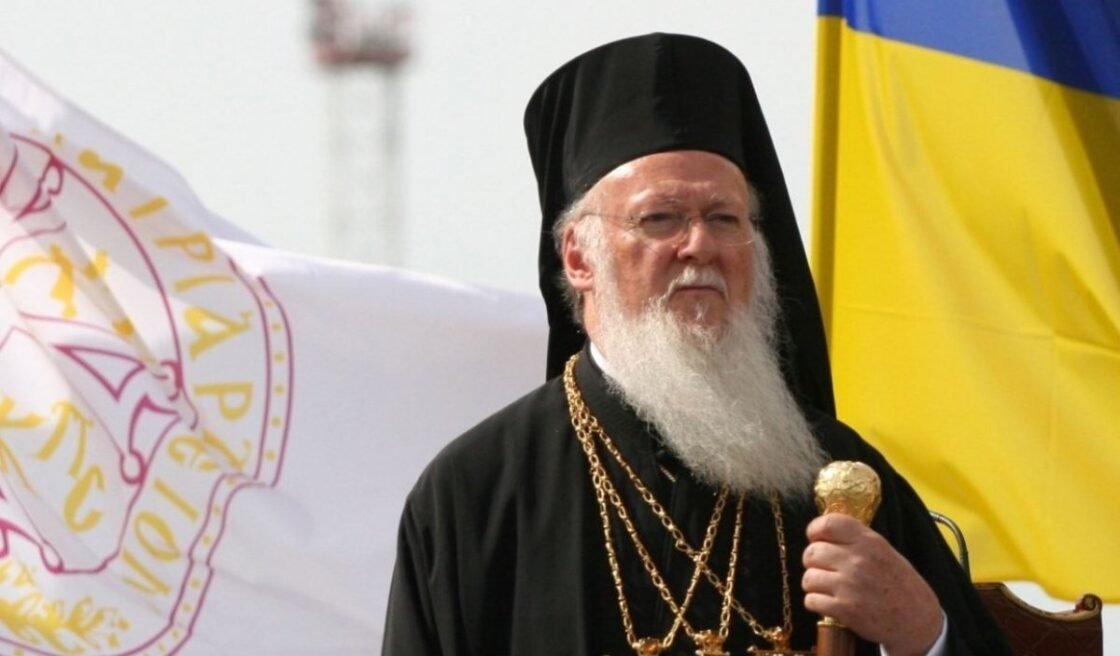
2025 marks the 85th anniversary of the birth of His All-Holiness, Archbishop of Constantinople – New Rome and Ecumenical Patriarch Bartholomew I. The future Patriarch was born in the Republic of Turkey on 29 February 1940 – at the beginning of World War II. His mother named the boy Demetrius, and Bartholomew is his church name.
The future Patriarch was born in a small ancient village called Ai Theodori (Greek: Saint Theodora). It was one of six Greek villages on the Aegean island of Imbros (Turkish: Imbros or Gökçeada) off the coast of Turkey, near the Dardanelles, a strait connecting the Aegean and Marmara Seas. The name “Saint Theodora” comes from the names of two holy horsemen of the early Church – Theodore the Tyrian (“recruit”) and Theodore Stratilates (“military leader”), who are often remembered as defenders of Christians, usually depicted together on icons. The village is located at the foot of Mount Kastri, also called Arasiya.
The island of Imbros is mentioned in Herodotus’s “History” and Thucydides’ “Peloponnese War”. The island was inhabited from the 5th century BC during the heyday of Byzantium. Still, the island’s inhabitants remained after the fall of Constantinople, and this continued until the beginning of the 20th century.
The village had two churches, St. George and the Assumption of the Virgin Mary, a primary school, narrow streets with many water fountains, six grocery stores and five cafes. There were about 850 inhabitants here, mostly farmers, and shepherds, but there were also shoemakers, merchants, builders, carpenters and beekeepers. The village was rich in olive oil and cheeses. Today the island itself is famous for its fishing and tourism. The village had two olive presses. In the autumn, the future Ecumenical Patriarch would go to those presses, taking with him fragrant bread to dip in oil. It is no coincidence that Ai-Theodori is called Zeytinli in Turkish, which means “village of olives”. In January, the two olive presses worked non-stop until the oil filled the peasants’ barrels to the brim and the air was saturated with its aroma.
According to the Ottoman census of 1893, the island had 9,456 inhabitants, of whom 200 were Turkish, 6 were Armenian, and the majority were Greek.
On 8 May 1940, the future Patriarch was baptized and given the name Dimitri. He was the third of four children born to Christos and Meropa Archondonis: Zakharo was the eldest girl, and Dimitri was the second of three boys. The elder brother was called Nikolaos (Nikos), and the younger brother was Antonis (Andoni). The family kept a horse, a donkey, goats that provided milk and cheese, and a small plot of land for growing vegetables and fruits. His father worked in the family café and hairdresser. In the café, one could buy coffee, rakia (anise vodka), visinada (a drink made from Morel cherries), and sweets.
Demetrius’s closeness to the church was probably “inherited” from his paternal uncle Photius, an archimandrite (celibate priest), and his maternal uncle Joseph, also an archimandrite and monk of the Vatopedi Monastery on Mount Athos. Every day after school, Demetrius would go to the village church of St. George. The local priest blessed Demetrius to be an altar boy in the church.
After receiving his primary education in his native village, Demetrius went to Constantinople (now Istanbul), where he entered the school at the Zografion Lyceum. The future Patriarch received his secondary and seminary education at the prestigious Patriarchal Theological School on the island of Halki in the Sea of Marmara. The island of Halki is located near Istanbul, which provides regular ferry service, and there are no cars on the island and people move on foot or in wheelchairs. After graduating from the Patriarchal Theological School on Halki in 1961, the future Patriarch served as a reserve officer in the Turkish armed forces in Gallipoli (from 1961 to 1963). In 1961, Demetrius was ordained a deacon, and in 1969 – a priest. During his ordination as a deacon, Dimitri received the monastic name Bartholomew in honor of a monk who lived on Mount Athos and edited liturgical texts. The future Patriarch Bartholomew tonsured a monk, considering this to be the fulfillment of his dreams. The ordination as a deacon took place in the cathedral of Imvros.
Bartholomew received his higher education at the Pontifical Oriental Institute, part of the Gregorian University in Rome. This higher education institution was founded in 1917 by Benedict XV with the hope that Catholics and Orthodox would study there together. In Rome, Bartholomew studied Italian, French, and Latin. In Rome, Bartholomew wrote and defended his thesis “Codification of the Sacred Canons and the Canon Law of the Orthodox Church,” published in 1970 by the Patriarchal Institute of Patristic Studies in Thessaloniki (Greece). Later, Bartholomew became one of the founders of the Society of Canon Law of the Eastern Churches, where he held the position of vice-president.
After completing his studies in Rome, Bartholomew was sent by Patriarch Athenagoras to receive education at the Ecumenical Institute in Bosse (Switzerland). This is a training center associated with the World Council of Churches, which at that time was headed by the Greek theologian Nikos Nissiotis, professor of philosophy and psychology of religion at the University of Athens. Under the guidance of Nissiotis, Bartholomew became acquainted with the philosophical trends – existentialism and personalism and the understanding of theology in the light of the mystery of the Holy Spirit. At the University of Munich, Bartholomew learned the German language.
Bartholomew began to work actively with Patriarch Athenagoras, who elevated him to the rank of archimandrite. In 1968, Archimandrite Bartholomew returned to Constantinople, where he served as deputy dean of the Patriarchal Theological School in Halki until 1972. After the death of Patriarch Athenagoras in 1972, Bartholomew became the personal secretary of his successor, Patriarch Demetrius. On Christmas Day 1973, Bartholomew was elected Metropolitan of Philadelphia and served as the director of the Patriarch’s administration until 1990. As personal secretary and assistant to the Ecumenical Patriarch, Bartholomew was responsible for ecumenical communication through bilateral dialogues between the Orthodox Churches and the Roman Catholic Church, which began in 1980. This “dialogue of truth” complemented and completed the long process begun by Patriarch Athenagoras and Popes John XXIII and Paul VI. The fruits of this dialogue were three important statements: on the understanding of the sacraments of the Church (1987) and sacred orders (1988), as well as an attempt to resolve the complex problem of the Union (1993).
In cooperation between Patriarch Demetrius and Bartholomew, work continued on preparations for the upcoming Great and Holy Council, and three Pan-Orthodox conferences were convened at the Orthodox Centre of the Ecumenical Patriarchate in Chambezi (Switzerland). The Ecumenical Patriarchate initiated a worldwide campaign to protect the natural environment, after which a message was published to all Orthodox Churches, in which September 1 (the first day of the church calendar) was declared the Day of Prayer for God’s Creation.
In 1990, the Metropolitan of Philadelphia of the Patriarchate of Constantinople was elected Metropolitan of Chalcedon. At that time, Metropolitan Bartholomew became a member of the Holy Synod and represented the Ecumenical Patriarchate at the highest level in various commissions on inter-church and inter-confessional relations. Metropolitan Bartholomew constantly accompanied Patriarch Demetrius during his visits to the Orthodox Churches, as well as during his visits to the Pope, the Archbishop of Canterbury and the World Council of Churches, in which Metropolitan Bartholomew was a member of the Commission on Faith and Church Order, and was also elected a member of the executive and central committees.
In 1991, after the death of Patriarch Demetrius, Metropolitan Bartholomew was unanimously elected Ecumenical Patriarch at the age of only fifty-one, which was a great rarity. The ceremony of accession to the Patriarchal Throne took place on November 2, 1991.
Let us recall that the history of the Patriarchate of Constantinople spans 16 centuries, during which it has held the throne in Constantinople. The Ecumenical Patriarchate is the centre of all local Orthodox Churches. It heads them not in the sense of leading them, but by the primacy of its ministry and its canonical right to coordinate the activities of all Orthodoxy in the world.
The unique functions of the Ecumenical Patriarchate in the life of the entire Orthodox Church stem from its centuries-old service to witness, defend, and spread the Orthodox faith. The Ecumenical Patriarchate has a supranational and supraregional character.
Under the norms of canon law, the Patriarch of Constantinople convened the Holy Great Council of the Orthodox Church for the first time in several centuries, which was held from 19 – 26 June 2016, in Crete. Despite the opposition of the Russian Church and the Russian Federation, under canon law, which only the Patriarchate of Constantinople has, with the blessing and support of His All-Holiness Patriarch Bartholomew, on 15 December 2018, the Unification Council of the Holy Orthodox Church of Ukraine was held, which elected the Primate – Metropolitan of Kyiv and All Ukraine Epiphany. Sometime later, on 5 January 2019, in the Cathedral of the Holy Great Martyr George on the Phanar (the Main Temple of the Patriarchate of Constantinople), Ecumenical Patriarch Bartholomew, by his exclusive right, signed the Tomos on the autocephaly of the Orthodox Church of Ukraine and presented it to His Beatitude Metropolitan Epiphanius of Kyiv and All Ukraine.
Tomos is a church document of the local Orthodox Church, which concerns important issues of church order. In particular, the publication of the Tomos grants autocephaly (the right of self-government and complete administrative independence from other churches) to the new local church, which became the Orthodox Church of Ukraine. The receipt of autocephaly by the Ukrainian Church was a historic event not only for Ukraine but also for the entire Orthodox world.
Thus, the personality of Patriarch Bartholomew is forever inscribed in the history of the Ukrainian state, the Ukrainian Church, and the entire Ukrainian people.
Oleksiy Usenko, religious scholar
Сумський історичний портал