
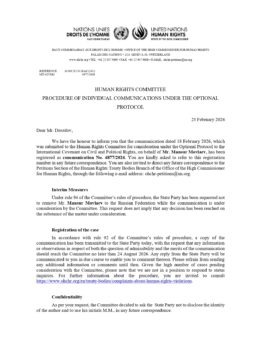
On 23 February 2026, the UN Human Rights Committee decided to grant interim measures in connection with an individual communication submitted on behalf of Mansur Movlaev, a citizen of the Russian Federation, requesting that the Republic of Kazakhstan refrain from extraditing him to the Russian authorities pending consideration of the case on the merits.
Interim measures are granted by the UN Human Rights Committee in situations where there is a real risk of irreparable harm, including risk to life or torture. In the present case, the Committee recognized the existence of such risks should Mansur Movlaev be transferred to the Russian Federation.
Mansur Movlaev originates from the Chechen Republic. Between 2019 and 2020, he transmitted information concerning abductions, enforced disappearances, torture, and the fabrication of criminal cases in the Chechen Republic to opposition platforms on Telegram, including the movement “ADAT.”
Following this, Mansur Movlaev was twice unlawfully detained, held in unofficial places of detention, and subjected to systematic torture and ill-treatment.
After escaping from detention, criminal proceedings were initiated against him based on fabricated evidence. Under torture, security officers gained access to his mobile phone and used his account to initiate correspondence with an opposition Telegram channel, after which a cryptocurrency transfer was arranged and subsequently presented as evidence of financing “extremist activity”. The officers also informed him of the creation of video and audio materials, which were later used as grounds for initiating criminal proceedings for extortion.
On 13 May 2025, Mansur Movlaev was arrested in Almaty in connection with an international search request initiated by the Russian Federation. In June 2025, the Russian authorities submitted a formal request for his extradition.
On 21 May 2025, Mansur Movlaev applied for asylum in the Republic of Kazakhstan, providing detailed accounts of his abductions, unlawful detention, and torture in the Chechen Republic, as well as the risk of renewed persecution in the event of his return. The asylum proceedings remain pending.
Despite the ongoing asylum procedure and the substantiated risk of torture, on 27 January 2026, the Deputy Prosecutor General of the Republic of Kazakhstan decided to grant the request of the Russian Federation for his extradition. This decision has been appealed and is currently under consideration before the Supreme Court of the Republic of Kazakhstan.
At the same time, Mansur Movlaev remains in detention in Almaty. In the present circumstances, there exists a real and immediate risk of his extradition to the Russian Federation prior to the completion of judicial and migration appeal procedures, which may result in irreparable harm to his life and safety.
In light of this risk, on 18 February 2026, an individual communication was submitted to the UN Human Rights Committee, prepared by lawyer Vadim Drozdov.
Vadim Drozdov is a lawyer specialising in protection against deportation, expulsion, and extradition, as well as in the removal of data from Interpol databases. Drawing on his professional experience in representing persecuted individuals from various post-Soviet countries, he developed an individualized legal protection strategy for Mansur Movlaev.
The communication substantiated the risks of violations of Articles 6 (the right to life), 7 (prohibition of torture), 9 (prohibition of arbitrary detention), and 14 (the right to a fair trial) of the International Covenant on Civil and Political Rights in the event of Mansur Movlaev’s extradition to the Russian Federation. Interim measures were requested simultaneously, and on 23 February 2026, the Committee granted the request.
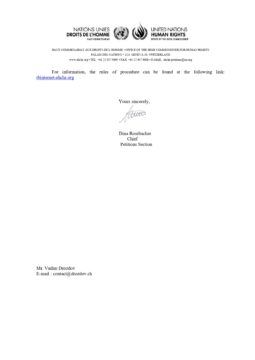
The Republic of Kazakhstan is a State party to the International Covenant on Civil and Political Rights and is bound by its international obligation to comply in good faith with the decisions and requests of the UN Human Rights Committee, including interim measures.
There have already been instances in which Kazakhstan proceeded with extraditions despite interim measures indicated by international bodies. In its decisions on the individual communications Abdussamatov et al. v. Kazakhstan and Tursunov v. Kazakhstan, the Committee against Torture concluded that such actions constituted violations of Kazakhstan’s international obligations and effectively undermined the effectiveness of the individual complaints procedure.

Commenting on the application of interim measures in the case of Mansur Movlaev, lawyer Vadim Drozdov notes that particular concern arises from Kazakhstan’s past practice of non-compliance with such measures:
In the present circumstances, compliance by the Republic of Kazakhstan with the interim measures indicated by the UN Human Rights Committee in the case of Mansur Movlaev is of particular importance. The issue at stake is the prevention of irreparable harm. Respecting these measures will demonstrate the State’s commitment to the principle of good-faith compliance with its international obligations. If Mansur Movlaev is extradited in disregard of the interim measures indicated, this would constitute a violation of the Republic of Kazakhstan’s international obligations under the International Covenant on Civil and Political Rights and its Optional Protocol.
Nina Belyaeva