

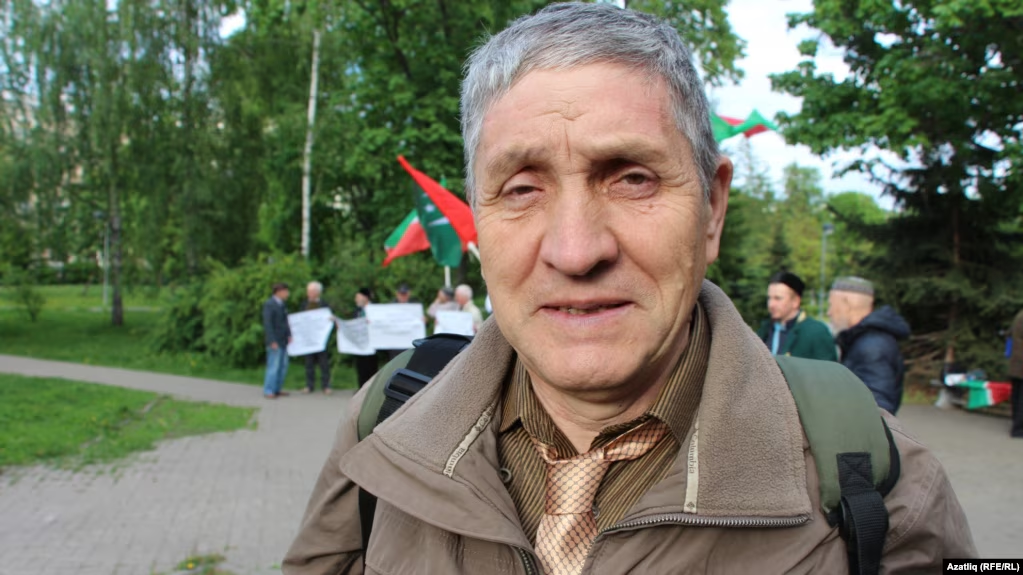
The 73-year-old veteran of the Tatar national movement Zinnur Agliullin was accused of “inciting hatred towards Russians” because of his words spoken in an audio stream on the Telegram channel “Yanarysh Tatar Halyk Partiyase”. “Idel.Realii” analysed the materials of the criminal case – from them, it became known that the security forces listened to the activist’s speech in real-time and recorded it.
— This morning, several police officers, the Centre for Combating Extremism, and the FSB came to the house. It turns out that they opened a criminal case on 6 September. As part of the criminal case, they searched and then took me away for questioning. After the questioning, they released me. The investigation of the criminal case is ongoing. I refused the services of a lawyer because it is useless since there is no independent court, — 73-year-old activist Zinnur Agliullin told the Union of Tatar Youth “Azatlyk” on 18 September.
Zinnur Agliullin is a veteran of the Tatar national movement and former chairman of the All-Tatar Public Centre. On 2 August 1990, he declared a 12-day hunger strike in Naberezhnye Chelny, demanding the status of a union republic.
In 1993, the Supreme Court of Tatarstan found Agliullin guilty of “calls to overthrow the existing system” and sentenced him to two years in prison with a one-year suspension term. The criminal case, the newspaper Kommersant wrote, was opened after he sent a telegram to Tatarstan President Mintimer Shaimiev in October 1992, informing him that he had been sentenced to death “for betraying the interests of the Tatar people, for Russian vouchers.”
In April 2012, the Naberezhnye Chelny City Court found Agliullin guilty under Part 1 of Article 282 of the Criminal Code of the Russian Federation ( “Incitement of hatred or enmity, as well as the humiliation of human dignity” ) and sentenced him to one year of correctional labour. He was charged with participating in a rally in defence of the Russian language in April 2021, where he came with a poster “If you do not respect the language of the indigenous people – Suitcase. Train Station. Russia.” In addition, according to the investigation, Agliullin made “derogatory comments about Russians.”
In September last year, the Naberezhnye Chelny City Court found Zinnur Agliullin guilty under Article 20.3.1 of the Code of Administrative Offenses of the Russian Federation ( “Incitement of hatred or enmity, as well as the humiliation of human dignity” ) and fined him 16,000 rubles. The ruling was not published on the court’s website. In an interview with Radio Azatlyk, Agliullin said that the reason for initiating the case was his performance at a concert by singer Flera Kolakhmetova-Talipova. According to him, the activist spoke about the situation with the Tatar language in schools and stated that the presidents of the republic, Mintimer Shaimiev and Rustam Minnikhanov, got rich with the help of the national movement. “After all, the Shaimievs benefited by threatening Moscow with the national movement. This brought them billions,” Agliullin explained.
On that day, 18 September, security forces came to Agliullin’s home in the village of Krasnye Chelny, conducted a search and confiscated his mobile phone.
Pro-government and security-related Telegram channels wrote that “a member of the extremist movement “Yanarysh” Zinnur Agliullin was detained.” In addition, it was reported that “since last year, this elderly man has joined the extremist movement “Yanarysh Tatar Halyk Partiyase.”
In August 2024, the Supreme Court of Tatarstan recognized the Tatar nationalist party “Renaissance” (“Yangarysh Tatar Halyk Partiyase”) as an “extremist” organization and banned its activities. According to the prosecutor’s office, the party members advocated armed struggle for Tatarstan’s independence from Russia, ran several Telegram groups, and published videos on YouTube calling for resistance.
Among the reasons for banning the party is a video of a speech at a public event by the leader of Yanarysh Tatar Halyk Party, Irshat Khabiyev, in which he claimed that the organization “has created dozens of groups ready to carry out subversive activities within Tatarstan, which is one of the most important components of the war.”
According to the ruling of the Supreme Court of Tatarstan, at least 15 people are participating in the party. Some of them are defendants in administrative and criminal cases due to political statements. Former members of the liquidated All-Tatar Public Centre were also named as party participants.
“Idel.Realii” found out that the reason for initiating a criminal case was Agliullin’s speech in the Tatar language in a voice chat on the Telegram channel “Yanyrysh Tatar Halyk Partiyasy” (later it was renamed “Yanyrysh! Without җѣәchәkbez! We will win!”).
According to the investigation, on 11 February of this year, Agliullin made statements that “humiliated human dignity based on the nationality of Russians.” Thus, the activist compared life in Russia to a “prison” in which “Russians work for the administration.” “They were put in place to prevent other nations from gaining independence so that they would not escape from this prison,” said Zinnur Agliullin.
In addition, the activist reasoned that “Russia cannot be Russia if it does not oppress other nations.” “If it had not sent Tatars, Chuvashes and other people to war in Ukraine instead of itself, it could not be Russia, it would be a different state. Therefore, as long as this state remains the same, nothing will change. Therefore, we have only one thing left to do – to not give up” ( translated from Tatar into Russian by R.R. Galiullin – “Idel.Realii” ), Agliullin stated.
At the start of Russia’s full-scale invasion of Ukraine, the media reported on the disproportionately high proportion of ethnic minorities being used in Russia’s war against Ukraine. This was pointed out, for example, by the FT. There are widespread media reports that the per capita casualty rate among ethnic minorities is much higher than among soldiers of Slavic origin. Anti-war activist Maria Vyushkova believes that this disproportion persists.
In a conversation with another user, the activist noted that in Tatarstan one may not know the Tatar language, but it is necessary to know Russian, since “knowledge of the Russian language is connected with your bread, income, salary, money, and the Tatar language is voluntary.” “So whose state is this? The Russians,” Agliullin said.
He also recalled his childhood and told how “14-year-old Russian boys beat us, 8-year-olds.” “When they hit you, you roll on the ground with tears, that’s how they mocked you. Many called you Tatar, Tatars. Why do you think I became a nationalist? Because it remained in my heart. It was like a knife to the heart, it sank like that. Why should I love them? They only understand force. <…> They are such a people, they only recognize force. The Russian world is cruel,” Agliullin said.
The former chairman of the All-Tatar Public Centre also noted that “now half of our people will become Russified, will become Russian”: “I am not worried about this. I am only glad that these stupid people, because of the crimes of the Russians, because they kill other people, will answer together with the Russians, because they are Russians.”
— If we have no independence, if we cannot say a word — such a life is of no use. <…> It is better to die in battle than to live as a slave. <…> I do not interfere in the affairs of the Russians, it is their right, to let them do whatever they want. But the Tatars’ business is our business. This is our Tatar business, it is not the right of the Russians to decide which alphabet to use. Because this is natural slavery. Each of us must be Spartacus, who rose up against slavery, against the Roman Empire. And here we must be Spartacus against the Muscovite yoke, — Agliullin said, in particular.
The conclusion of the expert of the primary comprehensive psychological and linguistic examination from 30 September of this year stated that Agliullin’s remarks “contain a combination of linguistic and psychological signs of incitement, of hostility (hatred, discord) towards a group of people, distinguished by their nationality (Russians).”
During the interrogation, the activist stated that he recognized his voice and confirmed that he had said what was described above. According to Agliullin, he “agrees with this text, if it is not taken out of context.” At the same time, he did not admit his guilt and explained that he “does not agree with the government of the Russian Federation in connection with the fact that the national language is being squeezed out of use, Tatar schools and universities are being closed.” Agliullin stated that “he has a positive attitude towards the Russian nationality, but a negative attitude towards anti-national policies.”
In January 2019, the Advisory Committee of the Framework Convention for the Protection of National Minorities of the Council of Europe criticized Russia for its national policy. Experts expressed concern about the “growing dominance of the Russian language” and the “lack of effective support for minority languages.”
That same year, the OSCE High Commissioner on National Minorities Lamberto Zannier stated in an interview with Idel.Realii that, according to his information, the Tatars’ opportunities to gain access to studying their language culture even in Tatarstan itself remain quite limited, although Tatar is also the state language of Tatarstan. The international official was surprised that the Unified State Exam (USE) in the republic is taken only in Russian; it is prohibited to do so in Tatar, even if the student was taught in Tatar.
Earlier, the Russian independent media outlet Takie Dela, citing experts, wrote that the share of Russian schoolchildren who study in their native languages other than Russian has decreased by half from 2016 to 2023. Teaching in 38 languages has ceased completely. As noted in the article, this situation was caused by a whole range of problems, including a decline in interest in native languages, a reduction in the number of lessons, a shortage of teachers, and a break with foreign partners due to sanctions.
THE CASE CHRONOLOGY
According to the case materials analyzed by Idel.Realii, on the day of the voice chat, 11 February, the deputy head of the Tatarstan prosecutor’s office department for supervision of compliance with laws on federal security, interethnic relations, countering extremism and terrorism “discovered access” to the Telegram channel “Yangarysh Tatar Halyk Partiyasy” and listened to the voice chat “Govoryat Aksakals”. On the same day, the prosecutor’s office employee drew up an inspection report.
“Idel.Realii” found out that the conversation was not recorded. The channel administrator Irshat Khabiyev explained this as for “security” reasons. “Someone could be recording, so be careful,” he warned. Thus, the prosecutor’s office representative listened to the conversation in real-time and recorded it.
On 8 April, during the preliminary investigation, operatives examined the recording of the stream. On 10 June, security forces received an “expert’s examination report” according to which Zinnur Agliullin’s remarks “contain a series of linguistic and psychological signs of incitement of hostility towards a group of people distinguished by their nationality (Russians).”
On 31 August, the operatives drew up a “report on the discovery of signs of a crime.” On 6 September, a criminal case was opened. On 18 September, the security forces came to Agliullin with a search and interrogated him; the activist was given a preventive measure in the form of a written undertaking not to leave the country and to behave appropriately. On 15 October, Agliullin was interrogated again. The case materials say that he did not agree with the charges brought against him and confirmed his earlier testimony.
— Yesterday evening, police officers came for me and took me to the investigator for questioning. <…> I feel that the investigation of the criminal case is coming to an end — and there will soon be a trial. The investigator is a person who does not like Tatars. <…> This case is being carried out to order. <…> What I want to say: whoever has left — do not come back under any circumstances, there is very strong repression here. It is enough to look at the wrong thing or say a crooked word about Russians or the authorities — and they immediately take you away. There were repressions before, too, but not such lawlessness. They do not need any evidence, the law does not work, and the Constitution is not observed. <…> A terrifying atmosphere reigns here. <…> Now this spiritual terror has taken a terrible form. Is this their agony or what — I do not know, — Zinnur Agliullin told the Union of Tatar Youth “Azatlyk” on 16 October.
He added that there was “no evidence in the case and they don’t need it.”
As part of the investigation of the criminal case, security forces interrogated several of Agliullin’s acquaintances. The only witness for the prosecution was 20-year-old Kamilla Gilmutdinova, who in early February “during the monitoring of the Telegram channel “Yanarysh Tatar Halyk Partiyasy” “drew attention to a live broadcast called “Aksakals Speak.” In her opinion, Agliullin’s statements were “aimed at inciting hatred and enmity towards Russians.”
On 30 October, the investigation sent the criminal case with the indictment to the Naberezhnye Chelny prosecutor’s office. On 18 November, the first Deputy City Prosecutor, Aidar Galiev, approved the indictment.
The start date of Agliullin’s trial has not yet been set.
- In April of this year, the Aznakayevo City Court of Tatarstan fined a 63-year-old resident of the village of Tumutuk Ruzilya Sharafutdinova 80 thousand rubles for audio messages published in the same Telegram chat “Yanarysh Tatar Halyk Partiyase”. She was found guilty of calling for the separation of Tatarstan from Russia and inciting hostility towards “Russians, Russians and Russian authorities.”






