

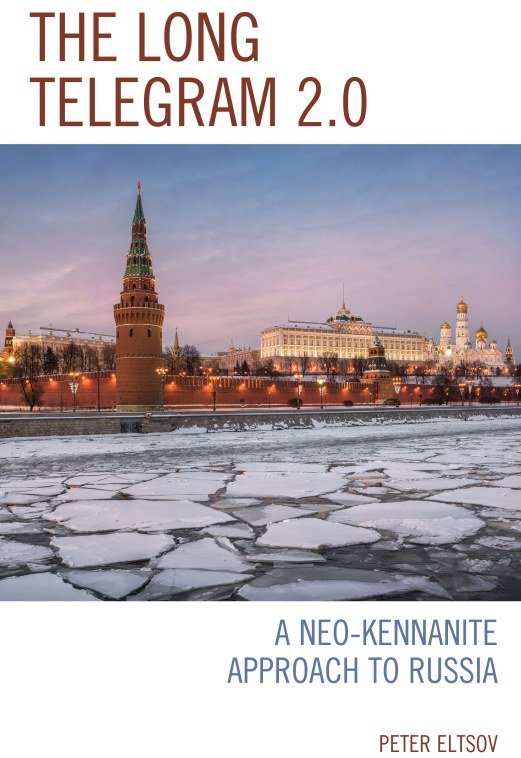
If any of your English-speaking colleagues are too intimidated by Janusz Bugajski, who speaks directly about the “dismemberment of Russia,” you can safely recommend Peter Yeltsov’s book to them. Personally, I am ready to subscribe to almost everything in it (with one exception, which I will discuss later).
The “Long Telegram” is a real telegram, an incredible 5,000 words long, sent from Moscow to Washington in February 1946 by George Kennan, trying to explain to American policymakers what Russia was and how it should be treated. Peter Yeltsov believes that Kennan was right in part, but not in all, and therefore offers an updated approach that is only partly based on Kennan’s ideas.
The main thesis that Yeltsov proclaims at the very beginning and proves throughout the content of his book completely coincides with the one that I have been defending for many years: Russia can exist and continue to exist within its current borders only by force, provided that an authoritarian, aggressive government, prone to territorial expansion and geopolitical adventures, is maintained there.
The only alternative to Russian authoritarianism is the third and final stage of the disintegration of the Russian empire.
At the same time, Yeltsov proves that the essence of Russian statehood has not changed over the past 300 years at least, and this essence is best reflected by Uvarov’s well-known triad “Orthodoxy. Autocracy. Nationality”, conceived as an antithesis to the French slogan “Liberty. Equality. Fraternity”. The essence of this triad, Yeltsov assures, remains unchanged even if Orthodoxy is temporarily replaced by “scientific communism” or the ideology of the “Russian world”, and the classical autocracy is transformed into the sole power of Stalin or Putin.
The most difficult thing, however, is with “nationality” – and it is here, according to Yeltsov, that the real Achilles’ heel of the Russian government lies.
Yeltsov believes that the further disintegration of Russia will not only be beneficial for its own people but is actually much closer than many people think. He lists five main reasons for this assessment:
- Putin’s autocracy is much more unstable than the Tsarist or Soviet one, because Tsarism at least provided for a predictable succession of power, and in Soviet times, such succession was ensured by the “collective leadership” of the Politburo of the Central Committee. However, now no one knows who and why Putin might succeed him, and if Putin does appoint someone, there are no guarantees that this appointee will be able to maintain the power entrusted to him.
- In today’s Russia, there are no strong institutions at all, with the exception of the FSB and… Putin himself. Therefore, Volodin was indeed right when he said, “No Putin, no Russia.”
- Putinism, as a “mixture of Eurasianism and the Fourth Political Theory,” is a much weaker “scrap” than the “anointed” tsar or Marxism-Leninism. It has no comparable pull either within Russia or in the rest of the world.
- Intellectually and economically, the Russian Federation is many times weaker than the Romanov empire and the USSR.
5. And most importantly: neither under the Tsar, nor under the Soviets, nor under Putin, has the Russian state ever managed to offer its population a “national identity” that would encompass the entire population without exception.
Of the interesting details: Yeltsov believes that the more optimistic scenario would be the disintegration of the Russian Federation into large regions, rather than purely “ethno-national” entities. In the second scenario, he fears radical nationalism, which would lead to numerous conflicts, and in the first, he hopes for the formation of several democratic states (including Siberia and the Urals separately), based on civic rather than ethnic identity. In his opinion, this is possible even in the North Caucasus, where the Mountain Republic existed without fatal internal conflicts from May 1917 to May 1920.
The only “but” that occurred to me while reading this book is the issue of sanctions against Russia. Following Kennan, Yeltsov considers sanctions against a country in general to be extremely unproductive, unlike personal sanctions, such as those provided for by the “Magnitsky Act”. But here, Yeltsov’s logic gives an interesting glitch. He admits that the majority of Russians sincerely support Putin because they are afraid of losing the “great country” that they are used to considering their own, and they quite rightly consider Putin’s authoritarianism the only chance not to lose this country. But, says Yeltsov, punishing Russians for this with sanctions is unproductive, because it does not encourage them to speak out against their government, but, on the contrary, it will rally them around this government even more tightly. In other words, although the people are accomplices in the crimes of their government, there is no point in punishing the people for this, because they are the people! A mantra that has been repeated for years by “good Russians,” and which, unfortunately, many Western intellectuals still buy into. One might think that the absence of sanctions against the country would somehow have a more positive effect on Russians! On the other hand, as we can clearly see now, the essence of economic sanctions against a country is not to somehow sober up its population, but simply to reduce this country’s capacity for murderous aggression, in particular against Ukraine.
With the only caveat regarding this local issue of sanctions, I strongly recommend this book by Yeltsov for careful reading and wide distribution.
Oleksiy Panych






