

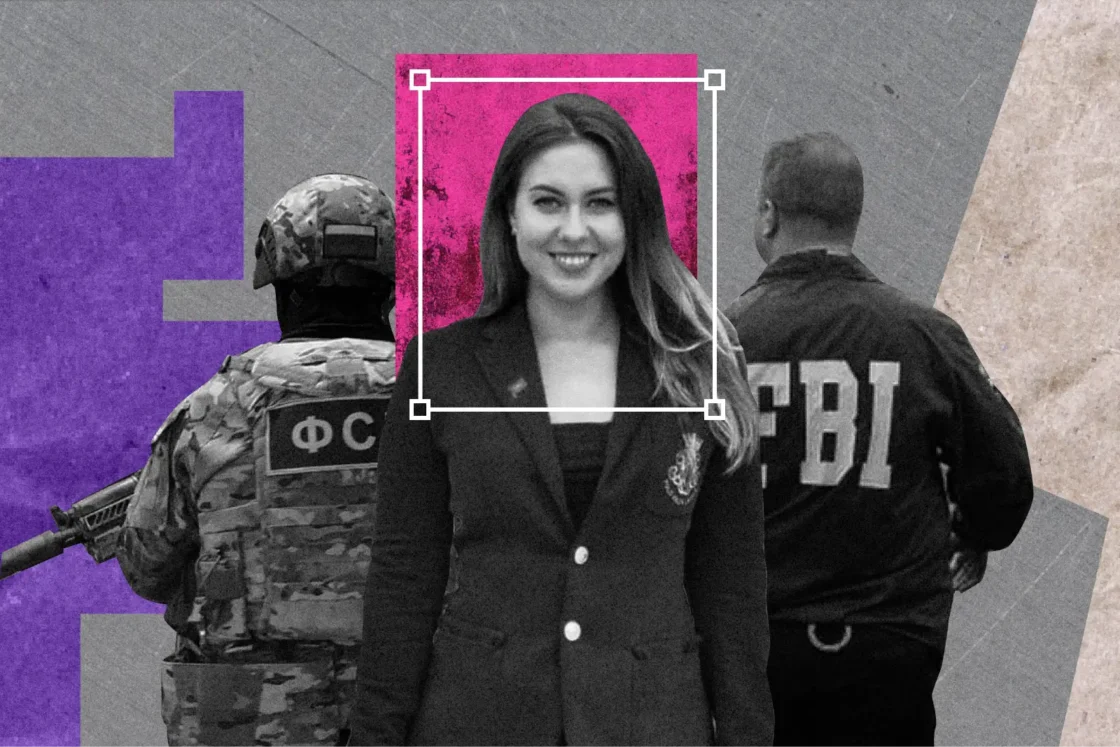
The New York federal courtroom was quiet. The woman, who several years ago spoke at international forums as an expert on the future of the post-Russian space, spoke briefly this time, admitting guilt.
On 19 February 2026, Nomma Zarubina, a native of Tomsk, officially confirmed that she had lied to the FBI about her contacts with Russian intelligence. For the court, this was another criminal case. For American intelligence agencies, it was proof that the Kremlin has long been waging another war, quiet and almost invisible.
While politicians debated sanctions and analysts argued about Russia’s future, the agent codenamed “Alisa” spent years inside the very circles that considered themselves the Kremlin’s main opponents.
This is not the story of one person. This is the story of a system.
—
A trusted agent
According to the investigation, Zarubina had an education in the field of national security, and after moving to the United States, she quickly found her place in the Russian emigration community. She organised events, worked with activists, spoke at conferences, and met journalists and politicians.
Her image was perfect: a young researcher, an independent expert, a participant in discussions about the “decolonisation” of Russia. According to the investigation, this is how modern agents work — not through secret meetings in dark alleys, but through trust, social connections, and open platforms.
Since late 2020, according to American investigators, she has maintained contact with an FSB curator. Her task is to collect information about journalists, academics, political activists, and above all, the Russian opposition in exile.
The climax came in the fall of 2024. Zarubina spoke at a forum on the future of Russia at the Canadian parliament building in Ottawa, alongside diplomats and politicians. Two days later, she was detained by the FBI.
For many participants in those events, it was a shock. The person they were taking pictures with, who they were inviting to discussions, turned out to be a source of information for the secret services.
—
Old tactics in a new form
The West has long faced Russian operations. In 2006, Alexander Litvinenko was poisoned in London with radioactive polonium-210, a substance to which only state agencies have access.
In 2018, GRU agents used the nerve agent Novichok in Salisbury to attack Sergei and Yulia Skripal, resulting in the death of an accidental British woman and an international diplomatic crisis.
In 2019, Zelimkhan Khangoshvili was shot dead in broad daylight in Berlin – the German court directly indicated the perpetrator’s connection with Russian structures.
These operations seemed different—a chemical attack, a radioactive poisoning, a professional assassination. But they all demonstrated one thing: the Kremlin’s willingness to act openly, even on the territory of other states.
—
The New Front — an Environment of Trust
The Zarubina case showed another level of this war. It is not about physical elimination, but about penetrating the environment where ideas are born, political positions are formed, and international support is built.
According to estimates by European security services, hundreds of individuals linked to Russian intelligence services may be operating in EU countries. Some of them work under the cover of journalists, volunteers, or political activists.
Their main weapon is not a gun or poison, but information. Who conflicts with whom? Who has influence? Who is ready to compromise? Who is principled?
In a world where politics increasingly depends on informal networks, such information can be more valuable than any classified documentation.
—
Why the West is not keeping up
The response from Western governments remains predictable: sanctions, expulsions of diplomats, criminal investigations. But each new case shows that these steps often occur after the operation is complete.
The problem lies elsewhere: democratic societies are built on trust and openness—the very thing that makes them vulnerable to infiltration.
Russian strategy uses this openness as a weakness.
—
The Ukrainian dimension
This story is not a surprise to Ukraine. What the West is only beginning to realise, Ukrainians have been observing for years — a combination of military force, information pressure, and intelligence work.
The war against Ukraine has shown that the Kremlin does not distinguish between front and rear. Murders abroad, information campaigns, and war crimes are elements of the same logic.
—
The final that has not yet come
When Nomma Zarubina pleaded guilty in a New York court, for some, it was a story of personal defeat. But for counterintelligence, it was just an episode in a longer game.
The main question remains unanswered: how many more people who are considered experts, activists, or allies are actually working for the other side?
The war waged by intelligence agencies has no trenches or front lines. It takes place in the halls of parliament, at conferences, in chat rooms and coffee shops, where people freely exchange ideas, convinced that they are in a safe space.
And that is why it can be the most dangerous.
Daniel Kozachok






