Modern states, as in their history, have several iconic figures who, in the collective imagination, symbolize independence and national identity.
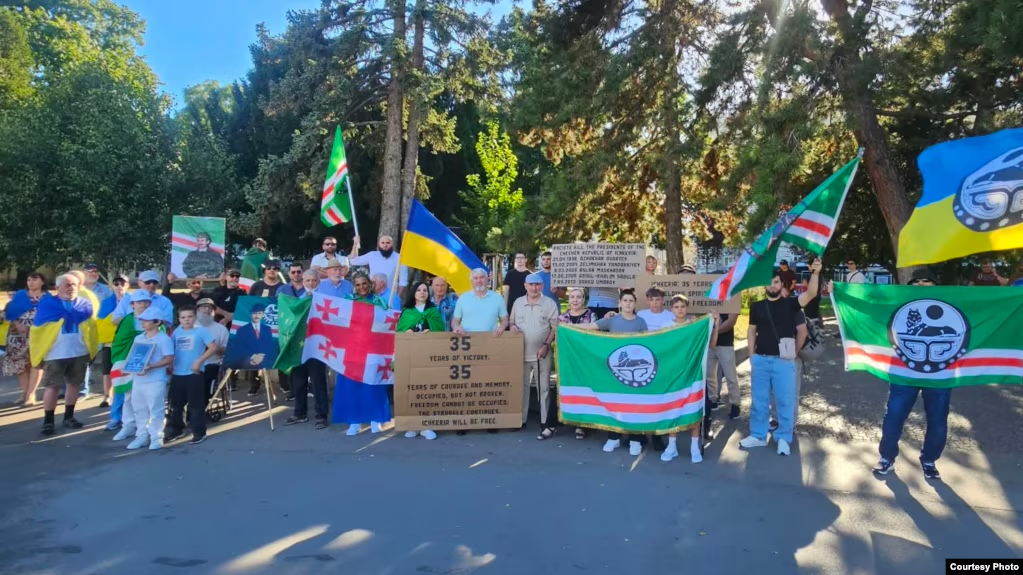
In Bashkortostan, the most notable are two: Salavat Yulaev and Akhmet-Zaki Validi. The latter went down in history as the president and founder of the independent Republic of Bashkortostan during the Ukrainian liberation struggle of 1917-1919.
Salavat Yulaev was the leader of the Bashkirs during the unsuccessful war of liberation, which imperial historiography modestly refers to as the “Emelyan Pugachev Rebellion” or, at best, the “Peasant War of 1773-75.” Moscow’s falsifiers of history present it as “an unsuccessful, senseless rebellion by an impostor from the lower classes who encroached on the kingdom.”
However, any conscientious historian delving into those events will unmistakably see in them a national liberation storyline. No single super-ambitious, selfishly motivated contender to replace the then monarchical dynasty could have secured the support of such a geographically vast and multi-ethnic mass of people. The maelstrom of the “rebellion” encompassed almost all the nationalities of the Urals and the Volga region — the Don and Ural Cossacks, the Mari, the Erzyans, the Tatars, the Udmurts, the Chuvash, and the Bashkirs. They were united by the goal of freeing themselves from the absolutist oppression of Catherine II and preserving their freedoms and autonomy.
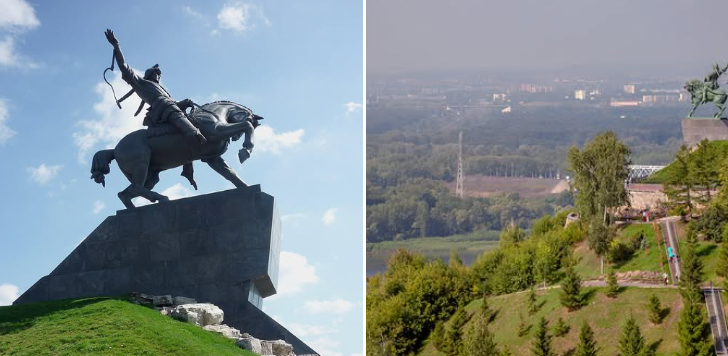
The bust of Akhmet-Zaki Validi, which was modestly erected in the early 1990s, not even in the capital Ufa, but in the peripheral and small town of Sibai, was dismantled in 2021 under the pretext of reconstruction. It has been decided that the monument to Salavat Yulaev, installed in Soviet times in a prominent place in Ufa, like Vladimir the Baptist rises above the Dnieper in Kyiv, will be removed “for reconstruction” now.
Both monuments are of sufficient quality and do not require any reconstruction. The real reason is obvious: we are not talking about repair, but about dismantling iconic symbols of Bashkir national identity and the desire for liberation.
The Soviet government, despite its declared atheism, materialism, and “fight against obscurantism,” was always deeply occult in its core. Party monks sincerely believed in esotericism and symbolism, and the low education of the people made them susceptible to superstitions and religious practices. The Soviets responded to this imminent need of the masses with a wild fusion of all possible religions:
 from Scythian-Turkic paganism – idols for “spiritual” control over the corresponding territory, but the Polovtsian women were replaced with monuments to Lenin;from ancient Mesopotamia – a ziggurat, in the form of a mausoleum on Red Square;from Christianity – the cult of holy relics in the form of an embalmed effigy of a dead leader placed in that mausoleum;from Ancient Egypt – a centrally planned economy and a death cult;from the Toltecs, Mayans and Aztecs – the cult of human sacrifice – the Red Terror, Stalinist repressions, the Great Patriotic War and the current “SVO”).
Perhaps the FSB’s department of astral-etheric combat magic decided that the traditional Lenin stone statue in Ufa was no longer able to hold the territory. Instead, local citizens are dangerously rallying around Salavat Yulaev, twisting the egregor of the supposedly already subdued Bashkortostan in a direction completely undesirable for the Kremlin. In addition, a nationally conscious and civically active regional community has traditionally begun to gather on the square near Salavat. So, with the “reconstruction”, the authorities have de facto closed this public space for potential protests – just as they tried to block the Maidan with a “Christmas tree” under Yanukovych.
At the same time, Moscow is blocking the channels of reliable information about the mood in the regions of the Russian Federation, and for the outside world, they are creating a picture of apparent “complacency” and “unity”. What kind of discontent is ripening inside and what is raging among the deep-seated people of the ethnic autonomies of the Russian Federation – one can only guess. And such preventive measures, such as the dismantling of iconic monuments, expose the Kremlin’s deep-seated fear: that just as Taras Grigorovich’s prophecy was met with “a new fire from Kholodny Yar”, now a new wave of national liberation uprisings and movements may break out.