The new nomination of Ramzan Kadyrov as a candidate for the post of head of Chechnya did not cause a sensation. The sensation would be different if the Kremlin dared to openly abandon the man who has kept the most dangerous region of the Russian Federation in a regime of personal power for almost two decades.
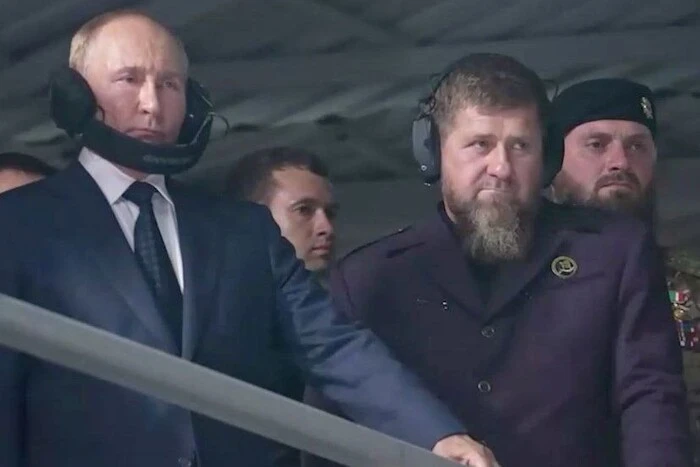
Kadyrov’s statement that he is “forced” to run for office, and “if the people support him, he is ready to serve,” is just another element of the political spectacle. In modern Russia, such issues are not decided by voters. They are decided by the Kremlin. That is why, back in the spring, Vladimir Putin actually gave Kadyrov his public blessing for a new term.
But this time there is one fundamental difference. For several years now, open sources have been reporting serious health problems with Kadyrov. There is no official confirmation of this, but regular disappearances from the information space, a noticeable deterioration in his physical condition, and the rapid promotion of his children and closest relatives to key state and security positions indicate that the question of a successor has long since moved from the realm of rumours to the plane of practical preparation.
That is why the current campaign is not an election, but an operation to maintain control. The Kremlin is demonstrating to the Russian elites that the situation is under control. In fact, Moscow understands perfectly well that the Kadyrov era is coming to an end, and there is no ready-made mechanism for the transfer of power.
It is symptomatic that for the first time since 2007, Kadyrov did not lead the regional list of “United Russia” in the elections to the State Duma. For a democratic state, this would be a technical detail. For an authoritarian system, this is a political signal. The Kremlin is gradually starting to distance itself, leaving room for any scenario of events.
In parallel, the accelerated formation of a family dynasty is taking place. Kadyrov’s relatives are occupying more and more key positions, and his son Adam, despite his young age, has already received an unprecedented set of positions, powers, and state awards. This does not look like personnel policy, but rather an attempt to preserve the family’s personal power after the end of Kadyrov’s own political era.
But the main thing is different.
Chechnya has long ceased to be an ordinary subject of the Russian Federation. In fact, it is a separate quasi-state with its own army, its own security structures, its own system of governance, its own ideology and special relations with the Kremlin. For many years, Putin bought the loyalty of Chechnya, exchanging huge federal subsidies for the personal devotion of Kadyrov.
This model only worked because there was a personal agreement between two people. If one of them disappears, the system will begin to collapse.
That is why the main intrigue today is not whether Kadyrov will win. The result of these “elections” is beyond anyone’s doubt. The real question is: who will control Chechnya after Kadyrov and whether the Kremlin will be able to keep the North Caucasus under control when the man who for many years was both a guarantor of stability and the main source of potential instability disappears.
For Ukraine, this issue is not only of theoretical importance. Any internal struggle for power in the North Caucasus would mean the diversion of Russian military resources, the transfer of troops, the escalation of inter-clan conflicts, and the weakening of Moscow’s ability to pursue an aggressive foreign policy.
History has repeatedly proven that empires do not begin to collapse when they lose an external war. They collapse when they lose control of their own peripheries.
That is why today it is worth closely observing not the results of the Chechen “elections”, but what is happening behind the scenes. After all, the future of the North Caucasus is increasingly becoming an indicator of the future of the entire Russian Federation. And if the process of disintegration of the empire begins, then Chechnya may well become one of its first catalysts.
Viktor Yahun