

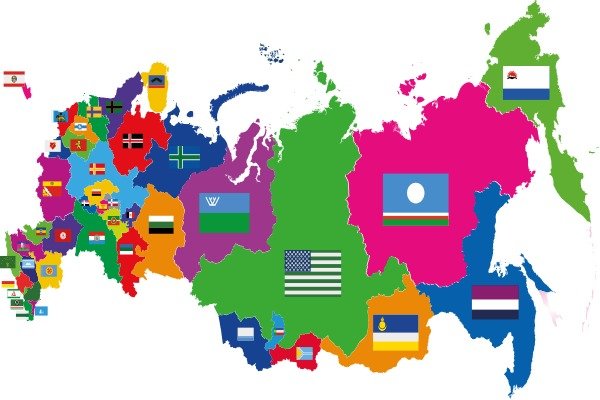
In December, the ninth Forum of Free Nations of Post-Russia took place in Rome and Berlin. This is an organization that unites political emigrants from different republics and regions of the Russian Federation, who see them as independent states in the future. Political scientists are often sсeptical about this project, but the event has already taken place in many countries over the past year and a half – from Great Britain to Japan. Its participants were received in both the European Parliament and American research institutes. In Russia itself, the Forum is recognized as “undesirable”, official television channels produce sharply critical videos about it, and the head of the investigative committee threatens its participants with criminal cases. The phenomenon is already difficult to ignore.
If desired, today’s (post)Russian regionalists can be likened to historical political emigrants from the Baltic countries or Ukraine in the 1960s and 70s. Then, they were also sometimes accepted into Western institutions, and their petitions were listened to, but in general, their demands were not taken too seriously. After all, in reality, there was a gigantic and seemingly unshakable USSR. However, by the 90s it suddenly turned out that these “marginal” movements represented projects for the future of new countries that appeared on the world map. And vice versa, “The Indestructible Union” turned out to be completely unbreakable.
Many authors today argue about “post-Putin Russia,” but often still see it as a single Moscow-centric state. This may be one of the fatal mistakes. Because it reflects only deep-rooted stereotypes, and not a desire to understand historical and geographical variability.
For example, well-known oppositionists like Mikhail Khodorkovsky or Alexei Navalny’s team declare the need for a “revival of federalism” in Russia. However, how can you “revive” something that essentially never existed? The Russian Federative Treaty of 1992 was not an agreement between political entities on the establishment of a new state. The Kremlin simply shared some of its economic powers with the “provinces.”
Many representatives of the Russian opposition continue this imperial meaning. They say that Moscow, of course, should not take away all their resources and taxes from the regions, but leave something for them. But this is a purely economic and reduced interpretation of federalism. The political interpretation of federalism is an agreement between equal subjects about what they want to delegate to the federal level and what they prefer to keep for themselves. This is exactly how the USA began – the first federation on the planet. But even the “most radical” Russian oppositionists, as a rule, do not have such an understanding. They immediately start with centralist ideas about “Russia as a whole.”
Therefore, it is not surprising that many regionalists are “post-Russian.” If the “Russia” project as such is built on hypercentralism (and only dreams of replacing the “bad” Kremlin tsar with a “good” one), it is difficult to deny the logic of those who would like to abolish it in principle. At the same time, the participants in the post-Russian forum do not at all seem to be supporters of any violent solutions. On the contrary, they together sign declarations on denuclearization and mutual recognition of existing interregional borders.
However, the virtuality of such projects is still noticeable. First of all, because the current regionalists do not have any political legitimacy. And here it would be interesting to compare the terms “post-Soviet” and “post-Russian”.
Post-Soviet reality began in the Soviet era. The non-party leaders of Lithuania Vytautas Landsbergis and Georgia Zviad Gamsakhurdia, elected in 1990, could no longer be called “Soviet politicians.” However, the paradox was that they headed the Supreme Councils of their republics.
This became possible as a result of perestroika when power moved from the “vertical” of the CPSU to freely elected councils. Today’s picture, of course, is radically opposite – there is no talk of any normal elections. But this also creates a rather sharp line between reality and virtuality. If at that time movements for independence in different republics of the USSR could be spoken of as politically real, today this is not at all the case. Their leaders were then democratically elected and, as such, had legal legitimacy, which provided the basis for international recognition of the new countries. And today’s emigrant regionalists from Ingria, Tatarstan or Siberia can hardly count on a similar attitude. They may be treated with “interest”, but nothing more.
For the post-Russian project to be talked about seriously, its representatives must become more than just “supporters of independence” and make loud statements. They need to provide the international community with serious and verifiable analytics about the state of affairs in their regions – economics, sociology, and demography, based on which people in other countries will conclude that the “post-Russian” situation will be better than the “Russian” one.
But in general, any “post-” does not automatically mean that “tomorrow is better than yesterday. ” We have already seen this with the post-Soviet situation, when the “new Russia” eventually turned into a totalitarian empire much worse than the perestroika USSR.
Vadim Shtepa
Регион-Эксперт





