

Imagine that in the fourth year of World War II, the President of Czechoslovakia, Beneš, who headed the government in exile in London, or one of the German anti-fascists in the West, for example, Thomas Mann or Willy Brandt, were asked the question: “Whose Bohemia is it?” How would they answer? For some reason, it seems to me, they would not start to argue – on the one hand, legally yes, on the other hand, formally yes. The answer would be unambiguous. Bohemia belongs to Czechoslovakia.
When Russian oppositionists fall into a stupor from the simple question “Whose Crimea?”, when, 12 years after its annexation by Russia and the fourth year of the Russian Federation’s full-scale invasion of Ukraine, they do not give a clear answer to this question, even though much depends on the Western content, and the West in this matter. First of all, they are not so far from Putin with his “foot of a Russian soldier” in this matter. What has become ours is ours! Not a sandwich to pass back and forth. The fact that Crimea has been annexed by Russia is news, probably only for Yulia Navalny, who picked up on Podrabinek’s words, that legally Crimea belongs to Ukraine, but in fact to Russia. However, this formula has been circulating among them since 2014, but then at least they uttered it out of fear of falling under the repressions of the Putin regime, and now what do they have to fear in the European will? Navalny is not being asked about what the regime in Crimea is, or who Putin has appointed as Gauleiter there.
It would seem that her husband, imprisoned and killed by the Russian authorities, rethought all this and clearly expressed himself in his 15-point memorandum about what Ukraine’s victory should be – a return to the 1991 borders, payment of compensation to Ukraine for destruction, withdrawal of troops and punishment of war criminals. Having raised Navalny, who was killed by the Putin regime, to the flag, making him almost a saint, his political heirs threw his memorandum into the trash can, and he is not mentioned anywhere. It is as if the apostles removed from the New Testament the Sermon on the Mount, or something that they would have considered personally disadvantageous to them at that time. In short, it has never been like this in Mother Russia, and here it is again. “Here we read Navalny, here we don’t read him, here we wrap the fish”! It seems that Zhvanetsky’s words have become the national idea of the Great Russians.
These relocators are strange people. Having been expelled or voluntarily leaving their homeland after the war it unleashed, they took with them many practices that helped them survive in their past lives. One of them is the ability to instantly forget what they repented of yesterday, especially if the situation has changed today. Many people remember the example of one scientist who left the Russian Federation in 2022 for Lithuania. He started working at Vilnius University. Ten years earlier, in 2012, he published an article in the Russian Federation in which he questioned the fact of the occupation of the Baltic States by the USSR and claimed that the Baltic countries’ accession to the USSR was almost voluntary. When Lithuania found out about this, he was threatened with termination of his contract with the university and wrote a letter of repentance in which he admitted the fallacy of his previous judgments, explaining them by the fact that he had become a victim of Russian propaganda. But here, various well-wishers from the relocated LOMs (Shenderovich and others) launched a campaign in the media in his defence. They said how un-European Lithuania acts, how one can harass a person for old articles, how the enemies of Russian culture have become loose! The scientist realized that he had rushed with repentance, shook himself off, added metal to his voice and began to snap at those who supported his release. It’s like a thief caught red-handed on a market day, at first he asks for forgiveness, tries to arouse pity for himself, refers to a harsh fate, but as soon as he feels that he will not be beaten, he becomes more impudent in front of his eyes, and immediately begins to rummage through the pockets of the people around him, planning his next victim.
This is the repentance of khor.ru, in which the semantic load is carried by the first five letters “WHILE I AM”. While I am forced to, I repent, but as soon as the danger for me disappears, I become myself again. Two years ago, I compared their repentance to Schrödinger’s cat. A cat can be both alive and dead at the same time, and khor.ru – both those who repented and those who are self-justified. I regretfully have to state that by 2025, almost the entire set of people who call themselves the opposition to Putin will have turned into one collective Schrödinger’s cat. Keith combined the incompatible concepts of life and death, they also combine the incompatible – loyalty to Navalny and his betrayal, declarations of commitment to democratic values, and the imperialism bulging from every statement (even if it is liberal according to Chubais), statements of disagreement with the Putin regime and the use of its main narratives about the war in Ukraine in everyday practice.
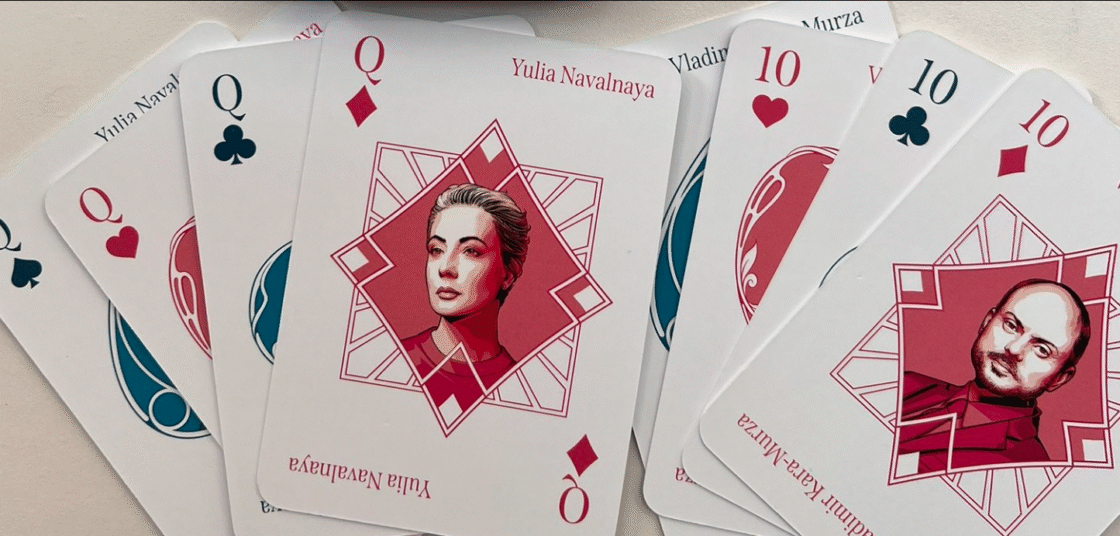
Even the family ties were taken over from him. Navalny’s widow declared herself the leader of the Russian opposition – she is an impostor, not a leader! Although Kisa Vorobyaninov did not declare himself, Bender fulfilled the mission of the herald. The same applies to Navalny’s daughter, it is a family contract of some kind. She teaches the minds of Georgetown University graduates at the graduation ceremony, at which someone of the level of former US presidents, senators, famous and accomplished people usually speaks with farewell to the graduates; then she disrupts the ovation of the European Youth Forum – one of the largest international youth events organized and held by the European Parliament. Well, isn’t that what Putin does with his daughters – “these women.”
Often, supporters of Navalny, Kara-Murza and Khodorkovsky are outraged by the criticism that their statements provoke in Ukraine. We are allies, they say, doing the same thing, fighting Putin. But Ukrainians are shedding blood in this fight, and the above-mentioned persons mostly work with their tongues, not caring at all about the feelings and perception of their words by those they call allies until the first turn. Maybe, before being outraged, they should monitor their statements and call black black and white white, and not get hung up on the question of whose Crimea is.
Konstantin Atoev
Facebook 





