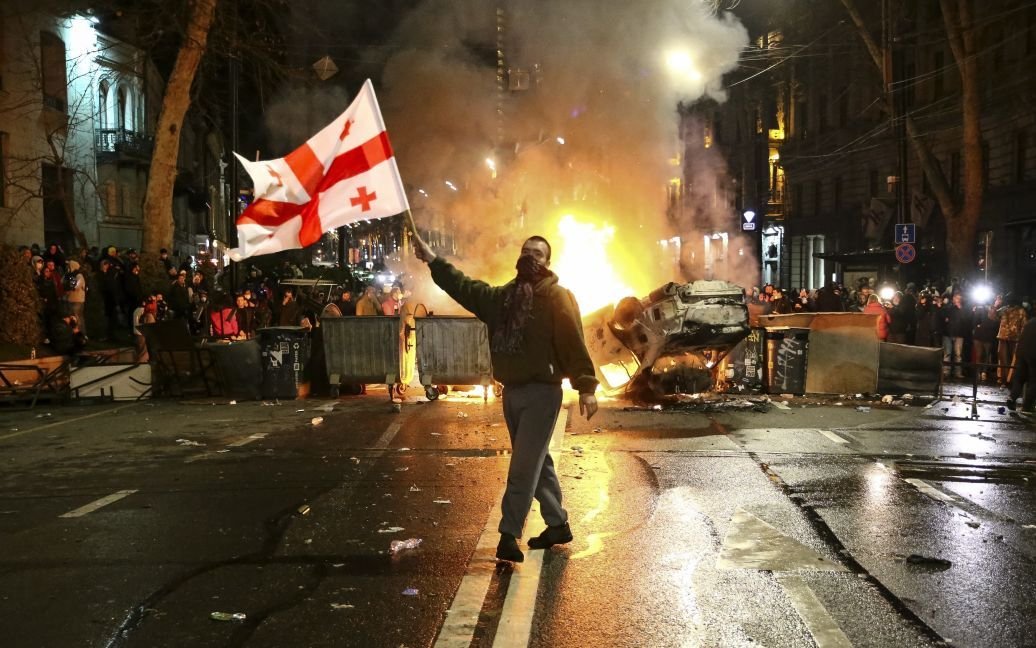
The streets of Tbilisi were recently filled with the clamor of protest as Georgians take a stand against the controversial “foreign influence” law. This legislation, which requires NGOs and media companies receiving more than 20% of their funding from abroad to register as “Pursuing the Interests of a Foreign Power,” has ignited a firestorm of opposition. The violent clashes between protesters and riot police serve as a stark reminder of Ukraine’s Euromaidan uprising in 2014, a watershed moment that reshaped the political landscape of Eastern Europe.
The parallels between the current unrest in Georgia and the Euromaidan movement are striking. Just as Ukrainians stood up against Russian influence and corruption, Georgians are now fighting against a law that many see as a poorly concealed attempt to stifle democracy and freedom. The law, which bears an unsettling resemblance to Russia’s 2012 Foreign Agent Law, threatens to pull Georgia back into the sphere of Russian control, undermining its aspirations for European integration. The protests in Tbilisi, with chants of “No to Russia, yes to Europe,” are a powerful testament to the Georgian people’s unwavering commitment to a democratic and European future.
At the surface and at the root, Georgia’s and Ukraine’s plight are one in the same. Both nations have faced the daunting challenge of asserting their sovereignty and democratic aspirations in the face of Russian aggression and influence. Georgia, like many other captive nations that have suffered under the yoke of Soviet and Russian domination, is fighting to break free from the remnants of Bolshevik-style authoritarianism.
The success of Ukraine’s Euromaidan revolution, which led to the ousting of a pro-Russian government and set the stage for a more democratic and European-oriented future, serves as an inspiration for Georgians today. Just as Ukrainians have had to fight and are continuing to fight against Russian propaganda portraying their country as a Nazi state, which was Putin’s justification for invading Ukraine, Georgians today are battling similar false narratives spread by Russia to justify its interference in their country. These baseless accusations are part of a larger pattern of Russian disinformation aimed at undermining the legitimacy of democratic movements in its neighboring countries. The U.S. must recognize that the outcome of Georgia’s protest movement will have far-reaching implications for the region and the global fight against authoritarianism.
As the world’s leading champion of democracy and freedom, the United States has a moral and strategic obligation to support Georgia in its struggle against authoritarianism and Russian influence. The current protests in Tbilisi are Georgia’s Euromaidan moment, and the U.S. must act decisively to ensure that Georgia does not succumb to the grip of a resurgent Russian empire.
To achieve this, the U.S. should spearhead international efforts to pressure the Georgian government to repeal the “foreign influence” law. By working in concert with allies in the European Union and NATO, the U.S. can present a united front against this anti-democratic legislation. Beyond the recent visa restrictions, targeted financial sanctions against key figures in the Georgian government, especially those with ties to Georgian oligarch Bidzina Ivanishvili, can serve as a powerful deterrent against further authoritarian measures. Sanctions should be considered against Russian entities and individuals found to be meddling in Georgian politics.
In addition to diplomatic pressure, the U.S. must provide increased funding and support for Georgian NGOs and independent media. By offering grants, training, and resources, the U.S. can ensure that these organizations can continue their crucial work without fear of repression. Congressman Joe Wilson and Steve Cohen’s MEGOBARI Act provides an important framework to advance these efforts, and should be swiftly passed.
As we witness this democratic shift in the region, the stakes could not be higher. The U.S. must stand shoulder to shoulder with Georgia, just as it has with Ukraine, and extend its support to all captive nations striving to break free from authoritarian influence. The struggle for freedom and democracy in Georgia is not just about one country’s future; it is about upholding the principles of liberty and self-determination that form the bedrock of the free world. If we fail to act now, we risk allowing another nation to fall under the shadow of Russian tyranny. The message is clear: Freedom is on the line.
Yurij Wowczuk is Director of the Vovk Foundation, Director of Research for the Organization for the Defense of Four Freedoms of Ukraine, and Head of the American Committee of the Anti-Imperial Bloc of Nations.