

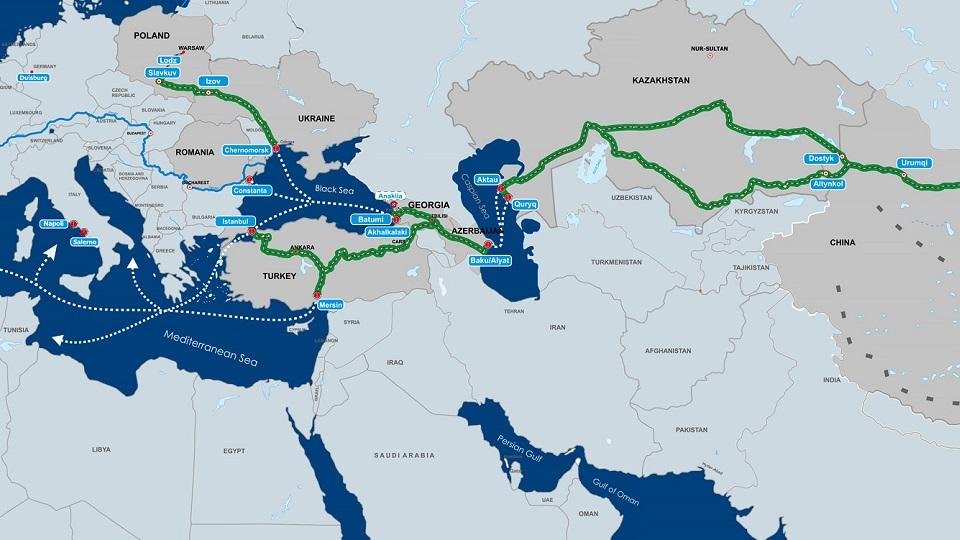
For decades, Moscow was the main transport hub for much of the post-Soviet space. Railways, pipelines and trade routes were built according to a simple “periphery-to-centre” model.
Russia’s full-scale invasion of Ukraine has begun to change that model.
Kazakhstan, Uzbekistan, Azerbaijan, Georgia and other states are increasingly developing the Trans-Caspian International Transport Route — the Middle Corridor, connecting Central Asia with the Caucasus, Türkiye and Europe while bypassing Russia. According to the EU, trade along the route has quadrupled since 2022.
This is about more than transport.
New routes mean new economic links, new partners and greater political freedom. The EU has already mobilised up to €2 billion for infrastructure along the corridor, while regional states are investing in ports, railways and border crossings.
The Middle Corridor cannot yet fully replace Russia’s routes. It remains more expensive and technically complicated. But the direction of change is clear.
Empire begins where the centre controls the roads.
Decolonisation begins when the roads no longer lead only to the centre.






